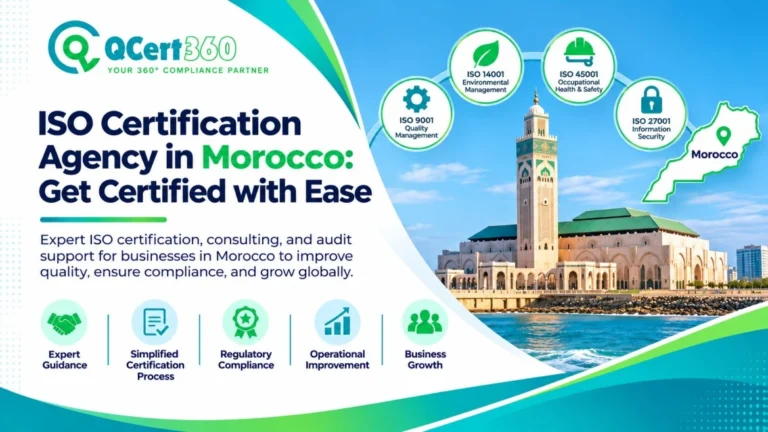
ISO Certification Agency in Morocco: Get Certified with Expert ISO Consulting
By Ryan, General Manager, QCert360 | Standards and editions checked October 2026
Moroccan organizations get ISO certified by choosing the management-system standard their customers and risks call for, building and running that system, and then passing an independent audit by a certification body. When you compare an ISO certification agency in Morocco, the questions that matter are which standard fits, which route is credible, and whether the provider can be verified.
QCert360 is an ISO certification and management consulting firm headquartered in Bengaluru, India, serving clients across more than 190 countries. For Moroccan companies, we help with standard selection, gap assessment, documentation, training, internal audits and audit preparation, and we guide you through the certification application. Certificates are issued by independent certification bodies, never by a consultant, and we explain that line at every step. Request an ISO certification quote for your business in Morocco.
What Is ISO Certification and Why Does It Matter for Moroccan Businesses?
ISO certification is independent confirmation that your management system meets an ISO standard such as ISO 9001. It matters because buyers, tender committees and export partners increasingly ask for proof that quality, safety, security or food-safety controls are managed systematically rather than informally.
ISO publishes the standards, but it does not certify companies. A certification body audits your système de management against the standard and decides whether to issue a certificate, which is then maintained through yearly surveillance audits and renewed at recertification.
For Moroccan businesses, the practical value is commercial. Automotive and aerospace suppliers, food exporters, construction contractors and IT providers often face supplier questionnaires and tender conditions that name specific standards. A working management system also reduces rework, incidents and audit surprises, which is the benefit that lasts after the certificate is framed.
Why Moroccan Businesses are getting ISO Certification in 2027
Most Moroccan companies pursue ISO certification now because buyers, tender committees and export partners ask for evidence of controlled processes, and because the 2026 editions of ISO 9001 and ISO 14001 have reset the planning window for quality and environmental systems. These are shifts in what customers ask for, not guarantees of business results.
- Export supplier qualification: manufacturers and food exporters selling into European or Gulf supply chains are often asked for management-system evidence during supplier approval.
- Tender conditions: some public and private tenders list ISO certificates among their requirements. Read each tender document, because the requirement is set by the buyer, not by Moroccan law.
- Security and continuity questionnaires: IT, logistics and outsourcing firms increasingly face client reviews of information security and business continuity.
- Standards cycle: ISO 9001:2026 and ISO 14001:2026 are now the current editions, so a new certification project should be scoped against them rather than the 2015 text.
- Climate and sustainability questions: management-system standards now ask organizations to consider climate change when they define their context, and customers are starting to ask about it.
The practical consequence is timing. Starting a system before a tender deadline or a buyer audit is far less stressful than starting after one.
Which ISO Certification standard Is Right for Your Business in Morocco?
The right ISO certification is the one your customers, regulators or tender documents actually ask for, applied to the risks you actually carry. Start with ISO 9001 for general quality, then add standards for environment, safety, food, information security or sector-specific needs.
Standard | Purpose | Relevant Moroccan industries | Common business drivers |
ISO 9001 (2026 edition) | Manufacturing, construction, services, trading | Tenders, customer audits, consistency | |
ISO 14001 (2026 edition) | Environmental management | Industry, mining, chemicals, packaging | Environmental risk, buyer requirements |
ISO 45001:2018 | Occupational health and safety | Construction, factories, logistics, mining | Incident reduction, contractor prequalification |
ISO 22000:2018 | Food safety management | Food processing, fisheries, catering | Export approvals, retailer audits |
ISO/IEC 27001:2022 | Information security | IT, outsourcing, finance, cloud | Client security reviews, data risk |
ISO 22301:2019 | Business continuity | Logistics, finance, energy, IT | Resilience, critical supply chains |
ISO/IEC 20000-1:2018 | IT service management | Managed services, telecom, software | Service contracts, SLAs |
ISO 13485:2016 | Medical device quality | Medical devices, healthcare suppliers | Market access, regulatory expectations |
ISO/IEC 17025:2017 | Laboratory competence | Testing and calibration laboratories | Accredited results, customer trust |
ISO 50001:2018 | Energy management | Energy-intensive industry, hotels | Cost reduction, energy reporting |
ISO 37001:2025 | Anti-bribery management | Construction, public contracts, services | Tender integrity, partner due diligence |
Educational organizations | Schools, training providers | Quality assurance, accreditation support | |
ISO 41001:2018 | Facility management | Property, hospitality, campuses | Service consistency, client contracts |
ISO/IEC 42001:2023 | AI management | Software, data and AI-using firms | Responsible AI, buyer questions |
Two cautions. ISO/IEC 17025 is different: laboratories are accredited for defined test or calibration scopes, not given ordinary management-system certificates, so our role there is readiness support. And not every ISO publication is certifiable. If you hold a 2015 certificate, note that ISO 9001:2026 was published on 16 September 2026 and ISO 14001:2026 on 15 April 2026, each with a roughly three-year transition, so new projects should be planned against the current editions.
See our service pages for ISO 9001, ISO 14001, ISO 45001, ISO 22000 and ISO 27001.
How to Choose the Right ISO Certification Agency in Morocco
Choose an agency by verifying who actually issues the certificate, whether the provider is accredited for your standard and sector, how audit days are calculated, and whether pricing is transparent. Be equally clear about who is advising you and who is auditing you, because those must be separate parties.
A useful pre-selection checklist:
- Legal identity: a registered entity with a verifiable address and named contacts.
- Accreditation: the specific standard and industry sector you need appear in the accreditation scope, and the accreditation is current.
- Buyer fit: your customer, tender or scheme owner accepts that body’s certificates.
- Scope and sector experience: auditors who understand your processes, not only the standard.
- Audit transparency: a written audit plan with Stage 1 and Stage 2 days, surveillance cycle and renewal terms.
- Independence: the body does not design or write your management system.
- Verification: the certificate can be checked independently by a third party.
- Commercial clarity: a written quotation that separates consulting, audit and travel costs.
If you want a consultant to prepare you, read how to choose the right ISO consultant for your industry.
Understanding SEMAC Accreditation and IMANOR Standards in Morocco
SEMAC is Morocco’s national accreditation service, operating under the Ministry of Industry and Trade, and it assesses the competence and impartiality of conformity-assessment bodies. IMANOR is the Moroccan standards institute. A company is certified; a certification body is accredited. Keeping those terms apart protects you from misleading claims.
SEMAC (Service Marocain d’Accréditation) evaluates bodies such as laboratories, inspection bodies and certification bodies against international criteria, within a defined accreditation scope. Its published documents on the ministry’s website include accreditation procedures and sector scopes, for example laboratory scopes under NM ISO/IEC 17025:2018. Institutional arrangements for accreditation in Morocco have been evolving, so confirm the current position on the official SEMAC pages.
IMANOR (Institut Marocain de Normalisation) develops and publishes Moroccan standards, which carry the NM prefix, such as NM ISO/IEC 17025. Check the exact designation and edition before citing one in your documents.
How to verify credentials. Ask for the certification body’s accreditation certificate and scope, confirm it is valid for your standard and sector on the accreditation body’s own directory, and check the certificate number with the issuing body. For international recognition, ask which arrangements cover the accreditation; these are coordinated by Global ACI, which now carries forward the work of the former IAF and ILAC.
SEMAC accreditation is not automatically required of every legitimate certification body. What counts depends on your buyer, tender, scheme and target market, so confirm that requirement first. Official starting points: Ministry of Industry and Trade, IMANOR and ISO.
What is the ISO Certification Requirements for businesses in Morocco
ISO certification requirements come from the standard you choose, not from a Moroccan ISO law. In practice, every management-system standard asks for a defined scope, committed leadership, risk-based planning, trained people, controlled operations, internal audits, management review and corrective action.
- Scope and context: which sites, products, services and interested parties the system covers.
- Leadership: a policy, objectives, assigned responsibilities and visible management involvement.
- Risk assessment: identified risks and opportunities, plus hazards or security risks where the standard demands it.
- Documented information: the procedures and records the standard requires and your processes need.
- Competence: training records and awareness for the people who affect results.
- Operational controls: supplier control, process monitoring and change control.
- Evaluation: internal audits and a recorded management review before the certification audit.
- Improvement: nonconformities handled through root cause and corrective action.
Specific clauses differ. ISO 45001 needs hazard identification and legal-requirements tracking, ISO 22000 needs hazard analysis and prerequisite programs, and ISO/IEC 27001 needs a statement of applicability.
ISO Audit Preparation Checklist for companies in Morocco and Sample Documentation checklist
ISO Auditors in Morocco verify evidence, so audit preparation means having the right records, in use, for long enough to show a pattern. The table lists the records most auditors ask for and the gaps we see most often when we review readiness.
Record or document | What the auditor looks for | Common gap |
Scope statement | Sites, activities and justified exclusions | Scope broader or narrower than real operations |
Policy and objectives | Management commitment and measurable objectives | Objectives with no owner or monitoring |
Risk and opportunity register | Risks linked to actions and reviewed | A one-time list never updated |
Training and competence records | Evidence people can do their jobs | Attendance sheets with no effectiveness check |
Supplier evaluations | Approved supplier list and performance review | Suppliers approved once and never re-evaluated |
Internal audit report | Independent audit covering all clauses | Audits of a single department only |
Management review minutes | Inputs reviewed, decisions and actions recorded | Minutes that list topics but no decisions |
Corrective action log | Root cause, action and verification of effectiveness | Fixing the symptom only |
Legal and other requirements register | Applicable requirements tracked and evaluated | Missing entirely, especially for ISO 45001 and ISO 14001 |
An illustrative way to use this list: three to four weeks before the certification audit, run a mock audit using this table as the checklist, open corrective actions for each gap, and give the actions time to close and show results. A readiness review at that point is far cheaper than a nonconformity discovered during the audit itself.
Morocco-Specific Regulations and Industry Requirements to Consider
ISO certification does not replace legal permits, inspections or approvals. It shows that you manage requirements systematically, but compliance with Moroccan law is a separate obligation, and a certificate does not prove it. Which rules apply depends entirely on your activities.
- Food: food businesses may fall under ONSSA oversight for sanitary approvals and controls.
- Environment: waste, water, emissions and environmental impact obligations vary by activity and site.
- Health and safety: employer duties under Moroccan labour law apply to factories, contractors and construction sites.
- Personal data: Law No. 09-08 and the CNDP regulate personal-data processing, including declarations and authorizations, and cybersecurity Law No. 05-20 may also be relevant. ISO/IEC 27001 supports security controls but does not equal 09-08 compliance.
- Regulated products: medical devices, chemicals, cosmetics and electrical goods can carry product-specific rules, and the ministry operates a market-surveillance framework for industrial imports under Law 24-09.
- Export and customer rules: buyers in Europe or the Gulf may require specific standards or schemes.
For legal interpretation, speak to a Moroccan lawyer or the relevant authority. Official sources include ONSSA and the CNDP.
ISO Certification Process in Morocco: Step by Step
The ISO certification process in Morocco runs from defining scope to an independent certification decision, then continues with surveillance and recertification. Consultants can support preparation, but only the certification body audits and decides.
- Define objectives and scope: decide why you need certification and which sites and activities are covered.
- Select the standard: match it to buyer demands and risks.
- Run a gap assessment: compare current practice with each requirement.
- Build or improve the system: write only the documentation your processes need.
- Train employees: brief everyone whose work affects the system.
- Implement and keep records: operate the processes long enough to generate evidence.
- Audit internally and review: complete an internal audit and a management review.
- Certification audit: Stage 1 reviews readiness and documentation; Stage 2 checks implementation on site.
- Close nonconformities: correct findings and show corrective action to the auditor.
- Certification decision: the certification body, independent of any consultant, decides whether to certify.
- Maintain the system: surveillance audits during the cycle, then recertification.
Our consulting methodology and how it works pages show how we structure the preparation stages
ISO Consultant, Certification Body and Accreditation Body: Who Does What
A ISO certification consultant in Morocco prepares your system, a certification body audits it and decides on certification, and an accreditation body checks that the certification body is competent. Keeping these roles separate is what makes a certificate credible.
Role | What it does | What it cannot do |
Consultant (such as QCert360) | Gap assessment, documentation, training, internal audits, audit preparation | Issue certificates or influence the certification decision |
Certification body | Audits your system and decides whether to certify | Design or write your management system |
Accreditation body (such as SEMAC) | Assesses whether certification bodies are competent and impartial within a scope | Certify your company |
Standards body (IMANOR, ISO) | Develops and publishes standards | Audit or certify organizations |
What Happens in Stage 1, Stage 2, Surveillance and ISO Recertification Audit in Morocco
A typical certification cycle has four audit events over roughly three years, and each has a different purpose. Understanding them removes most of the anxiety around the process.
- Stage 1 audit: the auditor reviews your scope, documented information and readiness, and confirms whether Stage 2 can proceed. It often includes a review of key documents and a walk through the operation.
- Stage 2 audit: the auditor visits your operation, interviews staff and samples records to confirm the system is implemented and effective.
- Surveillance audits: shorter audits, usually yearly, that confirm the system is maintained and improving.
- Recertification audit: a fuller audit before the certificate cycle ends, to renew the certificate for the next cycle.
Nonconformities. Auditors record findings as nonconformities. A minor nonconformity is an isolated lapse against a requirement, while a major nonconformity is a failure that undermines the system’s ability to deliver its intended results or a missing requirement altogether. You submit corrective action with root cause, and the certification body must be satisfied before it decides. Exact grading rules vary by certification body, so ask for theirs in advance.
How much does ISO Certification Cost in Morocco: What Affects the Price?
ISO certification cost in Morocco depends on your size, number of sites, chosen standards, industry risk and how ready your system already is. No honest provider can quote a fixed figure without these facts, so a tailored quotation is the only reliable way to budget.
- Size and headcount: more people and processes mean longer audits.
- Sites and complexity: each additional site or shift pattern adds audit time.
- Standards chosen: an integrated system usually costs less than separate ones.
- Industry risk: food, construction and information security need more audit effort.
- Readiness: a documented, running system needs less preparation.
- Support needed: gap assessment, documentation, training and consulting are separate from audit fees.
- Travel and expenses: applicable audit travel is often quoted separately.
- Ongoing costs: surveillance audits and recertification recur through the certificate cycle.
Ask every provider to separate consulting fees from certification-body fees. See plans and pricing or request a quote.
How Long Does ISO Certification Take in Morocco? ISO certification timeline in Morocco
The timeline depends on readiness, scope, number of sites, audit scheduling and how fast findings are closed. As a planning assumption only, QCert360 typically plans three to six months for a smaller organization starting from limited documentation. That is not a guarantee, and larger or multi-site projects take longer.
The system needs enough operating time to produce records, because auditors verify what you do, not what you wrote. Delays most often come from unclear scope, slow management decisions and open nonconformities.
Integrated Management Systems: One System for Several ISO Standards
An integrated management system lets one organization run quality, environment, safety and other standards through a single set of processes, documents and audits. It works because the main ISO management-system standards share a common high-level structure, so clauses on leadership, risk, competence, internal audit and management review can be written once.
The practical benefits are fewer duplicate documents, one internal audit programme, one management review and often more efficient external audits. Moroccan manufacturers, for example, commonly combine ISO 9001, ISO 14001 and ISO 45001, while IT firms combine ISO/IEC 27001, ISO/IEC 20000-1 and ISO 22301.
Three cautions apply. Each standard is still assessed against its own requirements, so integration does not remove the need for standard-specific controls such as hazard analysis or a statement of applicability. Scope must be consistent across the standards you combine. And it is usually easier to start with ISO 9001 and add standards in stages than to launch all of them at once. Ask your certification body whether it offers combined audits and how it calculates audit time for them.
Industry-Specific ISO Certification Solutions in Morocco
The right standards differ by sector, and so do the reasons for pursuing them. The scenarios below are illustrative, not client case studies. Remember that tender conditions and customer requirements are not the same as legal obligations.
Manufacturing and Industrial Operations
Most manufacturers start with ISO 9001, then add ISO 14001, ISO 45001 and ISO 50001 as customers and costs demand. The same pattern applies to chemicals, packaging, mining and renewable energy operations, where environmental and safety control drives buyer confidence. See manufacturing and mining and metals.
Automotive and Aerospace Suppliers
Suppliers to vehicle and aircraft makers face rigorous quality audits. ISO 9001 is the common base, while sector schemes such as IATF 16949 are set by the customer and are separate from ISO 9001. Check which scheme your buyer names. See automotive and aerospace.
Food Processing, Agriculture and Fisheries
Food exporters typically need ISO 22000, plus HACCP or FSSC 22000 where retailers require it. An illustrative case: a packhouse targeting a European buyer may be asked for a recognized food-safety certificate before listing. See food and beverage processing and FSSC 22000.
Construction and Engineering
Contractors use ISO 9001 for project quality, ISO 45001 for site safety and ISO 14001 for environmental control, often to meet prequalification. ISO 37001 can help where public tenders stress integrity. See construction and infrastructure.
IT, Software and Cloud Services
Outsourcing and software firms are asked about data security first, which points to ISO/IEC 27001, with ISO/IEC 20000-1 for service management and ISO 22301 for continuity. See IT services and ISO 22301.
Logistics, Warehousing and Transport
Logistics operators combine ISO 9001, ISO 45001 and ISO 14001, and may add ISO 28000 for supply-chain security where clients ask for it. See logistics and supply chain.
Healthcare and Medical Devices
Medical-device makers use ISO 13485, which supports but does not replace product approvals. Laboratories follow ISO/IEC 17025 or ISO 15189 routes through accreditation. See ISO 13485 and healthcare.
Hotels, Tourism and Hospitality
Hotels and caterers use ISO 9001 for service consistency, ISO 22000 for food safety and ISO 14001 or ISO 50001 for resource use. See hospitality.
ISO Certification Services Across Ten Major Cities in Morocco
Organizations in any Moroccan city can discuss ISO projects with QCert360. We do not claim local offices or on-site staff in these cities, and how we support a given site depends on the service and our actual capabilities. The city notes below are general business context, not claims about specific clients.
- Casablanca: the country’s commercial hub, with industrial suppliers, logistics, finance and business services.
- Rabat: public bodies, professional services, education and IT firms, where quality and security systems often matter.
- Tangier: port-linked logistics and export manufacturing, including automotive suppliers.
- Marrakech: hotels, tourism and catering, where service quality and food safety are the focus.
- Agadir: hospitality plus agri-food and fisheries operations serving export buyers.
- Fez: manufacturing, crafts, education and regional services.
- Meknes: agriculture and food processing in a strong farming region.
- Kenitra: industrial zones and supplier networks tied to manufacturing and vehicle production.
- Oujda: regional trade, construction and services in the eastern region.
- Tetouan: light industry, tourism and logistics in the north, close to Tangier’s supply chains.
Common ISO Certification Challenges faced by Moroccan companies and How to Avoid Them
Most certification delays come from avoidable problems: vague scope, paper systems nobody uses, and passive management. Fixing them early shortens the audit path and reduces nonconformities.
- Over-documentation: write only what your processes and the standard require, and test it with the people who use it.
- Employee resistance: involve process owners in design and explain what changes for them.
- Unclear scope: list sites, activities and exclusions in writing before the gap assessment.
- Weak internal audits: use auditors independent of the area audited and follow findings to closure.
- Incomplete records: start recording early, because auditors sample evidence from several months.
- Limited management involvement: hold a real management review with decisions and actions.
- Supplier-control gaps: qualify and evaluate suppliers that affect quality, safety or food safety.
- Accreditation confusion: verify the certification body’s scope before signing.
How QCert360 Supports Businesses Seeking ISO Registration in Morocco
QCert360 provides consulting, training and documentation support, not independent certification. We help you pick the right standard, assess gaps, build an audit-ready system, train staff, run internal audits and prepare for surveillance. We also guide you through the certification application with an independent certification body.
That separation protects you. The body that audits you must stay independent of the people who prepared your system, and a certificate comes from that body, not from QCert360. Before you start, we confirm which certification route your buyer or tender accepts, and we do not promise a certificate, a timeline or acceptance by any specific regulator. Our about page and Morocco country page give more detail.
Frequently Asked Questions About ISO Certification in Morocco
- How can a company get ISO certified in Morocco?
Choose a standard, assess your gaps, build and run the system, complete internal audits and a management review, then pass Stage 1 and Stage 2 audits by a certification body, which makes the decision. - Which ISO certification is best for a Moroccan company?
ISO 9001 is the usual starting point. The best choice is whichever standard your customers, tenders or risks require, such as ISO 22000 for food or ISO/IEC 27001 for data security. - How do I choose an ISO certification company in Morocco?
Check legal identity, accreditation scope for your standard and sector, buyer acceptance, audit transparency and independence, then compare written quotations. Verify any certificate independently. - Is ISO certification mandatory in Moroccan businesses?
Generally no. ISO management-system certification is voluntary, though a tender, customer or sector rule may require it. Check your own contracts and applicable regulations. - What is the difference between SEMAC accreditation and ISO certification?
SEMAC accredits conformity-assessment bodies, confirming they are competent and impartial. ISO certification is awarded to an organization’s management system by a certification body. - What is IMANOR’s role in Moroccan standards?
IMANOR is the national standards institute. It develops and publishes Moroccan standards, including NM designations that adopt international standards. - How much does ISO certification cost in Morocco?
It varies by size, sites, standard, risk and readiness, and consulting is billed separately from audit fees. Request a tailored quotation rather than relying on fixed prices. - How long does the ISO certification process take in Morocco?
It depends on readiness, scope and audit scheduling. Smaller organizations often plan several months, but no one can guarantee a fixed number of days. - Can small and medium-sized enterprises obtain ISO certification?
Yes. The standards scale to organization size, and a proportionate system with fewer procedures is acceptable if it meets the requirements. - Which ISO standards are suitable for Moroccan manufacturers?
ISO 9001 first, then ISO 14001, ISO 45001 and ISO 50001 depending on environmental, safety and energy priorities. Add sector schemes when customers specify them. - Which ISO standards help food exporters and food-processing companies?
ISO 22000 is the main one, often alongside HACCP or FSSC 22000 where buyers require it. ISO 9001 supports wider quality control. - Is ISO 9001 suitable for construction companies in Morocco?
Yes. It structures project planning, subcontractor control and handover, and it pairs well with ISO 45001 for site safety. - What is the difference between an ISO consultant and a ISO certification body in Morocco?
A consultant helps you build and prepare your system. A certification body independently audits it and decides on certification. One organization should not do both for the same client. - How can I verify whether an ISO certificate is accredited in Morocco?
Ask for the certificate and the issuer’s accreditation scope, then confirm both in the accreditation body’s directory and with the issuer. - Can a company obtain multiple ISO certifications through an integrated management system?
Yes. Standards share a common structure, so one system with shared documents, audits and reviews can cover several standards. - Does ISO certification replace Moroccan legal requirements?
No. Permits, inspections and statutory duties remain separate. ISO helps you manage them, but it is not proof of legal compliance. - Can ISO certification help businesses meet international buyer requirements?
Often, because buyers use certificates in supplier screening. Always confirm which standard and certification body each buyer accepts. - What documents should a company prepare before an ISO audit in Morocco?
Policy and objectives, scope, risk records, required procedures, training records, internal audit and management review reports, supplier evaluations, and corrective-action logs.
Request an ISO Certification Quote for Your Business in Morocco
Tell us about your organization and we will recommend a practical route. The more detail you share, the more accurate your quotation will be.
Please include:
- Industry and location
- Employee count and number of sites
- Preferred ISO standard, or the problem you want solved
- Current certification status
- Target deadline
- Whether you need implementation support, training, certification guidance or a combination
Request an ISO certification quote, email contact@qcert360.com, or message us on WhatsApp. You can also find the right ISO standard for your business before you enquire.
Our Services
ISO Standards
- ISO 9001 Certification
- ISO 14001 Certification
- ISO 45001 Certification
- ISO 22000 Certification
- ISO 17025 Certification
- ISO 27001 Certification
- ISO 13485 Certification
- ISO 20000-1 Certification
- ISO 41001 Certification
- ISO 22716 Certification
- ISO 50001 Certification
- ISO 22301 Certification
- ISO 29993 Certification
Product Certifications
Other international standards
- FSSC 22000 Certification
- HIPAA
- HACCP Certification
- SA 8000 Certification
- GMP Certification
- GDPR
- GDP Certification
- GLP Certification
- Certificate of Conformity
QCert360 provides a wide range of services including ISO certification, audit support, compliance consulting, and training. They specialize in helping businesses achieve global standards and certifications like ISO 9001, ISO 27001, ISO 14001, and many others. Their team ensures a seamless experience from consultation to certification, supporting clients at every stage.
The time it takes to achieve certification can vary depending on the complexity of the standard and the readiness of your organization. On average, it takes about 3 to 6 months. QCert360 works closely with clients to streamline the process, ensuring that all requirements are met efficiently and within a reasonable timeline.
QCert360 is a trusted partner with years of experience in helping businesses obtain international certifications. Their expert consultants provide tailored solutions, ensuring your organization not only meets but exceeds industry standards. With a customer-centric approach, they focus on offering end-to-end support to simplify the certification journey.
QCert360 serves a wide range of industries including manufacturing, healthcare, information technology, education, and services, among others. They customize their certification solutions to meet the unique requirements of each industry, ensuring relevance and compliance with global standards.
Yes, QCert360 provides ongoing support even after certification. They offer services like surveillance audits, recertification guidance, and consultancy to help maintain and improve your certification status. Their team ensures that your organization stays compliant and up-to-date with any changes in certification standards.
Getting started with QCert360 is simple. You can contact them via their website to request a consultation. Their team will assess your needs, discuss the best certification options for your business, and outline the steps involved. From there, they’ll guide you through the entire process, ensuring you’re prepared for certification.
QCert360 stands out due to its customer-focused approach, industry expertise, and comprehensive service offerings. Their team doesn’t just help you obtain certification but works to ensure your organization thrives in compliance with international standards. They also offer personalized consultation, making the process smoother and more efficient, ensuring long-term success for your business.
The cost of certification varies depending on factors such as the type of certification, the size and complexity of your organization, and the specific industry requirements. QCert360 offers competitive pricing and provides tailored quotes based on your unique needs. They ensure transparency and work with you to find the most cost-effective solution for your certification goals.
Yes, QCert360 offers internal audit services to help assess and improve your organization’s processes. Their expert auditors conduct thorough reviews of your systems and operations to ensure they meet required standards. They also provide actionable recommendations to help enhance efficiency and compliance, making sure you’re fully prepared for external audits.
If your organization doesn’t pass an audit or certification assessment, QCert360 works with you to understand the reasons for non-compliance and provides support to rectify the issues. They offer guidance on corrective actions and help you prepare for a re-assessment. Their goal is to ensure your organization meets the necessary standards for certification, and they will be by your side to make the process as smooth as possible.