ISO Certifications for Non-Scheduled Air Transport Services
By Ryan, General Manager, QCert360
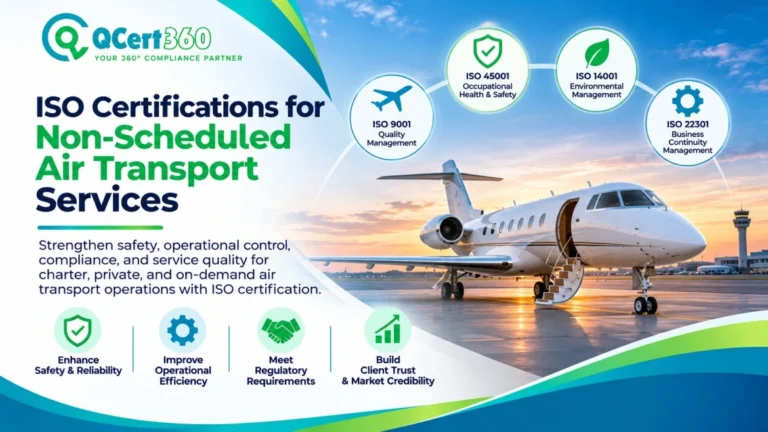
ISO certifications for non-scheduled air transport services are voluntary, independently assessed management-system certifications that help charter, private aviation, air taxi, air ambulance and air cargo charter operators run consistent, documented and auditable operations. The standards most often considered are ISO 9001 (quality), ISO 45001 (occupational health and safety), ISO 14001 (environment), ISO/IEC 27001 (information security) and ISO 22301 (business continuity). The right combination depends on your operations, risks, customer requirements and the aviation rules that apply to you. None of them replaces an Air Operator Certificate (AOC), a Safety Management System (SMS) or any approval from your civil aviation authority.
This guide explains which standards fit which business models, where ISO ends and aviation regulation begins, what certification requires, how the process works, and how to choose a provider.
CTA: Get ISO Certification Support for Your Aviation Business
Which ISO Standards Are Relevant to Non-Scheduled Air Transport Operators?
Non-scheduled air transport covers flights operated on demand rather than to a published timetable: private jet charter, business aviation, air taxi, air ambulance and medical evacuation, and air cargo charter. Each flight can involve a different route, customer, crew roster, handler and supplier, so consistency has to come from the management system rather than the timetable. ISO management-system standards give that structure.
Choose standards by working backwards from three questions. What do customers, brokers, hospitals or tenders ask you to demonstrate? Which risks hurt you most: service failure, workplace injury, data breach, disruption or environmental exposure? And which standards does your leadership team have the capacity to maintain?
Standard | Purpose | Relevance to non-scheduled air transport | Who benefits most |
Consistent booking, flight coordination, passenger communication, supplier control, complaint handling | Charter brokers and operators, air taxi, aircraft management companies | ||
Occupational health and safety management | Hazards for crew, technicians, ramp, dispatch and ground staff | Operators with in-house maintenance or ground teams, cargo charter | |
Environmental management | Fuel use, waste, hazardous materials, hangar and ground operations | Operators with bases, hangars or maintenance activity | |
Information security management | Passenger data, bookings, payments, flight plans, crew records | Private jet and charter companies handling confidential client data | |
Business continuity management | Aircraft unavailability, IT failure, weather, supplier disruption | Air ambulance, cargo charter, time-critical operators | |
Energy management | Energy performance of hangars, maintenance bases, ground support | Organisations with significant facility energy use | |
Anti-bribery management | Dealings with agents, brokers, authorities and suppliers across borders | Operators working in higher-risk markets | |
Privacy information management | Structured management of personal data | Operators handling large volumes of passenger data | |
Facility management | Managing aviation facilities and support spaces | Facility and aircraft management companies | |
IT service management | Aviation technology and IT service providers | Providers supplying operational IT |
ISO 31000 is a risk management guidance standard, not a conventional certifiable management-system standard, so it supports your risk approach but is not something a certification body certifies you against.
Edition check before you commit. Several core standards are in revision. ISO 14001 was published in a 2026 edition in April 2026, ISO 9001 was scheduled for a 2026 edition in September 2026, and ISO 45001 is under revision. Transition arrangements are set by the International Accreditation Forum (IAF), accreditation bodies and certification bodies, so confirm the edition and transition rules with your certification body when you plan your project.
ISO Certification vs Aviation Safety Approvals: An Important Distinction
ISO certification does not authorise you to fly, carry passengers or replace regulatory oversight. It is an independent assessment of a management system against a specific ISO standard. Aviation approvals are legal requirements set by the civil aviation authority responsible for your operation.
ISO management-system certification | Aviation operating approvals and oversight | Safety Management System (SMS) | |
What it is | Independent assessment against an ISO standard | Authority requirements for activities, aircraft, personnel and procedures | Aviation-specific approach to managing safety risk and performance |
Who sets it | ISO publishes the standard; a certification body assesses | The relevant civil aviation authority | Required or accepted under the applicable regulatory framework |
Nature | Voluntary (unless a customer or contract requires it) | Mandatory for the regulated activity | Mandatory or accepted depending on jurisdiction and operation type |
Examples | ISO 9001, ISO/IEC 27001 certificates | Air Operator Certificate, operating licence, airworthiness obligations | Hazard identification, safety risk assessment, safety assurance, safety promotion |
ISO 9001, ISO 45001, ISO 14001, ISO/IEC 27001 and ISO 22301 do not automatically replace your SMS, AOC, operating licence, airworthiness obligations or any other required approval. Likewise, an ISO certificate does not validate aircraft maintenance records or regulatory compliance.
Why ISO 45001 Is Not an Aviation SMS
ISO 45001 protects people from work-related injury and ill health: a technician working at height, a ramp worker near an aircraft, a dispatcher under sustained pressure. An aviation SMS manages risks to flight operations, aircraft and passengers. The two have related purposes and can reinforce each other, for example through shared incident-reporting discipline, but one is not a certification of the other.
For authoritative aviation safety guidance, see ICAO Annex 19 and the ICAO Safety Management Manual. Regulatory requirements are jurisdiction-specific: EASA rules apply to European operations, FAA requirements to US operations, and other states have their own regimes. Always refer to your own civil aviation authority and current legislation rather than assuming one country’s rules apply globally.
ISO 9001 for Air Transport Services
ISO 9001 helps charter and aviation service providers deliver the same service standard even when every flight is different. A quality management system (QMS) gives structure to the customer-facing and coordination processes that surround the flight itself:
- Booking enquiries, quotations and customer communication
- Flight planning coordination and service handoffs between teams
- Controlled operational documentation and records
- Supplier and subcontractor selection, evaluation and review (handlers, caterers, fuel suppliers, ground transport)
- Complaint handling and customer feedback
- Performance monitoring, corrective action and continual improvement
For an operator whose schedule, routes and customer expectations change daily, the value lies in defining what “done properly” looks like, measuring it, and acting when it slips. Useful indicators include service completion rate, complaint trends, supplier performance and corrective action closure time.
ISO 45001 Certification for Aviation Operators
ISO 45001 gives aviation employers a structured way to find and control workplace hazards for the people who keep operations running. It is relevant to flight crews, aircraft maintenance personnel, ground handling staff, ramp workers, dispatch and operations teams, and technical and support employees.
The standard asks for hazard identification and risk assessment, worker consultation and participation, competence and awareness, incident investigation, emergency preparedness and ongoing performance evaluation. Typical aviation hazards include work at height, noise, manual handling, exposure to fuels and chemicals, vehicle movements on the apron, shift patterns and fatigue-related workplace risks.
To be clear, ISO 45001 sits alongside, not in place of, aviation-specific operational safety requirements.
ISO 14001 certification for Aviation Companies
ISO 14001 helps aviation businesses identify their environmental aspects, meet compliance obligations and improve environmental performance. Relevant topics include fuel consumption and associated emissions, aircraft-related waste, ground operations and resource consumption, maintenance-related impacts, hazardous material handling, waste management and disposal, compliance obligations and performance monitoring.
An environmental management system does not certify aircraft emissions performance or guarantee reduced emissions. It certifies that you have a system to identify, control and improve the aspects within your scope.
ISO 27001 certification for Aviation Businesses
Charter and private aviation companies hold information that clients expect to stay confidential, and ISO/IEC 27001 provides a recognised framework for protecting it. Typical information assets include passenger personal information, flight plans and schedules, booking and payment details, crew and employee records, aircraft operational information, customer contracts, dispatch and flight coordination systems, and digital communication platforms.
An information security management system (ISMS) covers access control, information classification, risk assessment and treatment, incident response, supplier security and protection of business information. For operators serving high-profile or privacy-sensitive clients, this is often the standard that prompts the first customer question.
ISO 22301 certification for Aviation Companies
ISO 22301 prepares operators to keep delivering critical services, or recover quickly, when something goes wrong. Disruptions common to non-scheduled operations include severe weather, aircraft unavailability, IT and communication failures, cybersecurity incidents, supplier disruption, operational base interruption, staff shortages, emergencies and sudden demand changes.
The standard is built around business impact analysis (what must continue, and how quickly it must be restored), continuity strategies, recovery arrangements, exercises and testing, and crisis communication. Continuity exercise results become a measurable indicator of readiness.
ISO 50001 certification and Other Standards Worth Considering
ISO 50001 supports organisations that want to monitor and improve energy performance in facilities such as hangars, maintenance bases and ground support operations. It does not certify aircraft fuel efficiency or guarantee lower aviation emissions.
Other standards fit specific situations:
- ISO 37001 for operators dealing with agents, intermediaries and authorities across jurisdictions.
- ISO/IEC 27701 for structured privacy management, subject to the applicable edition and certification arrangements.
- ISO 41001 for organisations managing aviation facilities.
- ISO/IEC 20000-1 for aviation technology and IT service providers.
Not every operator needs all of them. Start with the one or two standards your customers and risks justify, then add others as the system matures.
ISO Certification for Different Non-Scheduled Aviation Business Models
Private Jet and Business Aviation Operators
Service quality, passenger confidentiality, operational coordination, supplier management and customer expectations dominate this segment. ISO 9001 and ISO/IEC 27001 are the usual starting pair.
Air Charter Companies
Charter businesses coordinate aircraft, crews, handlers and customers under time pressure. ISO 9001 structures service delivery, ISO/IEC 27001 protects booking and passenger data, ISO 22301 supports continuity, and ISO 45001 protects operations and ground teams.
Air Ambulance and Medical Evacuation Operators
Operational coordination, patient information protection, emergency readiness, service reliability, staff competence and continuity planning matter most. ISO 9001, ISO 45001, ISO 22301 and ISO/IEC 27001 can all be relevant. ISO certification does not independently establish medical or aviation operational authorisation.
Air Taxi Operators
Documented processes, customer service, employee safety, operational coordination and risk management support consistent delivery across frequent, short-notice flights.
Air Cargo Charter Operators
Cargo handling coordination, customer requirements, supplier management, information security, documentation and service continuity are the priorities. ISO 9001, ISO/IEC 27001 and ISO 22301 are commonly considered, with ISO 14001 where environmental obligations apply.
Aircraft Management Companies
Structured quality controls, information security, supplier oversight, maintenance coordination and customer reporting add the most value.
Aviation Maintenance and Technical Support Providers
Maintenance organisations differ from air transport operators. ISO standards can strengthen documentation, quality assurance, workplace safety and environmental control, but maintenance approvals and technical authorisations remain governed by applicable aviation rules.
ISO Certification Requirements for Air Transport Companies
The exact requirements depend on the selected standard and your scope, but most ISO management-system standards share a common core. Here is what that core looks like in an aviation setting:
Requirement | Aviation example |
Defining scope | Charter operations from two bases, excluding the separately approved maintenance unit |
Organisational context | Seasonality, customer mix, regulatory environment, supplier dependence |
Interested parties | Passengers, brokers, hospitals, handlers, authorities, insurers |
Leadership and responsibilities | Accountable manager sponsors the system and assigns roles |
Risks and opportunities | Risk register covering supplier failure, IT outage, data exposure |
Policy and objectives | Measurable targets such as complaint response time |
Competence and training | Training records for dispatch, customer service and ground staff |
Operational planning and control | Controlled procedures for booking, coordination, passenger communication |
Documented information | Version-controlled procedures and retained records |
Supplier and outsourced controls | Evaluation and review of handlers and subcontractors |
Monitoring and measurement | Service completion rate, training completion, corrective action closure |
Internal audits | Planned audits by competent, impartial auditors |
Management review | Leadership reviews results, risks and resources |
Nonconformity and corrective action | Root-cause analysis and verified closure |
Continual improvement | Documented improvements from audits, feedback and incidents |
A charter operator might, for instance, establish controlled procedures for booking enquiries, flight coordination, passenger communication, supplier evaluation, complaint handling and operational record management.
ISO Certification Process for Non-Scheduled Air Transport Services : Step by Step
ISO Certification is a staged journey: preparation and implementation first, then an independent audit and certification decision.
- Identify objectives and the appropriate standard. Clarify why you want certification and which standard serves that goal.
- Define scope. Decide which activities, locations and aircraft-related services are included.
- Conduct a gap assessment. Compare current practice with the standard.
- Identify weaknesses. List missing procedures, unclear responsibilities and weak records.
- Develop or improve policies, processes and documentation. Keep documents proportionate to your operation.
- Train employees and management. Awareness and competence are audited.
- Implement the system. Operate the processes in daily work.
- Maintain records and evidence. Auditors look for proof of operation, not just documents.
- Conduct an internal audit. Test the system before the external audit.
- Complete management review. Leadership evaluates performance and resources.
- Select an independent certification body. See the provider section below.
- Complete the certification audit. Typically Stage 1 (documentation and readiness review) and Stage 2 (implementation assessment), where required.
- Address nonconformities. Correct findings and show corrective action.
- Independent certification decision. The certification body decides, not your consultant.
- Maintain the system. Surveillance and recertification audits follow.
Steps 1 to 10 are where consulting and implementation assistance can help. Steps 11 to 14 belong to the independent certification body. These roles must stay separate.
Documents and Records for ISO Certification in Aviation
Documentation requirements differ by standard and by organisation. The table shows typical examples; no operator needs an identical set.
Document or record | Purpose | Example for a non-scheduled aviation organisation |
Quality, environmental, OH&S, information security and business continuity policies | State leadership intent and direction | Information security policy covering passenger and booking data |
Risk assessments | Identify and prioritise risks and opportunities | Risk register covering supplier failure and IT outage |
Interested-party requirements | Record what stakeholders expect | Broker and hospital service requirements |
Operational procedures | Control how work is done | Booking-to-flight coordination procedure |
Training and competence records | Show people are competent | Dispatch and customer service training records |
Supplier evaluation records | Demonstrate supplier control | Handler and caterer performance review |
Customer feedback records | Capture satisfaction and complaints | Post-flight survey and complaint log |
Internal audit reports | Verify the system works | Annual audit of charter operations |
Management review records | Show leadership oversight | Quarterly review of indicators and actions |
Corrective action records | Show problems are fixed | Root-cause record for repeated late-communication complaints |
Incident and nonconformity records | Track and learn from events | Ground injury or data-access incident report |
Business continuity test records | Prove readiness | Tabletop exercise on IT outage at the operations centre |
Information security risk treatment records | Show how risks are treated | Access-control decisions for the booking platform |
ISO certification does not validate aircraft maintenance records or regulatory approvals; those stay under aviation oversight.
Benefits of ISO Certification for Non-Scheduled Aviation Businesses
The practical value of ISO certification is a more disciplined, evidenced and credible operation. Typical benefits include:
- More consistent service delivery and improved operational processes
- Better documentation and accountability
- Stronger customer confidence and support for contractual requirements
- Improved supplier oversight
- Better workplace hazard management
- Stronger information security controls
- More structured business continuity planning
- Better environmental management
- Stronger internal audit and corrective action processes
- Improved readiness for supplier assessments and tenders
These are potential benefits, not guarantees. ISO certification cannot promise accident prevention, regulatory approval, automatic tender qualification or revenue growth.
Common Challenges and Practical Solutions
The scenarios below are illustrative rather than drawn from named client cases.
Challenge | Practical recommendation |
Limited management involvement | Name an accountable sponsor, tie objectives to commercial priorities, schedule management reviews early |
Inconsistent documentation | Use one controlled template set and a single owner for each document |
Difficulty coordinating operational teams | Map the booking-to-flight process and assign a clear owner at each handoff |
Incomplete employee training | Build a competence matrix by role and track completion |
Weak supplier controls | Evaluate critical suppliers by risk and review performance on a schedule |
Train auditors or use impartial external support, then audit before the certification audit | |
Confusion between ISO and aviation regulation | Keep a simple register mapping each ISO requirement and each aviation obligation, and avoid mixing the two |
Records across changing flight schedules | Capture records at the point of work in a standard format tied to the flight or job reference |
Information security risks | Start with an asset inventory, access review and supplier security check |
Business continuity gaps | Run a business impact analysis, then test one scenario at a time |
How Much Does ISO Certification Cost for an Aviation Company?
Cost depends on your organisation, so a tailored quotation is the only reliable answer. The main factors are organisation size and number of employees, number of locations and operational bases, scope and complexity of aviation activities, number of standards selected, existing management-system maturity, consultancy and implementation needs, training needs, certification audit duration, travel and applicable audit expenses, and surveillance and recertification requirements.
How Long Does ISO Certification Take for an Aviation Business?
Timelines vary with readiness, complexity and audit scheduling. The main variables are organisational readiness, operational complexity, number of locations, documentation maturity, employee involvement and availability of audit dates. A single-base charter office with mature processes will move differently from a multi-base operation starting from scratch. No responsible provider can guarantee a fixed number of days or weeks before assessing your situation.
Choosing an ISO Certification Provider for an Aviation Business
First, understand the two roles. An ISO consultant helps you prepare: gap assessment, documentation, training and audit readiness. An independent certification body audits your system and makes the certification decision. Not every consultant can issue certificates, and not every certificate is accredited.
Check these points before you choose:
- Relevant experience with management-system standards and understanding of aviation business processes
- Transparency about consultancy and certification roles
- Appropriate certification-body credentials
- Accreditation scope and validity, where accreditation is required, and whether it covers your standard and sector
- Technical competence of auditors
- Audit methodology and reporting
- Certificate verification arrangements
- Clear pricing and service scope
- Surveillance and post-certification arrangements
Always verify the certification body’s credentials and the exact scope of accreditation with the accreditation body.
How QCert360 Supports Your ISO Certification Requirements
QCert360 is a global ISO certification and management consulting firm, headquartered in Bengaluru, India, supporting organisations across industries and regions. For aviation organisations, our support can include:
- ISO certification guidance and help selecting the right certification route
- Management-system gap assessment
- ISO implementation consulting and documentation support
- Employee awareness and training
- Internal audit preparation and certification audit readiness
- Support for integrated management systems
We adapt this support to private aviation, charter operations, air ambulance providers, air cargo charter businesses and other aviation-related organisations. QCert360’s consulting and implementation services are distinct from independent third-party certification. We do not present consulting as certification, and the certification decision always rests with an independent certification body.
Tell Us About Your Aviation Business
Share your details to receive a tailored response. Helpful information includes:
- Type of aviation business and nature of your non-scheduled operations
- Preferred ISO standard, if known
- Number of employees, operational locations and bases
- Number of aircraft or relevant operational units, where useful
- Current management-system status and required timeline
- Whether you need consultancy, training, implementation support or an independent certification route
CTA: Find the Right ISO Standards for Your Air Transport Operations | Discuss ISO Implementation and Audit Preparation
Illustrative Scenarios
These are hypothetical examples, not QCert360 case studies, and no results are implied.
Example 1: Private jet charter operator. The operator adopts ISO 9001 to standardise quotation, booking confirmation, passenger communication and supplier review, and ISO/IEC 27001 to control access to passenger manifests, booking records and payment data. Useful indicators: complaint trends, quotation response time, supplier performance scores and access-review completion.
Example 2: Air ambulance operator. The operator uses ISO 9001 for coordination and service reliability, ISO 45001 for workplace hazards affecting crews and ground staff, and ISO 22301 for continuity when aircraft or communications are unavailable. Medical and aviation approvals remain separate requirements. Useful indicators: training completion, incident reporting rates, corrective action closure and continuity exercise results.
Example 3: Air cargo charter company. The company combines quality management for customer requirements and documentation, information security for shipment and customer data, environmental controls for waste and hazardous materials, and continuity planning for supplier and system disruption. Useful indicators: service completion rate, audit findings, supplier performance and exercise results.
Frequently Asked Questions
- What ISO certifications are relevant to non-scheduled air transport services?
ISO 9001, ISO 45001, ISO 14001, ISO/IEC 27001 and ISO 22301 are the most common, with ISO 50001, ISO 37001, ISO/IEC 27701, ISO 41001 and ISO/IEC 20000-1 relevant in specific cases.
- Is ISO 9001 useful for private jet charter companies?
Yes. It structures booking, coordination, communication, supplier management and complaint handling, supporting consistent service.
- Which ISO standard is suitable for air ambulance operators?
There is no single answer. ISO 9001, ISO 45001, ISO 22301 and ISO/IEC 27001 are commonly considered, and none replaces medical or aviation approvals.
- How does ISO 45001 support aviation companies?
It provides a framework for hazard identification, risk assessment, competence, incident investigation and emergency preparedness for employees.
- Why should air charter operators consider ISO/IEC 27001?
Because they handle passenger data, bookings, payments, flight plans and contracts that clients expect to be protected.
- Is ISO 14001 relevant to private aviation companies?
Yes, particularly where operations involve fuel, waste, hazardous materials, hangars or maintenance activity.
- How can ISO 22301 support aviation business continuity?
By identifying critical services, setting recovery strategies, testing them and preparing crisis communication for events such as weather, IT failure and supplier disruption.
- Is ISO certification mandatory for non-scheduled air transport operators?
ISO certification is generally voluntary, though a customer, tender or contract may require it. Aviation approvals are separate and mandatory where regulations apply.
- Does ISO certification replace an Air Operator Certificate (AOC)?
No. An AOC is issued under aviation regulation; ISO certification does not substitute for it.
- What is the difference between an aviation SMS and ISO 45001?
An SMS manages aviation safety risk under the applicable regulatory framework. ISO 45001 manages workplace health and safety for employees.
- What documents are needed for ISO certification in aviation?
Policies, risk assessments, procedures, training records, supplier evaluations, audit and review records, and corrective action records, varying by standard.
- How long does ISO certification take for an air charter company?
It depends on readiness, complexity, locations and audit scheduling. A gap assessment gives a realistic estimate.
- How much does ISO certification cost for a private aviation company?
Cost varies with size, scope, number of standards and support needed. Request a tailored quotation.
- Can a small air charter operator obtain ISO certification?
Yes. The system should be proportionate to the size and complexity of the organisation.
- Can aviation businesses integrate ISO 9001, ISO 14001 and ISO 45001?
Yes. These standards share a common structure, so many organisations integrate them into one management system.
- Does ISO 9001 improve aviation service quality?
It provides a framework for consistency, measurement and improvement, but results depend on how well it is implemented.
- How can an air cargo charter company prepare for an ISO audit?
Define scope, run a gap assessment, train staff, keep records, complete an internal audit and hold a management review.
- What should aviation companies check before selecting a certification body?
Accreditation scope and validity, auditor competence, audit methodology, certificate verification and clarity between consulting and certification.
Next Step: Get Tailored ISO Support for Your Aviation Operation
Tell us about your business activities, locations, preferred standards and timeline, and QCert360 will respond with guidance suited to your operation.
CTA: Get ISO Certification Support for Your Aviation Business
Our Services
ISO Standards
- ISO 9001 Certification
- ISO 14001 Certification
- ISO 45001 Certification
- ISO 22000 Certification
- ISO 17025 Certification
- ISO 27001 Certification
- ISO 13485 Certification
- ISO 20000-1 Certification
- ISO 41001 Certification
- ISO 22716 Certification
- ISO 50001 Certification
- ISO 22301 Certification
- ISO 29993 Certification
Product Certifications
Other international standards
- FSSC 22000 Certification
- HIPAA
- HACCP Certification
- SA 8000 Certification
- GMP Certification
- GDPR
- GDP Certification
- GLP Certification
- Certificate of Conformity
QCert360 provides a wide range of services including ISO certification, audit support, compliance consulting, and training. They specialize in helping businesses achieve global standards and certifications like ISO 9001, ISO 27001, ISO 14001, and many others. Their team ensures a seamless experience from consultation to certification, supporting clients at every stage.
The time it takes to achieve certification can vary depending on the complexity of the standard and the readiness of your organization. On average, it takes about 3 to 6 months. QCert360 works closely with clients to streamline the process, ensuring that all requirements are met efficiently and within a reasonable timeline.
QCert360 is a trusted partner with years of experience in helping businesses obtain international certifications. Their expert consultants provide tailored solutions, ensuring your organization not only meets but exceeds industry standards. With a customer-centric approach, they focus on offering end-to-end support to simplify the certification journey.
QCert360 serves a wide range of industries including manufacturing, healthcare, information technology, education, and services, among others. They customize their certification solutions to meet the unique requirements of each industry, ensuring relevance and compliance with global standards.
Yes, QCert360 provides ongoing support even after certification. They offer services like surveillance audits, recertification guidance, and consultancy to help maintain and improve your certification status. Their team ensures that your organization stays compliant and up-to-date with any changes in certification standards.
Getting started with QCert360 is simple. You can contact them via their website to request a consultation. Their team will assess your needs, discuss the best certification options for your business, and outline the steps involved. From there, they’ll guide you through the entire process, ensuring you’re prepared for certification.
QCert360 stands out due to its customer-focused approach, industry expertise, and comprehensive service offerings. Their team doesn’t just help you obtain certification but works to ensure your organization thrives in compliance with international standards. They also offer personalized consultation, making the process smoother and more efficient, ensuring long-term success for your business.
The cost of certification varies depending on factors such as the type of certification, the size and complexity of your organization, and the specific industry requirements. QCert360 offers competitive pricing and provides tailored quotes based on your unique needs. They ensure transparency and work with you to find the most cost-effective solution for your certification goals.
Yes, QCert360 offers internal audit services to help assess and improve your organization’s processes. Their expert auditors conduct thorough reviews of your systems and operations to ensure they meet required standards. They also provide actionable recommendations to help enhance efficiency and compliance, making sure you’re fully prepared for external audits.
If your organization doesn’t pass an audit or certification assessment, QCert360 works with you to understand the reasons for non-compliance and provides support to rectify the issues. They offer guidance on corrective actions and help you prepare for a re-assessment. Their goal is to ensure your organization meets the necessary standards for certification, and they will be by your side to make the process as smooth as possible.