ISO Certification for Transcription Services: Expert Consulting & Audit Support
ISO certification for transcription services is independent confirmation that a transcription company delivers accurate transcripts, protects confidential recordings, and runs repeatable, auditable processes. It gives clients documented proof instead of marketing claims. For providers that handle medical dictations, legal depositions, research interviews, and corporate meetings, that proof often decides who wins the contract.
Transcription is a trust business. Clients upload audio that may contain personal data, trade secrets, privileged advice, or unpublished research. They expect near-perfect accuracy, fast turnaround time, and strict confidentiality. One misheard drug name or one leaked recording can end a client relationship.
Procurement teams know this. Vendor due diligence questionnaires, tender documents, and security reviews now ask transcription providers for quality and information security certificates. An ISO certified transcription company clears those checks faster and with less friction.
This guide explains which standards apply, what each one requires, what auditors check, how the certification process works, and how to prepare. QCert360 supports transcription businesses in 175+ countries, and you can request a custom quote at any point.
What Is ISO Certification for a Transcription Company?
ISO certification for a transcription company is a formal assessment by a certification body that confirms your management system meets an international ISO standard. The standard defines the requirements. The auditor checks whether your documented processes meet them and whether your team follows them.
The International Organization for Standardization publishes the standards, but it does not issue certificates. An independent certification body audits your company and issues the certificate. This separation keeps the process impartial.
For transcription services, certification typically covers the full workflow:
- Receiving audio and video files from clients
- Converting speech to text through human transcriptionists, speech recognition software, or a hybrid transcription workflow
- Applying style rules such as verbatim or clean verbatim, speaker identification, and timestamping
- Proofreading, editing, and quality assurance review
- Delivering files securely and deleting them under a data retention schedule
A certificate states the standard, the scope of services, and the validity period. Clients can verify it, which is why it carries more weight than a self-declared quality statement.
Why Transcription Businesses Need ISO Certification
Transcription businesses need ISO certification because clients now treat it as a baseline requirement for quality assurance and data security. Certification replaces claims with evidence and shortens the path from inquiry to signed contract.
Four pressures drive this demand.
Vendor due diligence. Enterprise buyers send security questionnaires before they share a single file. Questions about encryption, access control, and incident response appear in nearly every one. A certificate answers many of them at once.
Sensitive content. Recordings often contain personal data, health details, financial figures, and legal strategy. Clients must show their own stakeholders that they chose a secure transcription service.
Competition from automation. AI transcription tools produce cheap, fast drafts. Human-verified providers justify higher rates by proving accuracy controls, confidentiality, and accountability. ISO certification makes that proof visible.
Tenders and procurement. Public and private tenders often list ISO 9001 or ISO 27001 as a minimum requirement or award extra points for them. Without a certificate, you may not qualify to bid.
Certification also strengthens operations from the inside. It replaces informal habits with documented procedures, so quality stays consistent as you add transcriptionists, reviewers, and clients.
Which ISO Standards Apply to Transcription Services?
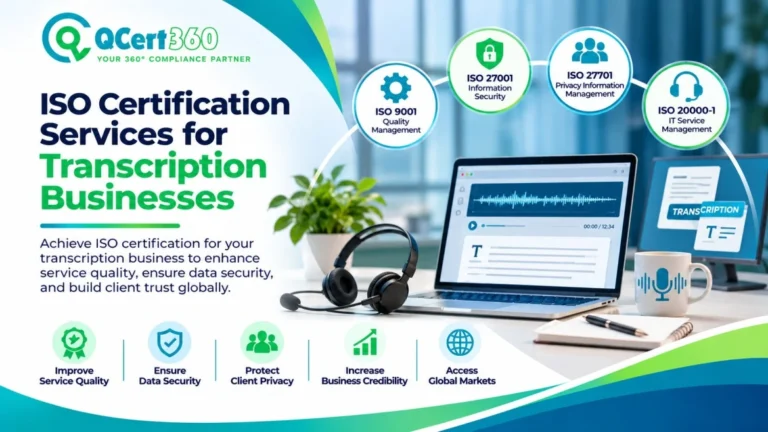
ISO 9001 and ISO/IEC 27001 are the two most relevant standards for transcription services. Many providers add ISO/IEC 27701, ISO 17100, ISO 22301, or ISO 14001 depending on their clients, services, and growth plans.
Standard | Focus | Best fit |
ISO 9001 | Every transcription provider | |
ISO/IEC 27001 | Information security management system | Providers handling confidential audio and text |
ISO/IEC 27701 | Privacy information management | Providers processing personal data at scale |
ISO 17100 | Translation service quality | Providers offering multilingual transcription or translation |
ISO 22301 | Business continuity management | Providers with strict deadlines and service commitments |
ISO 14001 | Environmental management | Providers serving sustainability-focused clients |
ISO 9001 for Transcription Companies
ISO 9001 gives a transcription company a structured quality management system for delivering accurate work every time. It requires you to define processes, set measurable objectives, monitor performance, and improve based on customer feedback.
For transcription, that means:
- Written accuracy targets, such as a minimum accuracy rate per file type
- Defined stages for transcription, proofreading, and final quality control
- A complaint and corrective action process for reported errors
- Competence records showing that each transcriptionist is trained and tested
- Metrics for turnaround time, error rates, and customer satisfaction
ISO 9001 also builds a habit of continual improvement. You review results, find the root cause of recurring mistakes, and fix the process instead of blaming individuals. That discipline improves transcription quality assurance and reduces rework.
ISO 27001 for Transcription Services
ISO/IEC 27001 certifies that you run an information security management system (ISMS) to protect client recordings and transcripts. It is the standard security teams look for first when they assess a transcription vendor.
The standard requires a risk assessment, a statement of applicability, and a set of controls matched to your risks. Typical controls for secure transcription services include:
- Encryption of files in transit and at rest
- Role-based access control, so staff see only assigned projects
- Secure onboarding and offboarding of remote and freelance transcriptionists
- Non-disclosure agreements and confidentiality training
- Defined data retention periods and secure deletion of audio and text files
- Audit trails that show who accessed which file and when
- Incident response procedures with clear reporting duties
Remote workforces raise the stakes. If freelance transcriptionists work from personal devices, ISO 27001 forces you to define device rules, access limits, and monitoring. That structure protects both you and your clients.
ISO 27701 Certification for Privacy Management
ISO/IEC 27701 extends ISO 27001 with controls for managing personal data. It suits transcription companies because recordings routinely contain names, health information, opinions, and contact details.
The standard helps you define whether you act as a data processor or data controller, document your processing activities, and apply privacy by design. Clients that handle sensitive personal data value this clarity because it shows how you treat their data once it leaves their systems.
ISO 17100 Certification for Multilingual Transcription
ISO 17100 sets requirements for translation services, including qualified linguists, revision by a second linguist, and project management. It does not directly cover single-language transcription.
It becomes relevant when you offer translated transcripts, subtitling, captioning, or multilingual projects. If you transcribe in one language only, ISO 9001 usually fits better. If you sell multilingual transcription, ISO 17100 shows buyers that qualified linguists review every deliverable.
ISO 22301 Business Continuity for Transcription Providers
ISO 22301 helps you keep delivering when disruption strikes, such as a platform outage, power failure, cyber incident, or sudden loss of staff. It requires a business impact analysis, a business continuity plan, defined recovery time objectives, and regular testing.
Clients with court deadlines, broadcast schedules, or regulatory filings cannot accept missed deliveries. This standard shows that you plan for disruption and can recover quickly.
ISO 14001 for Environmental Management for transcription companies
ISO 14001 helps transcription companies document and reduce environmental impact. Transcription is a low-footprint service, but you can still manage energy consumption, device lifecycles, paper use, and carbon footprint. A paperless workflow and a responsible electronic waste policy give you concrete material for the audit.
Corporate and public-sector clients with sustainability targets in their supply chain often ask suppliers for this certificate.
ISO Certification Across Transcription Sectors
The right standards depend on the sector you serve. Each sector places different weight on accuracy, confidentiality, and continuity.
Medical transcription. Medical dictation contains patient information and clinical terms where one error can cause harm. ISO 27001 and ISO 27701 address confidentiality and privacy, while ISO 9001 supports accuracy controls and terminology checks. ISO certification for medical transcription helps you pass hospital and healthcare vendor reviews.
Legal transcription. Legal transcription covers depositions, hearings, interviews, and client calls. Verbatim accuracy and chain-of-custody evidence matter most. ISO 9001 documents your review stages, and ISO 27001 protects privileged material. Law firms often require both before they share case files.
Market research transcription. Research agencies send focus group and interview recordings that contain participant opinions and sometimes personal data. ISO 27701 and ISO 27001 help agencies show their own clients that participant data stays protected.
Academic transcription. Universities and research teams need accurate transcripts of interviews and lectures, often under ethics approvals. Certified confidentiality controls and defined retention rules help providers meet institutional requirements.
Media, captioning, and subtitling. Broadcasters and content producers work to tight deadlines. ISO 22301 shows resilience, while ISO 17100 supports multilingual subtitling and captioning.
Corporate and call center transcription. Companies transcribe board meetings, earnings calls, and customer calls. ISO 27001 reassures compliance teams, and ISO 9001 supports consistency across high volumes.
Government and public-sector transcription. Public bodies transcribe hearings, committee sessions, and consultations. Procurement rules in this sector often require recognized certificates, so ISO 9001 and ISO 27001 open doors that remain closed to uncertified suppliers.
ISO Certification Requirements for Transcription Services
ISO certification requirements for transcription services come from the clauses of each standard, applied to your specific workflow. Every management system standard follows a similar structure, so the core requirements overlap.
You must typically demonstrate the following:
- Context and scope. Define your services, locations, clients, and the boundaries of the certified system.
- Leadership commitment. Top management sets policy, assigns roles, and supports the system.
- Risk and opportunity planning. Identify risks to quality, security, or continuity and plan actions.
- Documented information. Maintain policies, procedures, and records, such as style guides, review checklists, and training logs.
- Competence and awareness. Test transcriptionists, train them on confidentiality, and keep records.
- Operational control. Control how projects move from intake to delivery, including supplier and subcontractor management.
- Performance evaluation. Run internal audits, track accuracy metrics, and hold management reviews.
- Improvement. Record nonconformities, apply corrective action, and show continual improvement.
A practical ISO audit checklist for transcription businesses starts with a gap analysis. You compare each requirement against your current practices, list the gaps, and close them before the certification audit.
Documents and Records Auditors Expect From Transcription Companies
Auditors expect a core set of policies, procedures, and records that prove your system exists and works. You do not need hundreds of pages, but you need the right documents and evidence that your team uses them.
Policies and system documents
- Quality policy and information security policy
- Scope statement describing certified services and locations
- Risk register and risk treatment plan
- Statement of applicability (ISO 27001)
- Organization chart with defined roles and responsibilities
Operational procedures
- Project intake and client requirements procedure
- Transcription style guide covering verbatim rules, speaker labels, timestamps, and formatting
- Proofreading and quality control procedure
- Secure file transfer, storage, and deletion procedure
- Freelancer onboarding, vetting, and offboarding procedure
- Complaint handling and corrective action procedure
- Incident response and reporting procedure
- Business continuity plan and backup procedure
Records that show the system working
- Transcriptionist test results and training logs
- Confidentiality agreements signed by staff and contractors
- Quality review sheets and error logs
- Client feedback and complaint records
- Access control lists and access review records
- Internal audit reports and management review minutes
- Supplier evaluations for software platforms and cloud providers
- Incident logs with corrective actions
Auditors sample these records. If a procedure says you review every transcript twice, they will ask to see the review records for recent projects. Keep records current, because gaps in recent records raise more questions than gaps in old ones.
Security Controls for Remote and Freelance Transcriptionists
Remote and freelance transcriptionists create the biggest security exposure in most transcription businesses, so auditors examine them closely. You must show that every person who touches a client file is vetted, trained, and controlled.
Build these controls into your system:
- Vetting. Verify identity, check references, and test skills before granting access.
- Contracts. Require signed confidentiality and data handling terms before the first assignment.
- Access limits. Assign files by project, and remove access when the job ends.
- Device rules. Define minimum standards for operating system updates, antivirus, screen locking, and disk encryption.
- Platform controls. Use a secure transcription platform that prevents downloading and local storage where possible.
- Monitoring. Review access logs and flag unusual activity such as bulk downloads.
- Training. Teach confidentiality, phishing awareness, and incident reporting, and record attendance.
- Offboarding. Revoke accounts, retrieve files, and document completion when a contractor leaves.
These controls also help your sales team. When a client asks how you protect their recordings, you can describe a documented system instead of making a general promise.
What Do Auditors Check in a Transcription Business?
Auditors check whether your documented system matches what your team actually does. They interview staff, review records, and trace real projects from intake to delivery.
Expect them to examine these areas:
- Project intake. How you capture client requirements, including format, verbatim style, speaker labels, timestamps, and deadlines.
- Competence. How you recruit, test, train, and evaluate transcriptionists and reviewers.
- Quality control. Your proofreading stages, accuracy measurement, error logs, and complaint handling.
- File security. How audio and text files move through your systems, who can access them, and how you delete them.
- Supplier management. How you vet freelancers, software platforms, and cloud providers.
- Continuity and incidents. How you test backups, handle outages, and report security events.
- Management oversight. Evidence of internal audits, management reviews, and corrective actions.
Strong records matter more than perfect processes. Auditors want to see that you find problems and fix them. A documented nonconformity with a clear corrective action often reflects a healthy system.
Benefits of ISO Certification for the Recycling Industry
The benefits of ISO certification for the recycling industry appear in safety, quality, costs and credibility. Certified companies run tighter operations, win more contracts and earn stronger trust from regulators, buyers and communities.
Key benefits include:
- Safer operations. Structured risk control reduces accidents and downtime.
- Better material quality. Consistent grading and contamination control raise value.
- Lower costs. Energy savings, less rework and fewer rejected loads improve margins.
- Stronger tender position. Buyers and program owners favor certified suppliers.
- Clearer traceability. Records support recycled-content and origin claims.
- Improved environmental performance. Higher recovery rates and lower residues.
- Continuity confidence. Plans reduce disruption risk.
- Reputation protection. Certification signals responsibility in a closely watched industry.
Key Performance Indicators for Transcription Quality and Security
Key performance indicators let you prove that your quality management system produces results. ISO 9001 requires you to monitor and measure performance, and auditors expect to see data, not opinions.
Useful quality metrics for transcription services include:
- Accuracy rate. The percentage of words or segments transcribed correctly after review, measured on a sample of files.
- Word error rate. A standard measure of substitutions, deletions, and insertions, especially useful when you compare human and automated output.
- Turnaround time performance. The percentage of files delivered on or before the agreed deadline.
- Rework rate. The percentage of files that clients return for correction.
- Complaint rate. The number of complaints per hundred files delivered.
- Customer satisfaction score. Ratings from surveys or periodic reviews.
- Reviewer consistency. How closely different reviewers score the same sample file.
Useful security and continuity metrics include:
- Security incidents. The number and severity of events, and the time taken to close each one.
- Access review completion. The percentage of scheduled access reviews completed on time.
- Training completion. The percentage of staff and contractors who completed required training.
- Backup test results. Whether restore tests succeeded and how long they took.
- Supplier assessment coverage. The percentage of critical suppliers assessed in the cycle.
Set a target for each indicator, review results at least quarterly, and record the actions you take when results miss targets. That cycle of measurement and response is exactly what auditors want to see
ISO Certification Readiness Checklist for Transcription Companies
Use this checklist to judge how ready your business is before you contact a certification body. Each “no” marks a gap to close.
- Have you defined which services, teams, and locations the certificate will cover?
- Does top management support the project and assign time and budget?
- Do you have written accuracy targets and a defined review process for every transcript?
- Do you test and train every transcriptionist before assigning client files?
- Do all staff and freelancers sign confidentiality agreements?
- Do you encrypt files in transit and at rest?
- Do you restrict file access by role and project?
- Do you delete client files on a defined schedule?
- Do you log incidents, complaints, and errors, and act on them?
- Do you have a tested backup and recovery plan?
- Have you evaluated your critical suppliers, including transcription platforms and AI tools?
- Have you completed an internal audit and a management review?
If you answered “no” to several items, you are not behind. Most companies start with gaps. A structured gap analysis turns this checklist into a prioritized action plan, and QCert360 can guide you through it.
How to Get ISO Certification for a Transcription Company
You get ISO certification by defining your scope, closing gaps, running an internal audit, and passing a two-stage certification audit. Most transcription businesses follow the same path.
- Select your standards. Start with ISO 9001 or ISO 27001, then add others as client demands grow.
- Define the scope. Decide which services, teams, and sites the certificate covers.
- Complete a gap analysis. Compare your current workflow against the requirements and list what to build or fix.
- Implement the system. Write procedures, apply security controls, train staff, and start keeping records.
- Run an internal audit and management review. Test your own system and fix issues before the external audit.
- Pass the Stage 1 audit. The auditor reviews your documentation and readiness.
- Pass the Stage 2 audit. The auditor assesses how you operate in practice through project sampling, record review, and interviews.
- Close any nonconformities. Fix findings within the agreed time.
- Receive your certificate. The certification body issues it after a final review.
- Maintain certification. Surveillance audits take place annually, and recertification follows at the end of the cycle.
ISO Certification Timeline for Transcription Companies
The timeline depends on company size, existing documentation, and the number of standards you pursue. A small team with clean processes moves faster than a large distributed workforce starting from scratch.
Think of the project in four phases rather than fixed dates:
- Phase 1: Preparation. Confirm scope, appoint a project owner, and complete the gap analysis. This phase sets the pace for everything after it.
- Phase 2: Implementation. Write procedures, apply controls, train people, and collect records. This phase usually takes the longest because your team must run the new processes long enough to generate evidence.
- Phase 3: Verification. Run the internal audit and management review, then fix findings.
- Phase 4: Certification. Complete the Stage 1 and Stage 2 audits and close any nonconformities.
A gap analysis gives you a realistic schedule for your own business. Avoid any provider that promises certification without genuine implementation, because auditors can tell the difference and clients may too
What Affects the Cost of ISO Certification for Transcription Services?
The cost of ISO certification for transcription services depends on scope, headcount, number of sites, and number of standards. It also depends on how much preparation work you handle in-house.
These factors shape your quote:
- Number of employees and contractors within the certified scope
- Number of locations, including remote work arrangements
- Number of standards, since integrated audits reduce duplicated effort
- Complexity of your data environment, such as multiple platforms and AI tools
- Maturity of existing processes, which affects the work needed before the audit
- Support needs, such as training, gap analysis, or internal audit help
QCert360 does not publish fixed packages because every transcription business is different. We provide a custom quote based on your scope and standards. Request yours here.
Integrating ISO 9001 and ISO 27001 Into One Management System
An integrated management system combines ISO 9001 and ISO 27001 into one set of processes, so you avoid duplicate documents, meetings, and audits. Both standards share the same high-level structure, which makes integration practical.
You can share these elements across both standards:
- Policy and objectives, with separate quality and security goals in one framework
- Document control, using one procedure for all controlled documents
- Internal audit, covering both standards in a single program
- Management review, with one meeting that reviews quality and security data
- Corrective action, using one process for all nonconformities
- Training and competence, with one training matrix
You still need standard-specific elements, such as the ISO 27001 risk assessment and statement of applicability. Integration saves effort without weakening either system. It also reduces confusion for staff, who follow one process instead of several.
ISO Certification for AI-Assisted and Hybrid Transcription
ISO certification applies equally to human, AI-assisted, and hybrid transcription workflows. The standards govern your management system, not your tools, so you can certify a process that combines speech recognition with human review.
AI-assisted transcription introduces specific risks that auditors expect you to control:
- Accuracy variation. Speech recognition performs differently across accents, audio quality, and subject matter. Your quality system must define when human review is mandatory.
- Data handling. Sending audio to third-party AI services creates supplier risk. Assess those suppliers, review their security terms, and document how data flows.
- Confidentiality. Confirm that client files are not retained or reused by tools without permission.
- Traceability. Record which parts of a transcript came from automation and which a person reviewed.
A hybrid workflow with documented human review is easier to defend to clients than a fully automated pipeline. ISO 9001 and ISO 27001 give you the framework to prove it.
Benefits of ISO Certification for Transcription Businesses
The benefits of ISO certification for transcription businesses include faster vendor approval, stronger client trust, fewer errors, better data protection, and access to regulated sectors. Each benefit has a direct commercial effect.
- Faster sales cycles. A valid certificate answers security and quality questions upfront and shortens due diligence.
- Tender eligibility. You qualify for procurement processes that require ISO certificates.
- Higher client confidence. Clients trust a provider that independent auditors have assessed.
- Lower error and rework costs. Defined review stages catch mistakes earlier and reduce redo requests.
- Reduced breach risk. Security controls lower the risk of exposed recordings and the cost of an incident.
- Scalable operations. Documented procedures let you onboard new transcriptionists without losing consistency.
- Competitive differentiation. Many competitors cannot show an ISO certificate, so yours stands out.
- Global credibility. ISO standards are recognized worldwide, which supports cross-border clients.
These benefits compound. Better processes reduce errors, fewer errors build trust, and trust leads to repeat business and referrals.
How to Maintain ISO Certification After the ISO Audit for Transcription Company
You maintain ISO certification by running your system every day and proving it at annual surveillance audits. The certificate is not a trophy. It reflects an ongoing commitment.
Keep these habits in place:
- Review KPIs quarterly and record actions on missed targets.
- Run internal audits on a planned schedule, covering all processes within the cycle.
- Hold management reviews at least once a year.
- Update your risk register when you add clients, tools, or suppliers.
- Train new staff before they handle client files, and refresh training periodically.
- Test backups and continuity plans and fix weaknesses.
- Close corrective actions on time and check that fixes worked.
Each surveillance audit becomes easier when you treat the system as part of normal operations.
Common Mistakes in ISO Certification for Transcription Services
Most certification problems come from preparation errors, not from the standards themselves. Avoid these common mistakes:
- Copying generic templates. Auditors notice procedures that do not match your real workflow. Write procedures around how your team actually works.
- Ignoring freelancers. If freelance transcriptionists touch client files, they belong in your scope, training, and access controls.
- Skipping the risk assessment. ISO 27001 depends on it. Weak risk assessments lead to weak controls.
- Treating records as an afterthought. Without training logs, error logs, and audit records, you cannot prove compliance.
- Setting too broad a scope. A large scope increases audit effort. Start with the services that matter most and expand later.
- Neglecting internal audits. Skipping them leaves surprises for the external auditor.
- Treating certification as a one-off project. Surveillance audits require continuous effort throughout the cycle.
Choosing an ISO Certification Partner for Transcription Services
Choose an ISO certification partner that offers accredited certification, clear communication, and experience with service businesses like yours. A good partner explains requirements plainly and helps you plan for the audit.
Check these points before you commit:
- Accreditation. Confirm the certificate will be recognized by your clients and tender authorities.
- Experience. Ask whether the team has worked with service, data-heavy, or remote-workforce businesses.
- Integrated support. Combining ISO 9001 and ISO 27001 saves time and avoids duplicate documents.
- Transparent process. The partner should explain each stage and what evidence you need.
- Custom quotes. Reliable providers quote based on your headcount, scope, and standards instead of fixed packages.
QCert360 supports transcription companies with ISO certification across 175+ countries. We start with your services, team structure, and client requirements, then build a certification roadmap that fits your workflow. Our approach avoids unnecessary paperwork and focuses on controls your auditors and clients care about.
Speak with a QCert360 specialist. Share your services, team size, and target standards, and we will prepare a custom quote and next steps.
FAQs: ISO Certification for Transcription Services
Is ISO certification mandatory for transcription services?
No. ISO certification is voluntary. However, many clients, tenders, and vendor reviews require it, which makes it a practical requirement for serious providers.
Which ISO standard is best for a transcription company?
ISO 9001 suits quality and consistency, and ISO/IEC 27001 suits confidentiality and data security. Most transcription companies benefit from holding both.
Does ISO certification guarantee transcript accuracy?
No. Certification proves that you run a managed system to set accuracy targets, review work, track errors, and correct problems. It does not guarantee zero errors on every file.
Can small transcription businesses get ISO certified?
Yes. Small transcription businesses can certify successfully, and the credential often helps them win enterprise clients that would otherwise shortlist only larger vendors.
Can freelance transcriptionists be included in the certified scope?
Yes, if their work falls within your scope. You must show how you vet them, train them, restrict their file access, and monitor their performance.
Is ISO 17100 required for transcription?
Not usually. ISO 17100 covers translation services. It becomes relevant when you add translation, subtitling, or multilingual deliverables.
How long does ISO certification take for Transcription Company?
The timeline depends on your size, your documentation, and the standards you choose. A gap analysis gives you a realistic schedule.
How much does ISO certification cost for a transcription company?
Cost depends on scope, number of employees, locations, and selected standards. QCert360 provides a custom quote on request.
How long is an ISO certificate valid for Transcription Company?
An ISO certificate typically stays valid for three years, subject to annual surveillance audits and recertification at the end of the cycle.
Can an AI transcription company get ISO certified?
Yes. ISO standards certify management systems regardless of the tools. You must control accuracy, supplier risk, and data confidentiality in your AI workflow.
Can I certify to ISO 27001 and ISO 9001 together?
Yes. Many transcription companies certify to both through an integrated management system, which reduces duplicated documents and audit effort.
Do clients check ISO certificates for Transcription Company?
Many do. Procurement and security teams often verify the certificate, the scope, and the validity dates before approving a vendor.
Get Transcription Company ISO Certified with QCert360
ISO certification for transcription services turns your commitment to accuracy and confidentiality into proof that clients, auditors, and procurement teams accept. It shortens sales cycles, reduces risk, and helps you grow with confidence.
QCert360 guides transcription companies through every step, from gap analysis to certificate. Request your custom quote today and start building a certification roadmap for your business.
Our Services
ISO Standards
- ISO 9001 Certification
- ISO 14001 Certification
- ISO 45001 Certification
- ISO 22000 Certification
- ISO 17025 Certification
- ISO 27001 Certification
- ISO 13485 Certification
- ISO 20000-1 Certification
- ISO 41001 Certification
- ISO 22716 Certification
- ISO 50001 Certification
- ISO 22301 Certification
- ISO 29993 Certification
Product Certifications
Other international standards
- FSSC 22000 Certification
- HIPAA
- HACCP Certification
- SA 8000 Certification
- GMP Certification
- GDPR
- GDP Certification
- GLP Certification
- Certificate of Conformity
QCert360 provides a wide range of services including ISO certification, audit support, compliance consulting, and training. They specialize in helping businesses achieve global standards and certifications like ISO 9001, ISO 27001, ISO 14001, and many others. Their team ensures a seamless experience from consultation to certification, supporting clients at every stage.
The time it takes to achieve certification can vary depending on the complexity of the standard and the readiness of your organization. On average, it takes about 3 to 6 months. QCert360 works closely with clients to streamline the process, ensuring that all requirements are met efficiently and within a reasonable timeline.
QCert360 is a trusted partner with years of experience in helping businesses obtain international certifications. Their expert consultants provide tailored solutions, ensuring your organization not only meets but exceeds industry standards. With a customer-centric approach, they focus on offering end-to-end support to simplify the certification journey.
QCert360 serves a wide range of industries including manufacturing, healthcare, information technology, education, and services, among others. They customize their certification solutions to meet the unique requirements of each industry, ensuring relevance and compliance with global standards.
Yes, QCert360 provides ongoing support even after certification. They offer services like surveillance audits, recertification guidance, and consultancy to help maintain and improve your certification status. Their team ensures that your organization stays compliant and up-to-date with any changes in certification standards.
Getting started with QCert360 is simple. You can contact them via their website to request a consultation. Their team will assess your needs, discuss the best certification options for your business, and outline the steps involved. From there, they’ll guide you through the entire process, ensuring you’re prepared for certification.
QCert360 stands out due to its customer-focused approach, industry expertise, and comprehensive service offerings. Their team doesn’t just help you obtain certification but works to ensure your organization thrives in compliance with international standards. They also offer personalized consultation, making the process smoother and more efficient, ensuring long-term success for your business.
The cost of certification varies depending on factors such as the type of certification, the size and complexity of your organization, and the specific industry requirements. QCert360 offers competitive pricing and provides tailored quotes based on your unique needs. They ensure transparency and work with you to find the most cost-effective solution for your certification goals.
Yes, QCert360 offers internal audit services to help assess and improve your organization’s processes. Their expert auditors conduct thorough reviews of your systems and operations to ensure they meet required standards. They also provide actionable recommendations to help enhance efficiency and compliance, making sure you’re fully prepared for external audits.
If your organization doesn’t pass an audit or certification assessment, QCert360 works with you to understand the reasons for non-compliance and provides support to rectify the issues. They offer guidance on corrective actions and help you prepare for a re-assessment. Their goal is to ensure your organization meets the necessary standards for certification, and they will be by your side to make the process as smooth as possible.