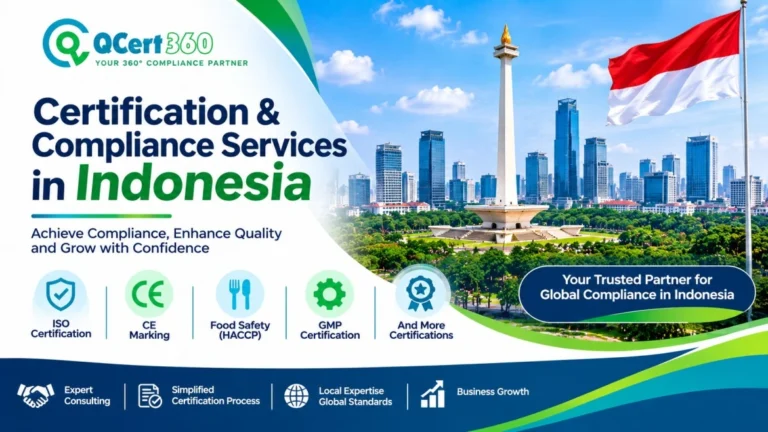
Certification & Compliance Services in Indonesia
Doing business in Indonesia means working within a detailed system of national laws, sector regulations and technical standards. Compliance certification in Indonesia is the structured process of proving that your organization meets those requirements, through document review, facility inspection, product testing and ongoing monitoring. Done well, it keeps operations legal, protects consumers and opens doors to larger customers and export markets.
The compliance landscape is shared among several agencies, each overseeing its own territory. Food and drugs sit with BPOM, standards with BSN, halal assurance with BPJPH, financial services with OJK and Bank Indonesia, and digital services with the Ministry of Communication and Digital Affairs (Komdigi). The most widely recognized credentials include SNI (Standar Nasional Indonesia), BPOM registration, halal certification and ISO management system certification. Audit and certification services in Indonesia help companies show conformity, manage risk and work more efficiently.
QCert360 supports organizations in Indonesia with practical, standards-based guidance: gap analysis, documentation, internal audits and audit readiness for ISO 9001, ISO 14001, ISO 45001, ISO/IEC 27001, ISO 22000, ISO 13485 and related schemes. Final certification is issued by accredited certification bodies, and our job is to make sure you arrive at that audit prepared, organized and confident.
Indonesia-Focused Compliance & Certification Services
- ISO 9001:2015 quality management system
- ISO 14001:2015 environmental management system
- ISO 45001:2018 occupational health and safety, aligned with SMK3
- ISO/IEC 27001:2022 information security management
- ISO/IEC 27701 privacy information management
- ISO/IEC 42001 artificial intelligence management system
- ISO 22000, HACCP and GMP food and pharmaceutical safety
- ISO 13485 medical devices
- SNI, halal and BPOM readiness for products sold in Indonesia
- CE marking, SOC 2 and GDPR readiness for exporters and technology providers
Why Is Compliance Critical for Businesses in Indonesia?
Every company in Indonesia must follow rules on taxation, worker rights, environmental protection and industry-specific licensing. Proper compliance certification protects a business from serious consequences. Non-compliance can lead to administrative sanctions, fines, licence revocation, product withdrawal, reputational damage and, in serious cases, criminal liability for company leaders.
Enforcement has also become more demanding. Since the Job Creation Law (Law No. 6 of 2023) reshaped licensing into the risk-based OSS-RBA system, businesses must hold a Business Identification Number (NIB) and the permits that match their risk level, and then keep their compliance current. Authorities expect transparency, documentation and verifiable evidence rather than promises.
Compliance also supports credibility and market acceptance. Independent certification shows regulators, customers and partners that your controls are documented, tested and effective. Certified organizations can use that evidence to enter new markets, win tenders, meet buyer requirements and build lasting stakeholder confidence. In a market as large and diverse as Indonesia’s, it becomes a competitive advantage.
Key Regulatory Bodies and Accreditation Authorities in Indonesia
Several institutions monitor and enforce compliance, so knowing who regulates what saves time and avoids errors.
- National Standardization Agency (BSN) – Develops and manages SNI standards and the national standardization system under Law No. 20 of 2014 on Standardization and Conformity Assessment.
- National Accreditation Committee (KAN) – Operating under BSN, KAN accredits certification bodies, inspection bodies and laboratories against international standards such as ISO/IEC 17021-1, ISO/IEC 17065 and ISO/IEC 17025.
- Financial Services Authority (OJK) – Supervises banks, insurers, capital markets and fintech under the P2SK Law (Law No. 4 of 2023) and OJK regulations (POJK), including IT risk management rules for banks.
- Bank Indonesia (BI) – Regulates payment systems, monetary policy and payment service providers.
- Ministry of Investment and Downstream Industry / BKPM – Oversees foreign and domestic investment and the OSS-RBA licensing platform.
- Ministry of Trade and Ministry of Industry – Handle trade licensing, import and export rules, SNI enforcement and local content (TKDN) requirements.
- National Agency of Drug and Food Control (BPOM) – Registers and supervises food, drugs, cosmetics and traditional medicine.
- Halal Product Assurance Agency (BPJPH) – Under the Ministry of Religious Affairs, administers mandatory halal certification under Law No. 33 of 2014 on Halal Product Assurance, working with LPH halal inspection bodies and MUI fatwa processes.
- Ministry of Environment – Sets environmental standards, issues approvals and monitors pollution control under Law No. 32 of 2009 on Environmental Protection and Management.
- Ministry of Manpower – Oversees labor standards and occupational safety, including SMK3.
- Ministry of Communication and Digital Affairs (Komdigi) and BSSN – Komdigi (formerly Kominfo) governs digital services, electronic system operator registration and telecom device approval, while the National Cyber and Crypto Agency (BSSN) leads cybersecurity policy.
Common Compliance Challenges for Businesses in Indonesia
Companies in Indonesia often encounter the same obstacles, and understanding them early makes certification smoother.
- Complex and Changing Regulation – Laws, government regulations (PP), ministerial regulations and circulars change frequently, and overlap between national and regional rules can confuse even experienced teams.
- Tax Compliance – Layered national and regional taxes, e-filing and e-invoicing demand accurate records and local expertise.
- Labor Law Requirements – The Manpower Law (Law No. 13 of 2003) as amended by the Job Creation Law, together with BPJS social security obligations, requires careful documentation.
- Environmental Obligations – Manufacturing and resource companies must complete AMDAL or UKL-UPL environmental approvals and keep up with monitoring and reporting.
- Licensing and Permits – Obtaining and maintaining NIB, sector licences and product registrations involves multiple agencies and systems.
- Data Protection – Personal data and electronic system duties are evolving quickly, with new implementing rules arriving.
Understanding Major Compliance Standards in Indonesia
The following frameworks form the backbone of compliance in Indonesia:
- Company and Investment Law – Law No. 40 of 2007 on Limited Liability Companies, the Investment Law and the Job Creation Law, which together govern incorporation, licensing and governance.
- Environmental Management – ISO 14001 alignment, AMDAL and UKL-UPL assessments, and permits under the environmental protection framework.
- Occupational Health and Safety – Law No. 1 of 1970 on Work Safety and Government Regulation No. 50 of 2012 on the OHS Management System (SMK3), which complement ISO 45001.
- Data Protection and Privacy – Law No. 27 of 2022 on Personal Data Protection (UU PDP), fully in force since October 2024, and Government Regulation No. 33 of 2026, which implements it and takes effect on 16 January 2027. The ITE Law (Law No. 11 of 2008, as amended, including by Law No. 1 of 2024) and Government Regulation No. 71 of 2019 on electronic systems and transactions remain central, and the PDP Authority is still to be established.
- Financial Reporting – Indonesian Financial Accounting Standards (PSAK) with regular statutory audits.
- Product and Food Standards – SNI, the Food Law (Law No. 18 of 2012), BPOM registration, halal certification and consumer protection under Law No. 8 of 1999.
- Industry-Specific Permits – For example, telecommunications equipment approval through Komdigi, banking licences through OJK and medical device distribution licences through the Ministry of Health.
Because rules are updated regularly, requirements should be reviewed with qualified Indonesian counsel before decisions are made.
How QCert360 Makes a Difference in Compliance for Business in Indonesia
Many organizations find the combination of local law, SNI and international standards hard to navigate. QCert360 simplifies it. We help clients plan and implement ISO 9001, ISO 14001, ISO 45001, ISO/IEC 27001, ISO/IEC 27701, ISO 22000, ISO 13485 and related management systems, then guide them through documentation, internal audits, management review and audit readiness so the formal certification audit runs smoothly.
We do not apply a one-size-fits-all template. Our consultants map your sector, size and goals against Indonesian requirements, including SNI, BPOM, halal, OSS-RBA permits, AMDAL, SMK3 and UU PDP, and against the expectations of international buyers. Work is structured around defined audit criteria, documented evidence and verifiable results, so your organization can demonstrate conformity with confidence. Training, advisory support and regular check-ins keep your teams engaged long after the audit.
The outcome is practical: stronger controls, fewer surprises, and certification that supports access to regulators, customers and partners in Indonesia and beyond.
Industries in Indonesia That Benefit Most from Compliance
- Financial Services and Fintech – Banks, insurers and payment providers in Jakarta face OJK and Bank Indonesia oversight and benefit from ISO/IEC 27001 and strong data governance.
- Manufacturing – Exporters around Bekasi, Tangerang, Surabaya, Semarang and Batam use ISO 9001, SNI and sector certifications to reach global supply chains.
- Healthcare and Pharmaceuticals – Patient safety depends on BPOM rules, GMP and ISO 13485 for medical devices.
- Food and Beverage – Producers need HACCP, ISO 22000, BPOM registration and halal certification to protect consumers and avoid costly recalls.
- Mining, Energy and Natural Resources – Operators must meet environmental approvals, safety systems and community standards, often supported by ISO 14001 and ISO 45001.
- Technology, Data Centers and E-Commerce – Digital businesses need ISO/IEC 27001, ISO/IEC 27701, SOC 2 and PDP compliance to earn customer trust.
- Tourism and Hospitality – Operators in Bali and other destinations strengthen safety and service quality through recognized certification.
Emerging Compliance Trends in Indonesia for 2027
Indonesia continues to modernize its business rules, so planning ahead matters.
- PDP Implementation – Government Regulation No. 33 of 2026 adds detailed duties on data governance, accountability and audits, with a compliance deadline of 16 January 2027.
- Data Authority and Cross-Border Transfers – The long-awaited PDP supervisory authority and tighter rules on transferring personal data abroad are still taking shape.
- AI Governance – A national AI roadmap and related regulation are under development, making ISO/IEC 42001 attractive for organizations that want to evidence responsible AI use.
- Mandatory Halal Expansion – Halal certification obligations are being phased in across more product categories.
- Sustainability and ESG Reporting – Buyers, lenders and regulators increasingly expect environmental and social disclosures.
- Digital Tax and Licensing – More reporting and permit processes are moving onto digital platforms, increasing transparency.
- Regional Alignment – Standards and practices continue to align with ASEAN neighbors.
Stages of Compliance Certification in Indonesia
- Identify Applicable Requirements. Confirm which Indonesian laws, SNI standards and international frameworks apply to your industry, data types and operations.
- Assess Current Conformity. Run a gap analysis comparing existing controls with the requirements.
- Establish Documented Policies. Define clear policies and procedures for quality, security, privacy, safety and environmental practices. These form the baseline of audit evidence.
- Implement Controls. Deploy technical and organizational controls that address identified risks, and keep records that demonstrate they work.
- Build Compliance Awareness. Train employees so everyone understands their role. Training records also serve as evidence.
- Perform Internal Audits and Management Review. Find and close gaps before the external certification audit.
- Undergo the Certification Audit. An accredited certification body evaluates conformity against the standard and issues a decision based on audit results.
- Maintain Compliance. Update policies when laws or standards change, and prepare for surveillance and recertification audits.
QCert360: A Win-Win Compliance Partner for Expanding Your Business in Indonesia
Entering or growing in Indonesia is a major opportunity, and understanding local expectations is the main hurdle. QCert360 gives you clear, practical support so you meet legal and industry requirements whether you are setting up your first entity in Jakarta or scaling plants across Java and Sumatra.
Our services cover ISO management systems, internal audits, privacy and security readiness, environmental and safety programs, and product conformity guidance across finance, healthcare, manufacturing, food, energy and technology. We follow regulatory changes closely so sudden updates do not derail your plans.
Compliance becomes an advantage when it is handled well: fewer penalties, smoother approvals, stronger customer trust. To learn how QCert360 can help you achieve compliance certification in Indonesia, get in touch today.
Frequently Asked Questions About Certification & Compliance in Indonesia
- What is compliance certification in Indonesia?
Compliance certification in Indonesia is an independent verification that an organization meets the legal, regulatory and standards requirements that apply to it. It typically involves document review, facility inspection, product testing and monitoring, and it supports market access, risk management and stakeholder trust.
- Which certifications are most common for businesses in Indonesia?
The most common are SNI (Standar Nasional Indonesia) product certification, BPOM registration for food, drugs and cosmetics, halal certification through BPJPH, and ISO management system certifications such as ISO 9001, ISO 14001, ISO 45001 and ISO/IEC 27001.
- Is ISO certification mandatory in Indonesia?
ISO certification is generally voluntary, but customers, tenders and some regulators expect it. Certain products and sectors, however, must meet mandatory requirements such as SNI, BPOM, halal or sector licences. Check which obligations apply to your products and industry.
- What is SNI and who needs it?
SNI is Indonesia’s national standard, developed and managed by the National Standardization Agency (BSN). Some products must carry SNI marking under mandatory technical regulations set by the relevant ministry, while many others use SNI voluntarily to show quality and win buyer confidence.
- Who accredits certification bodies in Indonesia?
The National Accreditation Committee (KAN), operating under BSN, accredits certification bodies, inspection bodies and laboratories against international standards such as ISO/IEC 17021-1, ISO/IEC 17065 and ISO/IEC 17025. Always confirm a certification body’s accreditation scope before engaging it.
- Is halal certification mandatory in Indonesia?
Halal certification is mandatory for a growing range of products under Law No. 33 of 2014 on Halal Product Assurance, administered by BPJPH and phased in by product category. Requirements differ for domestic and imported products, so confirm the current deadline for your category.
- What is BPOM approval, and when is it needed?
BPOM, the National Agency of Drug and Food Control, registers and supervises food, drugs, cosmetics and traditional medicine. Products in these categories generally need a BPOM distribution permit before they can be marketed in Indonesia.
- How does Indonesia’s Personal Data Protection Law affect my business?
Law No. 27 of 2022 (UU PDP) applies to organizations that process personal data of individuals in Indonesia, and it is fully in force. Government Regulation No. 33 of 2026 adds detailed implementing duties and takes effect on 16 January 2027. The PDP supervisory authority had not yet been established at the time of writing.
- Does ISO/IEC 27001 satisfy Indonesian data protection requirements?
No. ISO/IEC 27001 strengthens security controls and supports compliance, but it does not replace legal obligations under UU PDP, the ITE Law or Government Regulation No. 71 of 2019. Many organizations combine it with ISO/IEC 27701 to manage privacy more systematically.
- What are OSS-RBA and NIB?
OSS-RBA is Indonesia’s Online Single Submission system with a risk-based approach to business licensing, and NIB is the Business Identification Number issued through it. Together they determine which permits and licences a business needs according to its risk level.
- What environmental approvals do Indonesian companies need?
Depending on the scale and impact of the activity, companies typically need AMDAL (full environmental impact assessment) or UKL-UPL (environmental management and monitoring efforts), plus the related environmental approval and sector permits. ISO 14001 helps manage these obligations continuously.
- What is SMK3, and how does it relate to ISO 45001?
SMK3 is Indonesia’s mandatory occupational health and safety management system framework for certain companies, based on Government Regulation No. 50 of 2012. ISO 45001 is an international standard covering similar ground, and many organizations align the two to avoid duplicate effort.
- How long does certification take in Indonesia?
Timelines depend on the standard, organization size, existing maturity and audit scheduling. A well-prepared small or medium organization may take a few months for an ISO management system, while product registrations such as BPOM or halal follow agency timelines. A gap analysis gives a realistic estimate.
- What is the difference between certification and consulting?
Consulting helps you build, implement and prepare your management system. Certification is an independent audit by an accredited certification body that confirms conformity and issues the certificate. Impartiality rules keep the two separate. QCert360 provides the consulting and audit-readiness support.
- How can QCert360 help my business get certified in Indonesia?
QCert360 guides you through requirement mapping, gap analysis, documentation, staff training, internal audits and management review, so you arrive at your certification audit prepared. We support ISO 9001, 14001, 45001, 27001, 27701, 22000, 13485 and related schemes, and we help you align them with Indonesian regulations.
Our Services
ISO Standards
- ISO 9001 Certification
- ISO 14001 Certification
- ISO 45001 Certification
- ISO 22000 Certification
- ISO 17025 Certification
- ISO 27001 Certification
- ISO 13485 Certification
- ISO 20000-1 Certification
- ISO 41001 Certification
- ISO 22716 Certification
- ISO 50001 Certification
- ISO 22301 Certification
- ISO 29993 Certification
Product Certifications
Other international standards
- FSSC 22000 Certification
- HIPAA
- HACCP Certification
- SA 8000 Certification
- GMP Certification
- GDPR
- GDP Certification
- GLP Certification
- Certificate of Conformity
QCert360 provides a wide range of services including ISO certification, audit support, compliance consulting, and training. They specialize in helping businesses achieve global standards and certifications like ISO 9001, ISO 27001, ISO 14001, and many others. Their team ensures a seamless experience from consultation to certification, supporting clients at every stage.
The time it takes to achieve certification can vary depending on the complexity of the standard and the readiness of your organization. On average, it takes about 3 to 6 months. QCert360 works closely with clients to streamline the process, ensuring that all requirements are met efficiently and within a reasonable timeline.
QCert360 is a trusted partner with years of experience in helping businesses obtain international certifications. Their expert consultants provide tailored solutions, ensuring your organization not only meets but exceeds industry standards. With a customer-centric approach, they focus on offering end-to-end support to simplify the certification journey.
QCert360 serves a wide range of industries including manufacturing, healthcare, information technology, education, and services, among others. They customize their certification solutions to meet the unique requirements of each industry, ensuring relevance and compliance with global standards.
Yes, QCert360 provides ongoing support even after certification. They offer services like surveillance audits, recertification guidance, and consultancy to help maintain and improve your certification status. Their team ensures that your organization stays compliant and up-to-date with any changes in certification standards.
Getting started with QCert360 is simple. You can contact them via their website to request a consultation. Their team will assess your needs, discuss the best certification options for your business, and outline the steps involved. From there, they’ll guide you through the entire process, ensuring you’re prepared for certification.
QCert360 stands out due to its customer-focused approach, industry expertise, and comprehensive service offerings. Their team doesn’t just help you obtain certification but works to ensure your organization thrives in compliance with international standards. They also offer personalized consultation, making the process smoother and more efficient, ensuring long-term success for your business.
The cost of certification varies depending on factors such as the type of certification, the size and complexity of your organization, and the specific industry requirements. QCert360 offers competitive pricing and provides tailored quotes based on your unique needs. They ensure transparency and work with you to find the most cost-effective solution for your certification goals.
Yes, QCert360 offers internal audit services to help assess and improve your organization’s processes. Their expert auditors conduct thorough reviews of your systems and operations to ensure they meet required standards. They also provide actionable recommendations to help enhance efficiency and compliance, making sure you’re fully prepared for external audits.
If your organization doesn’t pass an audit or certification assessment, QCert360 works with you to understand the reasons for non-compliance and provides support to rectify the issues. They offer guidance on corrective actions and help you prepare for a re-assessment. Their goal is to ensure your organization meets the necessary standards for certification, and they will be by your side to make the process as smooth as possible.