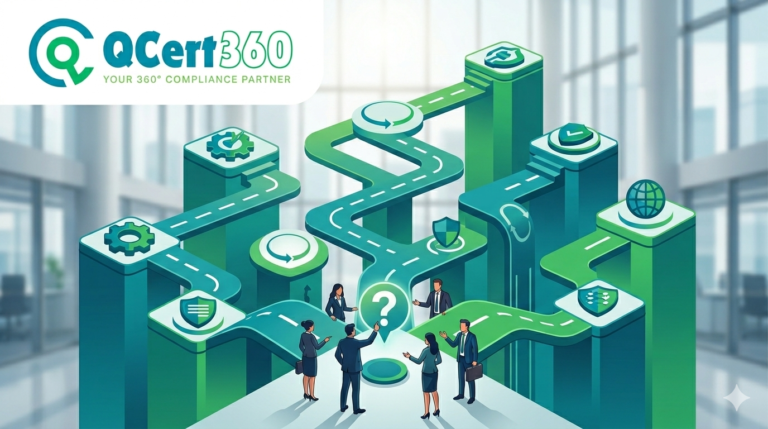
Growing companies often ask: “We know we need ISO certification — but where do we start?” The answer isn’t one-size-fits-all. It depends on your industry, your biggest risks, your clients, and your long-term business goals. This guide gives you a clear, actionable certification roadmap.
Whether you’re a SaaS startup chasing enterprise contracts, a manufacturing firm eyeing export markets, or a construction company managing contractor safety — the right ISO certification at the right time can be the single most powerful business decision you make this year.
At QCert360, we’ve helped hundreds of growing businesses build their certification roadmaps. In this guide, we break down the top ISO standards, explain exactly who needs what, and show you how to sequence your certifications for maximum ROI.
Why a Certification Roadmap Matters for Growing Companies
Most growing businesses don’t have the budget, time, or internal resources to pursue every ISO standard at once. A strategic certification roadmap lets you:
Unlock specific contracts, markets, and tenders that require certification
Build management system foundations that scale as you grow
Avoid costly rework by sequencing certifications in the right order
Demonstrate credibility to investors, enterprise clients, and regulators
Reduce risk exposure — operational, legal, financial, and reputational
ISO certifications are not just compliance exercises. They are competitive advantages. Companies with ISO 9001 certification consistently win more contracts. Organizations with ISO 27001 certification close enterprise SaaS deals faster. The question is: which one moves the needle first for your specific business?
KEY INSIGHT Companies that pursue certifications strategically — in the right order, at the right business stage — achieve certification 40% faster and with 30% lower consulting costs than those that approach it reactively. |
The Top 4 ISO Standards for Growing Businesses
These four ISO standards cover the most critical business functions and are the most commonly required by procurement teams, regulators, and enterprise clients worldwide.
ISO 9001:2015 — Quality Management System (QMS) | |
What it is: The world’s most recognized quality management standard. ISO 9001 helps organizations consistently deliver products and services that meet customer and regulatory requirements. Who needs it most: Manufacturing, construction, engineering, professional services, logistics, healthcare supply chain — any business where consistent quality is critical. Business impact: ISO 9001 certified companies report higher customer satisfaction, fewer defects, more efficient operations, and significantly improved chances of winning government tenders. | |
ISO 27001:2022 — Information Security Management System (ISMS) | |
What it is: The global gold standard for information security management. Establishes a framework for protecting sensitive data, managing cyber risk, and demonstrating security governance. Who needs it most: SaaS companies, IT services firms, fintech, healthcare technology, legal services, cloud providers, and any business handling sensitive client data or intellectual property. Business impact: Now a hard requirement for enterprise SaaS sales cycles. Dramatically accelerates security questionnaire responses and signals mature security culture to investors during due diligence. | |
OH&S MANAGEMENT ISO 45001:2018 — Occupational Health & Safety Management System (OHSMS) | |
What it is: The international standard for occupational health and safety. Provides a framework for proactively identifying and eliminating workplace hazards and reducing injuries. Who needs it most: Construction, mining, oil & gas, manufacturing, utilities, transportation, and any business with significant physical workplace risk. Critical for government infrastructure tendering. Business impact: Reduces workplace incident rates, lowers workers’ compensation costs, satisfies safety prequalification requirements, and protects from regulatory enforcement action. | |
ENVIRONMENTAL MANAGEMENT ISO 14001:2015 — Environmental Management System (EMS) | |
What it is: Establishes a framework for organizations to systematically manage environmental responsibilities — reducing waste, energy consumption, emissions, and environmental compliance risk. Who needs it most: Manufacturing, chemicals, food & beverage, construction, waste management, logistics, and any business facing environmental scrutiny or supplying ESG-focused multinationals. Business impact: Satisfies environmental prequalification in tenders, demonstrates ESG commitment to investors, reduces regulatory risk, and often delivers cost savings through resource efficiency. | |
Which ISO Certification Should You Get First?
The right first certification depends on three critical factors: what your clients and contracts demand, what risks your business faces most immediately, and what your operational maturity looks like today.
Your Situation | Recommended First Cert | Standard |
Selling to enterprise clients requiring security assessments | ISO 27001 | Information Security |
Bidding on government, construction, or manufacturing tenders | ISO 9001 | Quality Management |
Operating in construction, mining, oil & gas, or high-risk environments | ISO 45001 | OH&S Management |
SaaS, IT, or data services company scaling sales | ISO 27001 | Information Security |
Supplying to multinationals with ESG supplier requirements | ISO 14001 | Environmental Management |
No certifications — want the best foundation to build on | ISO 9001 | Quality Management |
Professional services firm (consulting, legal, accounting) | ISO 9001 or ISO 27001 | Quality + Security |
Regulated industry (healthcare tech, fintech, legal) | ISO 27001 | Information Security |
PRO TIP FROM QCERT360 If you’re unsure, ISO 9001 is almost always the right place to start. It builds the operational foundation — documented processes, risk management, internal auditing, and management review — that makes every subsequent certification faster, cheaper, and more effective. |
How to Sequence Multiple ISO Certifications
Smart companies don’t stop at one certification. They build an integrated management system (IMS) that combines multiple ISO standards — sharing documentation, audit cycles, and management reviews. Here’s the optimal sequencing:
1 | ISO 9001 — Establish the Foundation Build your quality management system, documented processes, and internal audit capability. This creates the infrastructure all other certifications will plug into. Timeline: 3-6 months for most growing businesses. |
2 | ISO 45001 or ISO 14001 — Expand the Management System Add occupational safety (if you have physical workplace risk) or environmental management (if required by clients or regulators). Both use the same Annex SL structure as ISO 9001, so integration is efficient. Timeline: 2-4 additional months. |
3 | ISO 27001 — Lock in Security Credibility Build your information security management system. If you’re a tech or data-driven company, you may want this earlier or even first. Timeline: 4-8 months depending on organizational complexity. |
4 | Integrated Management System (IMS) — Unified Audit Program Combine all certifications into a single integrated audit schedule, shared management review, and unified documentation framework. Reduces ongoing compliance burden by 40-60%. QCert360 specializes in IMS design. |
The key advantage of sequencing is shared structure. ISO 9001, ISO 14001, and ISO 45001 all follow the same Annex SL framework — meaning core management system elements are written once and reused across all three standards.
Looking to combine multiple standards under one audit? Explore QCert360’s Integrated Management System (IMS) services to see how we help growing companies achieve multi-standard certification efficiently.
Industry-by-Industry Certification Recommendations
Technology & SaaS Companies
Start with ISO 27001. Enterprise customers will ask for it. Investors will reward it. Your security team will thank you. Once ISO 27001 is in place, consider ISO 9001 to formalize your development and delivery processes.
ISO 27001 for Technology Companies — QCert360 →
Manufacturing & Engineering Firms
ISO 9001 is your essential first step — it’s required by most OEM supply chains, automotive, aerospace, and industrial clients. Follow it with ISO 14001 if you face environmental regulatory pressure, and ISO 45001 if you have significant workplace safety risk.
Construction & Infrastructure
The construction industry has a unique triple requirement: quality, safety, and environment. The optimal sequence is ISO 9001 → ISO 45001 → ISO 14001, often needed simultaneously for major government or infrastructure contracts.
Construction Industry Certification Services — QCert360 →
Professional Services (Consulting, Legal, Accounting)
ISO 9001 demonstrates service quality and process consistency. ISO 27001 addresses the data protection concerns that clients increasingly require. Start with whichever your largest clients are actively asking for.
Healthcare & Life Sciences
ISO 9001 (adapted via ISO 13485 for medical devices) and ISO 27001 are most common. Contact QCert360 for healthcare-specific certification advice.
Food & Beverage / FMCG
ISO 9001 provides the quality foundation, often combined with HACCP/ISO 22000 for food safety. ISO 14001 is increasingly required by supermarket chains and export markets.
Frequently Asked Questions: ISO Certification Roadmaps
How long does ISO certification take for a growing company?
For most growing businesses with 10-200 employees, ISO 9001 certification takes 3-6 months. ISO 27001 typically takes 4-9 months. ISO 45001 and ISO 14001 generally take 3-6 months. With QCert360’s structured consulting approach, many clients achieve certification 30-40% faster than industry averages.
Can we pursue two ISO certifications at the same time?
Yes — and it can be cost-efficient, especially for ISO 9001, ISO 14001, and ISO 45001, which share the same Annex SL structure. However, pursuing ISO 27001 simultaneously with another standard requires significant internal resource commitment.
What’s the cost of ISO certification for a small or growing business?
Certification costs vary by company size, complexity, and readiness. Use QCert360’s free Certification Cost Estimator to get a tailored cost estimate for your business.
Do we need to hire a full-time compliance manager?
Not necessarily. Many growing businesses manage ongoing ISO compliance with part-time internal resources supported by a specialist consultant. QCert360 offers ongoing surveillance support services so you don’t need to build an entire compliance team in-house.
Which ISO certification is most recognized internationally?
ISO 9001 holds the broadest global recognition — over one million organizations in 170+ countries are certified. ISO 27001 has the fastest-growing adoption globally, particularly in technology, finance, and regulated industries.
Can QCert360 help us build a multi-certification roadmap from scratch?
Absolutely. Book a free 30-minute Certification Roadmap Consultation with our specialists. We’ll assess your industry, existing processes, client requirements, and growth goals to design a custom certification roadmap that maximizes your return on investment.
The Bottom Line: Start Strategic, Not Reactive
The most successful growing companies don’t certify reactively — scrambling to get certified when they lose a contract because of it. They certify strategically, building management systems that become durable competitive advantages as they scale.
The right ISO certification roadmap considers where you are today, where your biggest opportunities and risks lie, and what your clients and markets will require tomorrow. Get that sequence right, and each certification you earn accelerates your path to the next one.
QCert360 specializes in helping growing businesses build exactly this kind of strategic certification roadmap — from your first certification through to a fully integrated multi-standard management system.
Our Services
ISO Standards
- ISO 9001 Certification
- ISO 14001 Certification
- ISO 45001 Certification
- ISO 22000 Certification
- ISO 17025 Certification
- ISO 27001 Certification
- ISO 13485 Certification
- ISO 20000-1 Certification
- ISO 41001 Certification
- ISO 22716 Certification
- ISO 50001 Certification
- ISO 22301 Certification
- ISO 29993 Certification
Product Certifications
Other international standards
- FSSC 22000 Certification
- HIPAA
- HACCP Certification
- SA 8000 Certification
- GMP Certification
- GDPR
- GDP Certification
- GLP Certification
- Certificate of Conformity
QCert360 provides a wide range of services including ISO certification, audit support, compliance consulting, and training. They specialize in helping businesses achieve global standards and certifications like ISO 9001, ISO 27001, ISO 14001, and many others. Their team ensures a seamless experience from consultation to certification, supporting clients at every stage.
The time it takes to achieve certification can vary depending on the complexity of the standard and the readiness of your organization. On average, it takes about 3 to 6 months. QCert360 works closely with clients to streamline the process, ensuring that all requirements are met efficiently and within a reasonable timeline.
QCert360 is a trusted partner with years of experience in helping businesses obtain international certifications. Their expert consultants provide tailored solutions, ensuring your organization not only meets but exceeds industry standards. With a customer-centric approach, they focus on offering end-to-end support to simplify the certification journey.
QCert360 serves a wide range of industries including manufacturing, healthcare, information technology, education, and services, among others. They customize their certification solutions to meet the unique requirements of each industry, ensuring relevance and compliance with global standards.
Yes, QCert360 provides ongoing support even after certification. They offer services like surveillance audits, recertification guidance, and consultancy to help maintain and improve your certification status. Their team ensures that your organization stays compliant and up-to-date with any changes in certification standards.
Getting started with QCert360 is simple. You can contact them via their website to request a consultation. Their team will assess your needs, discuss the best certification options for your business, and outline the steps involved. From there, they’ll guide you through the entire process, ensuring you’re prepared for certification.
QCert360 stands out due to its customer-focused approach, industry expertise, and comprehensive service offerings. Their team doesn’t just help you obtain certification but works to ensure your organization thrives in compliance with international standards. They also offer personalized consultation, making the process smoother and more efficient, ensuring long-term success for your business.
The cost of certification varies depending on factors such as the type of certification, the size and complexity of your organization, and the specific industry requirements. QCert360 offers competitive pricing and provides tailored quotes based on your unique needs. They ensure transparency and work with you to find the most cost-effective solution for your certification goals.
Yes, QCert360 offers internal audit services to help assess and improve your organization’s processes. Their expert auditors conduct thorough reviews of your systems and operations to ensure they meet required standards. They also provide actionable recommendations to help enhance efficiency and compliance, making sure you’re fully prepared for external audits.
If your organization doesn’t pass an audit or certification assessment, QCert360 works with you to understand the reasons for non-compliance and provides support to rectify the issues. They offer guidance on corrective actions and help you prepare for a re-assessment. Their goal is to ensure your organization meets the necessary standards for certification, and they will be by your side to make the process as smooth as possible.