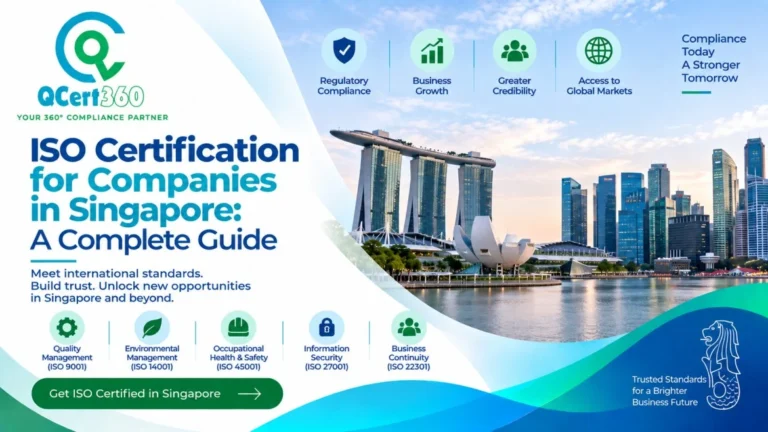
ISO Certification for Companies in Singapore: A complete guide for Businesses
Singapore built its economy on trust: trust that a shipment clears on time, that a bank’s systems hold, that a factory in Jurong meets the same standard as one in Rotterdam. That trust is not assumed. It is audited, documented and renewed every year. ISO certification for companies in Singapore is how local firms turn good practice into evidence that regulators, buyers and government tender panels can independently verify.
If you are looking to get ISO 9001 certified in Singapore, get ISO 27001 certified in Singapore, or need ISO certification services in Singapore for any other standard, this page explains which standards matter most here, how Singapore’s accreditation system works, what auditors expect, what certification costs and which market trends make it timely.
Which ISO Standards Matter Most for the businesses in Singapore?
ISO 9001 is the most widely held standard across Singapore’s manufacturing, logistics, finance and services sectors, often required for government tender eligibility. ISO/IEC 27001 is growing fastest in finance, fintech and IT, driven by the volume of personal and payment data these sectors handle under the Personal Data Protection Act (PDPA). ISO 14001 and ISO 45001 matter most in the industrial hubs of Jurong, Tuas and Woodlands, where the National Environment Agency (NEA) and the Ministry of Manpower (MOM) actively promote both standards. ISO 22000 and ISO 13485 serve food exporters and medical device makers respectively. Certificates come from bodies accredited by the Singapore Accreditation Council (SAC) under Enterprise Singapore, or by another International Accreditation Forum (IAF) member, and stay valid for three years with annual surveillance.
What Is ISO Certification for Companies in Singapore?
ISO certification in Singapore is independent proof that your company’s management system meets an internationally recognized standard. An accredited auditor checks that your documented procedures, controls and records match what actually happens on your factory floor, in your office, or in your server room, and issues a certificate once conformity is confirmed.
Certification is not a government license, and it is not mandatory under Singapore law for most sectors. Is ISO certification mandatory in Singapore? Generally no, but it functions as a practical requirement in several situations:
- Bidding for government tenders through GeBIZ, where technical evaluation criteria often score ISO 9001, ISO 14001, ISO 45001 or ISO/IEC 27001 certification
- Supplying multinational buyers in electronics, semiconductors or pharmaceuticals who require certified suppliers
- Winning construction and facilities contracts, where bizSAFE and ISO 45001 both signal safety maturity
- Serving finance, fintech or healthcare clients who expect audited information security or quality controls
ISO certification for SMEs and MNCs operating in Singapore applies at every scale, from a five-person fintech in the central business district to a multi-plant semiconductor group spanning Tuas and Woodlands.
Why Businesses in Singapore need ISO Certification
Singapore runs an export-oriented, services-heavy economy, and both halves of that description explain the demand for certification. Services contribute roughly three-quarters of GDP, spanning finance, IT, logistics and professional services, while manufacturing, concentrated in electronics, semiconductors, chemicals and pharmaceuticals, remains a substantial share of output and export value. Both sides face constant scrutiny from regulators, overseas buyers and increasingly sustainability-focused investors.
Common pressures ISO standards address here:
- Meeting technical evaluation criteria in public-sector tenders
- Satisfying supply chain audits from multinational electronics and pharma buyers
- Protecting customer and payment data under the PDPA
- Managing workplace safety obligations under the Workplace Safety and Health Act
- Controlling environmental impact in industrial park operations regulated by NEA
- Competing for contracts against better-resourced multinational competitors
- Supporting expansion into ASEAN, EU, US and Middle East markets that expect certified suppliers
Singapore's Accreditation System: Who Stands Behind Your Certificate
How does ISO accreditation work in Singapore? The Singapore Accreditation Council (SAC), operating under Enterprise Singapore, is the national accreditation body. SAC does not certify companies directly. Instead, it accredits the certification bodies, testing laboratories and inspection bodies that audit and certify companies, checking that they operate competently and impartially against standards such as ISO/IEC 17021-1 for management system certification bodies.
What does SAC-SINGLAS accreditation mean? SINGLAS is SAC’s scheme specifically for testing and calibration laboratories, accredited against ISO/IEC 17025. A SAC-SINGLAS accredited calibration certificate is recognized under the ILAC Mutual Recognition Arrangement across more than a hundred economies, which matters if your ISO 9001 system depends on calibrated equipment for exported products.
How do I choose an accredited ISO certification body in Singapore? Confirm the body holds SAC accreditation, or accreditation from another IAF member body if it is based overseas. You can verify any certificate through IAF CertSearch, the global database for accredited management system certifications. A certificate from a body without recognized accreditation may not be accepted by government tender panels, overseas regulators or multinational buyers, so this check comes before price or scheduling in your selection process.
Which ISO Standards Do Companies in Singapore Need?
Most companies start with ISO 9001, then add standards matched to their sector and buyer demands. The table summarizes ISO standards for businesses in Singapore.
Standard | Focus | Where it matters most in Singapore | Certifiable? |
All sectors, especially manufacturing, logistics, construction | Yes | ||
ISO/IEC 27001 | Information security management | Finance, fintech, IT, telecom | Yes |
ISO 14001 | Environmental management system | Manufacturing, agro-processing, industrial parks | Yes |
ISO 45001 | Occupational health and safety | Construction, marine, oil and gas, manufacturing | Yes |
ISO 22000 | Food safety management system | Food processing, seafood export, nutraceuticals | Yes |
ISO 13485 | Medical device quality management | Medical device manufacturing and distribution | Yes |
Energy management | Electronics, chemicals, energy-intensive plants | Yes | |
Business continuity management | Banking, critical infrastructure, data centers | Yes | |
ISO/IEC 20000-1 | IT service management | Managed IT and cloud service providers | Yes |
ISO 31000 | Risk management guidance | Structured risk thinking across all sectors | No, guidance only |
How ISO Standards Map to Singapore's Economy
Singapore’s compact geography puts most industries within a short drive of each other, but each cluster faces different regulatory and buyer pressure.
Sector or hub | Main pressures | Lead standards |
Jurong and Tuas (petrochemicals, electronics) | Environmental compliance, worker safety, export quality | ISO 14001, ISO 45001, ISO 9001 |
Central business district and Marina Bay (finance) | Data protection, business continuity, audit trails | ISO/IEC 27001, ISO 22301, ISO 9001 |
One-north and Biopolis (biomedical, tech) | Device quality, IP protection, R&D data security | ISO 13485, ISO/IEC 27001 |
Woodlands and Sembawang (manufacturing) | Quality consistency, environmental control | ISO 9001, ISO 14001 |
Changi and logistics corridors | Continuity, traceability, security | ISO 9001, ISO 22301, ISO 28000 |
Food processing zones | Contamination control, export certification | ISO 22000, ISO 9001 |
Use this map to prioritize standards that match your sector’s actual pressure points rather than pursuing every certificate available.
ISO 9001 in Singapore: The Baseline Standard
ISO 9001 remains the most widely adopted standard across Singapore, cutting across manufacturing, electronics, pharmaceuticals, construction, logistics, finance and IT services. It sets requirements for a quality management system built around customer focus, process control and continual improvement.
Why do companies in Singapore need ISO 9001 certification? Beyond the operational gains, it is frequently a scoring criterion in GeBIZ government tenders and a baseline expectation from multinational buyers auditing suppliers in Jurong’s industrial parks. For Singapore-based exporters, ISO 9001 also reduces the number of separate quality audits that ASEAN, EU and US buyers would otherwise conduct independently.
ISO 9001 for manufacturing and service companies in Singapore covers:
- Design control where applicable, procurement and supplier evaluation
- Production planning, in-process inspection and testing
- Calibration of equipment, often tied to SAC-SINGLAS accredited labs
- Nonconforming product control and corrective action
- Customer complaint handling and satisfaction monitoring
- Internal audits and management review
ISO/IEC 27001 in Singapore: Data Security for a Digital Economy
ISO/IEC 27001 is growing faster than almost any other standard in Singapore, driven by the scale of the finance, fintech and IT sectors concentrated in the central business district and Marina Bay. It sets requirements for an information security management system that protects data confidentiality, integrity and availability through a risk-based approach.
Why is ISO/IEC 27001 important for finance and IT companies in Singapore?
Singapore’s Personal Data Protection Act (PDPA), enforced by the Personal Data Protection Commission (PDPC), requires organizations to protect personal data they collect, use or disclose. ISO/IEC 27001 does not itself certify PDPA compliance, since certification verifies your management system rather than legal compliance directly, but a working ISMS gives you the access controls, risk assessments, incident response plans and audit trails that make demonstrating PDPA compliance far easier.
Data protection and cybersecurity requirements for Singapore businesses covered under an ISMS typically include:
- Access control for customer and payment data
- Encryption and secure data transfer
- Vendor and third-party risk assessment
- Incident detection, response and breach notification procedures
- Staff awareness training on data handling
Banks, payment service providers and IT companies serving government or financial clients increasingly treat ISO/IEC 27001 as a baseline procurement requirement rather than a differentiator.
ISO 14001 in Singapore: Environmental Management in Industrial Parks
ISO 14001 matters most where Singapore’s industrial base is concentrated: the petrochemical and electronics complexes of Jurong and Tuas, and agro-processing operations serving export markets. The standard builds an environmental management system that controls emissions, waste, water use and chemical handling.
How does ISO 14001 support environmental compliance in Singapore?
The National Environment Agency (NEA) is the statutory authority for environmental protection and actively recognizes ISO 14001 as evidence of systematic environmental management, often referencing it in guidance for organizations seeking to demonstrate sustainability commitments. NEA enforces air, water, waste and chemical handling requirements independently of ISO certification, so an EMS supports compliance rather than replacing it.
Environmental management for manufacturing and industrial companies in Singapore typically addresses:
- Air emissions from processing and combustion equipment
- Chemical storage, handling and spill response
- Wastewater treatment and discharge monitoring
- Solid and hazardous waste segregation and disposal
- Alignment with Singapore’s Green Plan 2030 sustainability targets, which many companies reference in ESG disclosures even though the plan itself is a national policy framework rather than a certifiable standard
ISO 45001 in Singapore: Workplace Safety and the bizSAFE Connection
ISO 45001 addresses occupational health and safety, and it sits alongside a distinctly Singaporean scheme worth understanding on its own terms. What is the difference between bizSAFE and ISO 45001 in Singapore? bizSAFE is a five-level workplace safety capability-building program run by the Workplace Safety and Health Council (WSHC), a statutory body under MOM, and is often a prerequisite for bidding on government construction and facilities contracts. ISO 45001 is a separate, internationally recognized management system standard, certifiable by any accredited body worldwide.
Many Singapore construction and manufacturing companies pursue both: bizSAFE Level 3 or higher to meet contractor eligibility requirements, and ISO 45001 to build a fuller, internationally portable occupational health and safety management system. The two are complementary, not interchangeable, and a company relying on bizSAFE alone should not assume it satisfies an overseas buyer asking specifically for ISO 45001.
The Workplace Safety and Health Act (WSH Act), administered by MOM, sets the legal safety obligations that apply regardless of certification status. ISO 45001 helps you organize your response to those obligations systematically: hazard identification, risk assessment, worker consultation, incident investigation and training records, particularly relevant for construction, marine, oil and gas and manufacturing operations across Jurong, Tuas and the wider industrial belt.
ISO 22000, ISO 13485 and Other Sector Standards
ISO 22000 for food processing companies in Singapore applies to seafood processors, nutraceutical manufacturers and other food exporters, combining HACCP hazard analysis with a full food safety management system. It supports compliance with the Singapore Food Agency (SFA)‘s food safety framework and eases entry into export markets that expect certified food safety systems.
ISO 13485 for medical device companies in Singapore fits manufacturers, importers and distributors of medical devices, supporting the quality documentation that the Health Sciences Authority (HSA) expects during device registration, and easing access to regional healthcare supply chains centered around one-north and Biopolis.
ISO 50001 targets energy-intensive manufacturers in electronics, chemicals and pharmaceuticals, offering a structured way to reduce electricity and fuel costs, which matters given Singapore’s dependence on imported energy. ISO 22301 suits banks, data centers and critical infrastructure operators who need documented, tested continuity plans. ISO/IEC 20000-1 fits IT and managed service providers layering service management discipline on top of ISO/IEC 27001.
Requirements of ISO Certification in Singapore
The requirements of ISO certification in Singapore follow the same structure as anywhere else, since ISO standards are international, but implementation should reflect how Singapore-based operations actually run.
Core requirements include:
- Defined scope. State which sites, business units and activities are covered, particularly important for multi-site groups spanning Jurong, Tuas and Woodlands.
- Leadership commitment. Senior management sets policy, allocates resources and owns the system’s performance.
- Risk-based planning. Assess risks relevant to your sector and Singapore’s operating environment, from PDPA exposure to industrial park safety obligations.
- Documented procedures. Written at a level your team, including frontline and shift workers, can actually follow.
- Competence and training. Records tied to each role, covering both technical skill and safety awareness.
- Supplier and outsourced process control. Especially relevant given Singapore’s role as a regional trading and logistics hub.
- Monitoring and measurement. Track defects, incidents, environmental data or security events against defined targets.
- Internal audits and management review. Conducted regularly, not just before the external audit.
- Corrective action. Fix root causes and verify the fix holds.
ISO Certification Process in Singapore: Step by Step
It follows the standard international sequence, adapted to local realities like multi-site operations and shift-based manufacturing.
- Select your standards. Match them to your sector, buyer demands and any tender eligibility requirements you are targeting.
- Define scope. List sites, business units and processes covered, particularly important if you operate across multiple industrial park locations.
- Run a gap analysis. Compare current practice against every requirement, using real records rather than assumptions.
- Build the system. Develop policies, procedures and records that fit how your Singapore operation actually works, integrating with existing ERP, MES or digital quality tools where they exist.
- Train your people. Brief leadership, supervisors and frontline staff, with particular attention to safety and data-handling procedures given Singapore’s regulatory expectations.
- Operate the system. Run it long enough to generate real records across a full operating cycle, not just the weeks before an audit.
- Complete an internal audit and management review. Use independent internal auditors, then present results to management and close every finding.
- Choose a SAC-accredited or IAF member-accredited certification body. Verify accreditation status before signing a contract; this single check protects the value of everything that follows.
- Pass the Stage 1 audit. The auditor reviews your documentation, scope and readiness.
- Pass the Stage 2 audit. The auditor verifies on-site implementation through observation, record sampling and staff interviews.
- Receive your certificate and maintain it. Valid for three years, with annual surveillance audits and a recertification audit at the end of the cycle.
Funding Support: The Enterprise Development Grant and ISO Certification
Can the Enterprise Development Grant fund ISO certification in Singapore? This needs a careful answer, because sources disagree on scope. The EDG, administered by Enterprise Singapore, supports business transformation projects under three pillars: Core Capabilities, Innovation and Productivity, and Market Access, and can fund up to 50 to 70 percent of qualifying costs including management consultancy, training and certain certification-related work.
However, Enterprise Singapore’s own published guidance states that EDG does not cover the cost of certifying to certain widely-held “basic” standards, historically naming ISO 9001, ISO 14001 and ISO 45001 among them, or the cost of annual surveillance and recertification for standards a company already holds. Some consultancy sources describe EDG as funding “ISO certification” broadly, which appears to refer to consultancy and implementation support around newer, more specialized or industry-specific standards rather than certification audit fees for the most common ones.
If you are planning to use EDG funding for an ISO project, verify current scope and exclusions directly with Enterprise Singapore or the Business Grants Portal before committing budget, since grant scope is reviewed periodically and a scheme called EDGE is expected to consolidate EDG with other grants. If you use a management consultant for an EDG-funded project, they must hold TR 43 or SS 680 certification accredited by SAC. This is separate from the Productivity Solutions Grant (PSG), which supports pre-approved productivity solutions rather than custom certification projects.
What Does an ISO Auditor Check in a Singapore Company?
An ISO auditor checks whether your documented system matches real practice. They review records, sample files, walk your site and interview staff, relying on objective evidence rather than assurances. Expect focus on:
- Scope accuracy against actual sites and activities
- Policy approval and staff awareness of it
- Risk assessments relevant to your sector and location
- Records proving procedures are followed, not just written
- Supplier and outsourced process evaluation
- Calibration records, particularly where tied to SAC-SINGLAS accredited labs
- Training and competence files
- Internal audit and management review evidence
- Corrective action records and their effectiveness
Multi-site groups across Jurong, Tuas or Woodlands should expect sampling across locations rather than a single-site check.
Benefits of ISO Certification for Companies in Singapore
The benefits of ISO certification for companies in Singapore show up in tender eligibility, buyer trust, operational discipline and market access.
- Government tender eligibility. Many GeBIZ tenders score ISO 9001, ISO 14001, ISO 45001 or ISO/IEC 27001 in technical evaluation criteria.
- Stronger buyer confidence. Multinational buyers auditing suppliers in Jurong and Tuas expect certified quality and safety systems.
- Data protection assurance. ISO/IEC 27001 supports PDPA compliance efforts for finance, fintech and IT companies.
- Safer workplaces. ISO 45001, alongside bizSAFE, reduces incidents in construction, marine and manufacturing.
- Environmental credibility. ISO 14001 supports Green Plan 2030 alignment and NEA compliance efforts.
- Export market access. Certification eases entry into ASEAN, EU, US and Middle East markets that expect certified suppliers.
- Operational efficiency. Standardized processes reduce defects, waste and rework.
- Continual improvement. Structured review cycles turn one-off fixes into lasting change.
Singapore ISO Certification Market Trends
Singapore’s certification landscape is shifting from a compliance checkbox toward a genuine competitiveness lever, particularly as the country pursues its 2030 economic goals.
Third-party industry estimates suggest ISO certification adoption among Singapore SMEs sits in a meaningful but still growing minority, with room to expand as public-sector tender requirements and multinational supply chain audits tighten. Projected growth in certified organizations through 2030 is described across sources as strong, driven by procurement reform, ESG-linked investment and buyer requirements from the EU, US, ASEAN and Middle East. Treat specific growth percentages from any single source as directional rather than precise, since methodologies vary and few are independently verifiable.
Several shifts shape what buyers and regulators expect:
- ISO/IEC 27001 outpacing other standards in finance and IT. Singapore’s position as a regional fintech and data hub is driving faster adoption here than in most other standards.
- ISO 22000 growth in food and agro-processing. Export-oriented seafood and nutraceutical processors are adopting it to meet ASEAN and EU import requirements.
- Multi-standard adoption in industrial hubs. Jurong, Tuas and Woodlands are seeing companies pursue ISO 9001, ISO 14001 and ISO 45001 together as integrated management systems rather than as separate projects.
- ESG and Green Plan 2030 alignment. Companies increasingly link ISO 14001 and ISO 50001 objectives to sustainability disclosures expected by investors and larger customers.
- Grant scheme consolidation. The planned EDGE grant, merging EDG, PSG and MRA, may change how certification-adjacent consultancy work is funded from the second half of 2026 onward.
- Rising scrutiny on accreditation legitimacy. As more certification bodies enter the market, buyers and tender panels are more likely to verify accreditation through IAF CertSearch before accepting a certificate.
The pattern is clear: Singapore buyers, regulators and tender panels want documented, independently verified control, not self-declared compliance. ISO certification, backed by genuine SAC or IAF member accreditation, is what gives you that evidence.
ISO Certification Services in Singapore: What You Get
Our ISO certification services in Singapore cover the full journey from first gap check to certificate and surveillance, with attention to how multi-site operations across Singapore’s industrial parks and business districts actually run.
Typical service components:
- ISO gap assessment services for Singapore companies. We compare your practices against each requirement and give you a ranked list of gaps.
- ISO implementation support for manufacturing, finance and services firms in Singapore. We help you build practical procedures that fit real operations across your sites.
- Independent Stage 1 and Stage 2 audits. Conducted by accredited auditors who understand Singapore’s regulatory and business environment.
- Surveillance and recertification audits. We keep your certificate current across the three-year cycle.
We keep audit teams independent from implementation support to protect impartiality, consistent with the impartiality requirements that govern accredited certification bodies globally.
How to Choose an ISO Certification Body in Singapore
Choose an ISO certification body in Singapore on accreditation and evidence, not price alone. Ask each candidate:
- Are you accredited by SAC or another IAF member body, and can I verify this on IAF CertSearch?
- Do your auditors understand my sector, whether that is electronics manufacturing, fintech, food processing or construction?
- Can you audit multiple standards together across my Singapore sites?
- What is your audit plan, timeline and reporting format?
- How do you keep audit and implementation support impartial?
- What does surveillance involve, and what will it cost across the three-year cycle?
How to Apply for ISO certification consultation in Singapore and Request a Quote
To apply for ISO certification in Singapore, share a short profile of your organization. A clear profile lets us scope the audit and price it accurately.
To request an ISO certification quote for your Singapore business, prepare:
- Company size, number of employees and number of sites, including which industrial parks or districts they sit in
- Standards you need and any existing certificates
- Sector-specific drivers, such as a GeBIZ tender deadline, a buyer audit or PDPA-related pressure
- Target certification date
We reply with a scoped plan, audit stages and a quote for your profile.
How Long Does ISO Certification Take in Singapore?
Timelines vary with organization size and readiness. Small, single-site businesses with reasonably organized existing practices often move through gap analysis, implementation and certification in about three to six months. Medium-sized businesses with more processes to document typically need four to nine months. Larger or multi-site organizations, particularly those spanning several industrial park locations or pursuing multiple standards together, should plan for six to twelve months.
A typical project moves through these phases:
- Gap analysis: roughly two to four weeks
- System build and training: one to three months
- Operation and record building: one to three months
- Internal audit and management review: two to four weeks
- Stage 1 and Stage 2 audits: scheduled a few weeks apart
Companies with existing quality or safety routines, common among Singapore’s more established manufacturers, tend to move faster than those starting from scratch.
How Much Does ISO Certification Cost in Singapore?
Cost depends on company size, number of sites, scope complexity and the standards chosen. No fixed price fits every company, so a quote based on your specific profile is the only reliable answer.
Typical cost elements:
- Stage 1 and Stage 2 certification audits
- Annual surveillance audits
- Recertification audit every three years
- Optional consulting and gap analysis
- Internal training and staff time
- Consultant fees, which may qualify for partial EDG support subject to current scope and exclusions
More sites, larger headcount and multiple standards raise cost. Mature existing records, a single site and integrated audits across standards lower it.
ISO Certificate Validity and Small Businesses in Singapore
ISO Certificate Validity and Small Businesses in Singapore
An ISO certificate stays valid for three years, with annual surveillance audits confirming the system still works and a recertification audit renewing it at the end of the cycle.
Can small businesses in Singapore get ISO certified? Yes. Requirements scale to organization size. A small firm can use lean documentation and simple records while still meeting every clause of the standard. Auditors judge whether your system works for your business, not how many pages your manual runs to. ISO certification for startups and SMEs in Singapore often delivers fast returns, since it answers buyer and tender questionnaires that would otherwise take far longer to satisfy individually.
Common Gaps We See in Singapore Companies
- Scope statements that do not match actual multi-site operations
- Risk assessments copied from generic templates rather than reflecting real Singapore operating conditions
- PDPA-related data controls assumed to be covered by ISO/IEC 27001 certification without direct verification
- bizSAFE assumed to substitute for ISO 45001 when a buyer specifically requires the latter
- Calibration certificates from labs without verified SAC-SINGLAS accreditation
- Supplier evaluations based on paperwork alone, without ongoing performance tracking
- Training records that do not prove competence for frontline and shift staff
- Internal audits scheduled only once, shortly before the external audit
How QCert360 Supports Companies in Singapore get ISO certificate
QCert360 helps manufacturers, financial services firms, IT and fintech companies, food processors, medical device makers and construction businesses across Singapore achieve ISO certification with clear guidance and audit services aligned to international standards. We support clients across 195 countries, including operations spanning Jurong, Tuas, Woodlands, the central business district, Marina Bay and one-north.
Our support includes:
- Standard selection advice. We help you choose the right mix of ISO 9001, ISO/IEC 27001, ISO 14001, ISO 45001 and sector-specific standards.
- Gap assessment. We compare your operations with each requirement.
- Implementation guidance. We help you build practical systems that fit real Singapore operations.
- Independent audit and certification. We assess conformity objectively.
Ongoing support. We stay with you through surveillance and recertification
Why Choose QCert360 for ISO Certification in Singapore?
QCert360 supports organizations in Singapore with ISO certification consulting, management system implementation, internal audits, training, and certification body coordination. Our approach is built around the organization’s actual operations, industry requirements, certification scope, and business objectives — following a Plan-Do-Check-Act (PDCA) approach — rather than using a one-size-fits-all ISO template.
Whether you are a manufacturing company in Jurong, a technology or fintech business in the Central Business District, a biomedical or research organization in one-north, a logistics or aviation-linked business near Changi, or a healthcare, construction, food, or professional services company elsewhere in Singapore, QCert360 can help you identify the ISO standards relevant to your operations and plan a practical certification roadmap.
QCert360’s ISO Certification Expertise in Singapore
QCert360 works across a broad range of international management system standards, including ISO 9001 (quality management system), ISO 14001 (environmental management system), ISO 45001 (occupational health and safety management system), ISO/IEC 27001 (information security management system), ISO 22000 (food safety management system), ISO 50001 (energy management system), ISO 22301 (business continuity management system), ISO 13485 (medical device quality management), ISO/IEC 27701 (privacy information management system), ISO/IEC 20000-1 (IT service management), ISO 42001 (AI management system), and other industry-specific standards.
Our certification support can cover:
- ISO gap assessment: A readiness assessment reviewing existing processes, documentation, controls, and records against the requirements of the selected ISO standard.
- ISO implementation support: Help organizations develop policies, procedures, and practical management systems that fit their existing business processes.
- Documentation support: Assist with policy development, procedure development, risk assessments, registers, objectives, records, and other required management system documentation.
- Employee awareness training: Practical training to help employees understand their responsibilities within the management system.
- Internal audit support: Conduct or support internal audits and audit checklists to identify gaps and opportunities for corrective action before the certification audit.
- Certification body coordination: Help organizations understand accreditation and conformity assessment requirements and coordinate with an appropriate certification body.
- Certification audit preparation: Prepare teams and documentation for Stage 1 and Stage 2 audits.
- Corrective action support: Assist with addressing nonconformities identified during the audit process.
- Ongoing certification support: Support surveillance audits, recertification audits, scope changes, and continual improvement of the management system.
Industry-Focused ISO Certification Support
ISO requirements carry different practical implications depending on the industry, so QCert360 approaches certification according to the organization’s operational environment and risk profile.
A Singapore-based manufacturer may need to integrate ISO 9001, ISO 14001, and ISO 45001 across production, environmental aspects and impacts, and workplace hazard identification. A technology or fintech company may require ISO/IEC 27001 for information security (covering the confidentiality, integrity, and availability of data), ISO/IEC 27701 for privacy information management and PDPA compliance, ISO/IEC 20000-1 for IT service delivery, or ISO 42001 for AI governance and responsible AI.
Food businesses may consider ISO 22000 and HACCP-based food safety hazards and traceability controls; energy-intensive organizations may consider ISO 50001 for energy performance; logistics and supply chain operators may consider ISO 22301 for business continuity and resilience; and medical device organizations in the biomedical sector may require ISO 13485 with defined design controls.
This industry-specific approach ensures the management system reflects actual business processes and regulatory readiness rather than documentation created solely for an audit.
Integrated ISO Certification support Approach
Organizations pursuing multiple standards in Singapore can consider an Integrated Management System (IMS). QCert360 helps identify common requirements across standards and structure documentation, internal audits, management reviews, and corrective actions into a single coordinated process — supporting multi-standard integration rather than managing each certification separately.
For example, an organization implementing ISO 9001, ISO 14001, and ISO 45001 can integrate quality, environmental, and occupational health and safety processes into one system. Technology organizations may similarly integrate ISO/IEC 27001 with ISO/IEC 27701, ISO/IEC 20000-1, or ISO 42001 where the certification scope allows, reducing duplicated audit and documentation effort.
Supporting Singapore Companies Across International Markets
As a regional hub for trade, finance, and technology, Singapore-based and ACRA-registered companies often serve customers across ASEAN and beyond. ISO certification supports supplier qualification, tender eligibility, vendor due diligence, and customer trust in international business relationships. QCert360’s international ISO certification experience helps organizations structure their management system and certification scope to meet the expectations of their target markets, whether pursuing recognition through Enterprise Singapore-aligned initiatives or direct customer and regulatory requirements.
The focus is not simply on obtaining a certificate — it’s on establishing a management system that supports operational efficiency and competitive differentiation, and that can be maintained, audited, and improved as the organization grows.
Start Your ISO Certification & implementation Journey in Singapore
If your organization is considering ISO certification in Singapore, QCert360 can help you determine which standard is relevant, understand the certification requirements, complete a readiness assessment, and establish a practical certification roadmap.
Whether you need ISO 9001 certification in Singapore, ISO 14001 certification in Singapore, ISO 45001 certification, ISO 27001 certification, ISO 22000 certification, ISO 50001 certification, or another ISO management system standard, the first step is defining the right scope of certification and understanding what conformity assessment requires.
Contact QCert360 to discuss your ISO certification requirements in Singapore and receive a certification approach based on your organization’s size, industry, locations, and business objectives.
Frequently Asked Questions
Do I need an ISO certificate to register a company in Singapore?
No. Company registration through ACRA has no ISO requirement. Certification becomes relevant later, once you bid for government tenders or supply buyers who ask for it.
Which government agency oversees ISO accreditation in Singapore?
The Singapore Accreditation Council (SAC), operating under Enterprise Singapore, accredits the certification bodies that audit and certify companies. SAC does not certify companies directly.
Can a company based in Malaysia or Indonesia get ISO certified through a Singapore-accredited body?
Yes. SAC-accredited and IAF member-accredited certification bodies audit clients across borders, and the resulting certificate carries the same international recognition regardless of where the client is based.
What happens if my ISO certificate lapses in Singapore?
A lapsed certificate is no longer valid for tender submissions or buyer audits. You would need a fresh application, including new Stage 1 and Stage 2 audits, rather than a simple renewal.
Do I need separate certificates for each site if my company operates in both Jurong and the CBD?
Not necessarily. A single certificate can cover multiple sites under one scope statement, provided the auditor samples each location during the audit.
Is ISO 9001 enough on its own, or do Singapore buyers usually expect more than one standard?
It depends on your sector. A logistics or general services firm may satisfy most buyers with ISO 9001 alone, while manufacturers in Jurong or Tuas are often expected to hold ISO 14001 and ISO 45001 alongside it.
Can I switch certification bodies partway through my certification cycle?
Yes. You can transfer to another SAC or IAF member-accredited body, usually at your next surveillance or recertification point, without restarting the full process from Stage 1.
Does holding ISO/IEC 27001 exempt my company from a PDPC investigation?
No. Certification demonstrates a managed approach to information security, but the PDPC assesses compliance with the PDPA independently, and certification is not a legal shield against investigation.
Are ISO standards the same version everywhere, or does Singapore use a local variant?
ISO standards are identical worldwide. Singapore has no local variant; national bodies like NEA and MOM reference the same international standard text that applies in every other country.
What is the first practical step if my company in Singapore has never pursued ISO certification before?
Run a gap analysis against the standard you need most, usually the one tied to your nearest tender deadline or buyer requirement, before committing to a full implementation timeline.
Ready to Get ISO Certified in Singapore with QCert360?
Singapore’s economy runs on documented, verifiable trust, and ISO certification is how your business supplies that proof to tender panels, regulators and buyers across Jurong, the central business district and beyond. It helps you win contracts, meet PDPA and workplace safety expectations, and build credibility across ASEAN and global markets.
Talk to QCert360 today for a free consultation, and request an ISO certification quote tailored to your Singapore-based business.
[Request Your Free ISO Certification Quote]
Our Services
ISO Standards
- ISO 9001 Certification
- ISO 14001 Certification
- ISO 45001 Certification
- ISO 22000 Certification
- ISO 17025 Certification
- ISO 27001 Certification
- ISO 13485 Certification
- ISO 20000-1 Certification
- ISO 41001 Certification
- ISO 22716 Certification
- ISO 50001 Certification
- ISO 22301 Certification
- ISO 29993 Certification
Product Certifications
Other international standards
- FSSC 22000 Certification
- HIPAA
- HACCP Certification
- SA 8000 Certification
- GMP Certification
- GDPR
- GDP Certification
- GLP Certification
- Certificate of Conformity
QCert360 provides a wide range of services including ISO certification, audit support, compliance consulting, and training. They specialize in helping businesses achieve global standards and certifications like ISO 9001, ISO 27001, ISO 14001, and many others. Their team ensures a seamless experience from consultation to certification, supporting clients at every stage.
The time it takes to achieve certification can vary depending on the complexity of the standard and the readiness of your organization. On average, it takes about 3 to 6 months. QCert360 works closely with clients to streamline the process, ensuring that all requirements are met efficiently and within a reasonable timeline.
QCert360 is a trusted partner with years of experience in helping businesses obtain international certifications. Their expert consultants provide tailored solutions, ensuring your organization not only meets but exceeds industry standards. With a customer-centric approach, they focus on offering end-to-end support to simplify the certification journey.
QCert360 serves a wide range of industries including manufacturing, healthcare, information technology, education, and services, among others. They customize their certification solutions to meet the unique requirements of each industry, ensuring relevance and compliance with global standards.
Yes, QCert360 provides ongoing support even after certification. They offer services like surveillance audits, recertification guidance, and consultancy to help maintain and improve your certification status. Their team ensures that your organization stays compliant and up-to-date with any changes in certification standards.
Getting started with QCert360 is simple. You can contact them via their website to request a consultation. Their team will assess your needs, discuss the best certification options for your business, and outline the steps involved. From there, they’ll guide you through the entire process, ensuring you’re prepared for certification.
QCert360 stands out due to its customer-focused approach, industry expertise, and comprehensive service offerings. Their team doesn’t just help you obtain certification but works to ensure your organization thrives in compliance with international standards. They also offer personalized consultation, making the process smoother and more efficient, ensuring long-term success for your business.
The cost of certification varies depending on factors such as the type of certification, the size and complexity of your organization, and the specific industry requirements. QCert360 offers competitive pricing and provides tailored quotes based on your unique needs. They ensure transparency and work with you to find the most cost-effective solution for your certification goals.
Yes, QCert360 offers internal audit services to help assess and improve your organization’s processes. Their expert auditors conduct thorough reviews of your systems and operations to ensure they meet required standards. They also provide actionable recommendations to help enhance efficiency and compliance, making sure you’re fully prepared for external audits.
If your organization doesn’t pass an audit or certification assessment, QCert360 works with you to understand the reasons for non-compliance and provides support to rectify the issues. They offer guidance on corrective actions and help you prepare for a re-assessment. Their goal is to ensure your organization meets the necessary standards for certification, and they will be by your side to make the process as smooth as possible.