
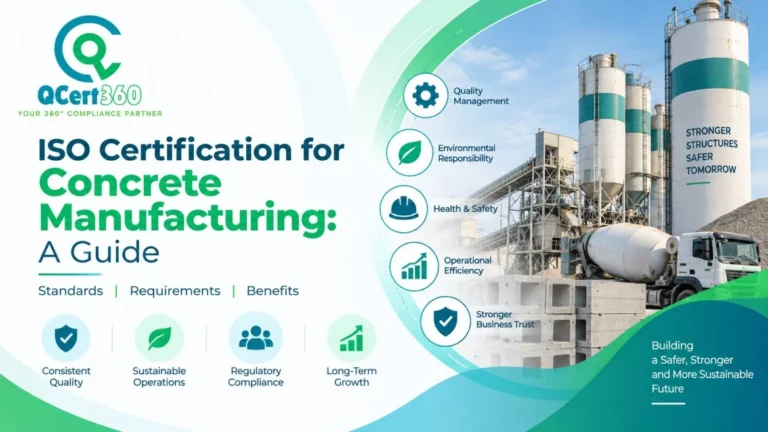
ISO Certification for Concrete Manufacturing: Standards, Requirements & Benefits
ISO certification for concrete manufacturing helps ready-mix, precast, and concrete product manufacturers establish documented controls for quality, environmental management, occupational health and safety, energy performance, and testing. Commonly relevant standards include ISO 9001:2015, ISO 14001:2015, ISO 45001:2018, ISO 50001:2018, and ISO/IEC 17025:2017, depending on the organization’s activities and certification scope.
ISO certification for concrete manufacturing gives ready-mix producers, precast manufacturers, and concrete product fabricators a documented, independently verified system for controlling batch quality, environmental impact, worker safety, energy use, and testing accuracy. The main management-system certification standards relevant to concrete manufacturers include ISO 9001, ISO 14001, ISO 45001, and ISO 50001. ISO/IEC 17025 is relevant to testing laboratories seeking accreditation for technical competence. ISO 22301, ISO 31000, and ISO 37001 support broader operational resilience.
Which ISO Standards Apply to Concrete Manufacturing?
Standard | Main Purpose |
ISO 9001:2015 | |
ISO 14001:2015 | Environmental management |
Occupational health and safety | |
ISO 50001:2018 | Energy management |
ISO/IEC 17025:2017 | Testing laboratory competence |
Business continuity | |
ISO 31000 | Risk management |
Anti-bribery management |
Why Concrete Manufacturers Need ISO Certification
Concrete production sits at the foundation of nearly every construction project — literally. Plants produce ready-mix concrete, precast elements, pipes, slabs, and paving blocks used in buildings, roads, bridges, and industrial infrastructure, and every batch depends on accurate proportioning of cement, aggregates, water, and admixtures.
A slight deviation in mix ratio, an uncalibrated testing instrument, or a curing process that isn’t tightly controlled can produce concrete that fails to meet compressive strength requirements — a defect that isn’t visible until it’s already poured into a structure. Add heavy batch plant equipment, large delivery fleets, chemical admixtures, and safety-critical testing labs, and it becomes clear why concrete manufacturing quality control cannot rely on informal procedures alone.
This is where a concrete manufacturing quality management system earns its value. ISO standards give manufacturers a documented way to control batching, mixing, curing, testing, and delivery, while proving to contractors, developers, and government project owners that the controls are real and independently verified — not just described in an internal policy. Some contractors, developers, infrastructure owners, and procurement programs may require or prefer ISO certification as part of supplier qualification. Requirements vary by contract, customer, industry, and jurisdiction.
Who Needs ISO Certification in Concrete Manufacturing?
ISO certification is relevant to a wide range of organizations across the concrete supply chain, including:
- Ready-mix concrete manufacturers
- Precast concrete manufacturers
- Concrete block manufacturers
- Concrete pipe manufacturers
- Paving block manufacturers
- Concrete product fabricators
- Concrete testing laboratories
- Multi-site concrete manufacturing companies
ISO Standards for Concrete Manufacturing
The table below summarizes the ISO standards for concrete manufacturing that matter most across ready-mix producers, precast concrete manufacturers, and concrete pipe and block fabricators.
ISO Standard | Management Focus | Why It Matters for Concrete Manufacturing |
ISO 9001:2015 | Quality Management | Controls batch proportioning, mix design, testing, and delivery consistency |
ISO 14001:2015 | Environmental Management | Manages dust, wash water, returned concrete, and waste generation |
ISO 45001:2018 | Occupational Health & Safety | Addresses batch plant, vehicle, and chemical handling hazards |
ISO 50001:2018 | Energy Management | Reduces energy use in mixers, conveyors, curing, and compressors |
ISO/IEC 17025:2017 | Testing & Calibration | Confirms lab competence for strength, slump, and material testing |
ISO 22301 | Business Continuity | Maintains delivery reliability through disruptions and shortages |
ISO 31000 | Risk Management | Provides a structured framework for operational and commercial risk |
ISO 37001 | Anti-Bribery Management | Strengthens procurement integrity and tender participation |
ISO 9001 for Concrete Manufacturers
ISO 9001:2026 for concrete manufacturers establishes documented controls over raw material receipt, mix design adherence, calibrated weigh batching, production records, and nonconforming product management. It requires systematic capture of customer feedback and corrective action processes that address root causes rather than just symptoms.
For any concrete quality control certification program, ISO 9001 is the foundation: it turns informal batching know-how into a traceable system with defined acceptance criteria, tracked performance data, and continual improvement built into daily operations.
ISO 14001 for Concrete Plants
Concrete production generates aggregate dust, wash water discharge, returned concrete, and lubricant waste across batching and transport operations. ISO 14001:2026 for concrete plants gives manufacturers a documented framework for identifying these environmental aspects, setting measurable reduction targets, and demonstrating continuous improvement over successive certification cycles.
Beyond environmental control itself, ISO 14001 sends a credible sustainability signal to infrastructure project owners and procurement teams who now routinely factor environmental performance into vendor evaluation. As sustainable concrete manufacturing certification becomes its own distinct expectation, ISO 14001 gives plants the documentation to support sustainability claims with evidence rather than assertions.
ISO 45001 for Concrete Manufacturing
A concrete manufacturing facility combines rotating heavy machinery, large commercial vehicles, chemical admixture handling, high-temperature curing environments, and physically demanding manual tasks in one workspace. ISO 45001:2018 for concrete manufacturing requires systematic hazard identification, risk assessment, and layered controls — from engineering safeguards to emergency response planning and worker participation.
Certification under this standard supports a documented framework to investigate and correct near misses and hazards tied to batch plant equipment, mixer truck operations, noise exposure, and manual lifting before they lead to serious injuries.
ISO 50001 for Concrete Plants
Cement silos, aggregate conveyors, mixer motors, curing chambers, and precast production lines all consume significant energy, making ISO 50001:2018 energy management one of the most financially impactful certifications available to this sector. The standard requires an energy policy, a baseline energy review, defined performance indicators, and monitored controls across major energy-consuming equipment.
Manufacturers implementing ISO 50001 frequently identify opportunities in motor load scheduling, curing chamber setpoint optimization, and heat recovery — improvements that support more efficient concrete batching plant energy management while also supporting broader sustainability commitments that increasingly factor into vendor qualification.
ISO/IEC 17025 for Concrete Testing Laboratories
In-house quality control labs perform compressive strength, slump, air content, and aggregate grading tests that determine whether a batch of concrete meets project specifications. ISO/IEC 17025:2017 for concrete testing laboratories ensures the technical competence and measurement accuracy of these labs, covering equipment calibration, method validation, and staff competency.
Concrete testing laboratory accreditation under this standard gives contractors and project engineers confidence that compressive strength testing standards are being met with verified precision, not just internally reported results.
ISO 22301, ISO 31000, and ISO 37001 for Concrete Manufacturing
Beyond the four core management-system standards, three additional certifications strengthen a mature concrete manufacturing management system:
- ISO 22301 supports concrete manufacturing business continuity planning against raw material shortages, batch plant breakdowns, or extreme weather events that threaten delivery commitments on time-critical construction projects.
- ISO 31000 gives manufacturers a structured concrete manufacturing risk management framework for identifying and treating operational, commercial, environmental, and reputational risk across the full production and supply cycle.
- ISO 37001 strengthens procurement integrity for raw material sourcing, subcontractor relationships, and tender participation — an increasingly relevant control for manufacturers pursuing large public and private infrastructure programs where concrete manufacturing tender qualification depends on demonstrated integrity controls.
ISO Certification for Ready-Mix Concrete Manufacturers
Ready-mix operations center on a continuous cycle of raw material control, mix design, batching, testing, truck dispatch, and delivery, so ISO controls concentrate heavily on consistency and traceability under time pressure:
- Raw material control. Calibrated weigh batching and supplier evaluation for cement, aggregates, and admixtures under ISO 9001.
- Mix design. Documented mix design adherence and change control to maintain consistent compressive strength across batches.
- Batching. Calibration records and process controls that tie each batch to a traceable set of inputs.
- Testing. Slump, air content, and strength testing performed under controlled, calibrated conditions.
- Truck dispatch and delivery. ISO 45001 hazard controls covering mixer truck operations, loading, and site delivery logistics.
- Traceability. Batch records that connect raw material lots, test results, and delivery tickets.
- Customer complaints. Structured nonconformity and corrective action processes for strength or dimensional deviations reported after delivery.
ISO Certification for Precast Concrete Manufacturers
Precast manufacturers apply the same core standards as ready-mix producers, with additional controls suited to a factory-based, multi-stage production process:
- Mould management. Documented inspection and maintenance schedules to prevent dimensional drift across repeated casting cycles.
- Reinforcement. Traceable records for rebar and mesh placement prior to casting.
- Casting. Controlled procedures for pour sequencing, vibration, and finish quality.
- Curing. Monitored curing schedules and conditions, a key focus area for both ISO 9001 and ISO 50001.
- Dimensional inspection. Documented tolerances and inspection records for finished units.
- Finished-product testing. Strength and quality verification consistent with ISO/IEC 17025 laboratory practices where testing is performed in-house.
- Storage. Controlled storage conditions to prevent damage or degradation before dispatch.
- Dispatch. Traceability from finished unit back through casting, curing, and testing records.
ISO Certification vs ISO/IEC 17025 Accreditation
These two types of certification are related but distinct, and are often confused:
- ISO 9001, ISO 14001, ISO 45001, and ISO 50001 are management-system standards that organizations can be certified against. They cover how a business plans, controls, and improves its processes.
- ISO/IEC 17025 establishes requirements for the competence of testing and calibration laboratories and is associated with laboratory accreditation rather than management-system certification.
A concrete manufacturer may hold ISO 9001 certification for its overall quality management system while its in-house testing laboratory separately pursues ISO/IEC 17025 accreditation for its testing activities. The two are complementary, not interchangeable.
Where ISO Controls Apply Across the Concrete Manufacturing Process
Mapping standards to actual production steps makes the value of certification easier to see in practice:
- Raw material receipt and storage. ISO 9001 controls incoming material acceptance criteria for cement, aggregates, and admixtures; ISO 14001 governs storage practices for chemical additives.
- Batching and proportioning. Calibrated weigh batching falls under ISO 9001 documented procedures, while ISO 50001 tracks the energy draw of batching plant motors and conveyors.
- Mixing and transport. ISO 45001 hazard controls apply directly to mixer truck operations, loading, and delivery logistics.
- Curing. This energy-intensive stage is a primary focus area for ISO 50001 performance indicators, alongside ISO 9001 controls on curing time and conditions.
- Testing and quality verification. ISO/IEC 17025 becomes relevant wherever in-house or third-party labs generate compressive strength, slump, or material test data used for customer acceptance.
- Delivery and dispatch. ISO 9001 traceability requirements tie batch records back to raw material lots and test results, supporting fast resolution if a quality issue is ever reported.
- Wash-out and waste handling. ISO 14001 requirements govern concrete wash water management, returned concrete disposal, and slurry recycling.
- Procurement and tendering. ISO 37001 controls apply to supplier selection, subcontractor engagement, and bid participation on larger infrastructure contracts.
ISO Certification Requirements for Concrete Manufacturers
Each standard carries its own clause structure, but certification bodies generally look for the same underlying discipline: documented scope, defined controls, trained personnel, and evidence that the system is actually followed on the plant floor.
ISO 9001 requirements typically include:
- Quality objectives for mix accuracy, compressive strength, dimensional tolerances, and on-time delivery
- Traceability from cement and aggregates through batching, mixing, curing, and final dispatch
- Controlled handling of nonconforming products such as low-strength results or rejected loads
- Calibrated testing for slump, cube strength, air content, and dimensions at planned intervals
- Internal audits and management reviews tracking plant performance, complaints, and corrective actions
- Supplier evaluation and monitoring for cement, aggregates, admixtures, and steel
ISO 14001 requirements typically include:
- Identification of environmental impacts including dust, wastewater, returned concrete, and chemical handling
- Measurable targets such as reduced wash water discharge or improved runoff control
- Monitoring of emissions, water, and waste against defined performance criteria
- Emergency procedures for spills, discharge failures, or dust control breakdowns
- Disposal and recycling records for returned concrete, slurry, and chemical waste
ISO 45001 requirements typically include:
- Risk assessment across batch plants, truck movement areas, admixture handling, and maintenance work
- Safety controls such as guarding, procedures, training, and protective equipment
- Emergency plans for burns, chemical exposure, vehicle accidents, and confined space entry
- Tracked safety indicators including injuries, near misses, and exposure levels
- Worker involvement in safety reporting, inspections, and improvement activities
ISO 50001 requirements typically include:
- Identification of major energy users such as mixers, conveyors, curing systems, and compressors
- Energy performance targets monitored against a defined baseline
- Operating controls on high-energy equipment to improve efficiency
- Energy performance criteria included in decisions for new equipment or plant upgrades
- Regular review of energy results with corrective action to maintain improvements
ISO/IEC 17025 requirements typically include:
- Documented method validation for strength, slump, and material tests
- Calibrated and traceable measurement equipment
- Demonstrated staff competency for testing procedures
- Impartiality and confidentiality controls for laboratory operations
- Internal audits and proficiency testing to confirm ongoing technical competence
A practical starting point for any of these systems is assembling a cross-functional team spanning quality control, production, environmental, safety, and laboratory personnel to map current documentation against the relevant ISO clauses before formal implementation begins.
Benefits of ISO Certification for Concrete Manufacturers
ISO Certification supports measurable operational and commercial value across a concrete manufacturing business:
- Easier access to large construction projects. Government, infrastructure, and commercial contracts increasingly require or prefer ISO-certified concrete suppliers as a qualification factor.
- More consistent product quality. Controlled batching and testing procedures support reduced strength variation and dimensional defects in high-volume production.
- Stronger environmental credibility. ISO 14001 certification supports tender qualification, especially where sustainability performance factors into project evaluation.
- Stronger workplace safety controls. Systematic hazard identification and risk management under ISO 45001 support fewer incidents and lower downtime and insurance risk over time.
- Potential for lower energy costs. ISO 50001 programs support efficiency improvements in batching plants, curing systems, and material handling equipment through structured energy monitoring.
- Higher confidence in test results. ISO/IEC 17025 accreditation assures contractors and engineers that lab results are technically sound.
- Better delivery reliability. ISO 22301 continuity planning helps manage equipment breakdowns, raw material shortages, or transport delays without missing project deadlines.
- Simpler compliance management. Certified systems can reduce repeated audits and paperwork requests from customers and project owners.
- Stronger procurement integrity. ISO 37001 controls support participation in larger public and private tenders where anti-bribery due diligence is part of vendor evaluation.
These outcomes depend on how effectively a management system is implemented and maintained, not on certification alone.
How to Get ISO Certification for a Concrete Manufacturing Company
To obtain ISO certification, a concrete manufacturer typically defines its scope, performs a gap assessment, implements the required management system, conducts internal audits, completes the certification audit, and addresses any nonconformities before certification is issued.
- Gap assessment. Compare current documentation, procedures, and records against the requirements of the chosen standard.
- System design and documentation. Build or update procedures, work instructions, and records to close identified gaps.
- Implementation and training. Roll out the system across batching, production, quality, environmental, and safety teams.
- Internal audit. Test the system internally and correct nonconformities before the external audit.
- Stage 1 audit. The certification body reviews documentation and readiness.
- Stage 2 audit. The certification body assesses implementation and evidence of conformity in actual plant operations.
- Certification decision. Once conformity is confirmed, the certification body issues the certificate.
- Surveillance and recertification. Annual surveillance audits and periodic recertification maintain certificate validity.
How Much Does ISO Certification Cost for a Concrete Manufacturer?
The cost of ISO certification for a concrete manufacturer depends on factors such as the selected standard, number of employees, number of manufacturing sites, certification scope, operational complexity, audit duration, and whether multiple standards are assessed together. A certification quotation normally requires reviewing these factors before the audit.
How Long Does ISO Certification Take for a Concrete Manufacturer?
The time required depends on the organization’s size, certification scope, existing management system, number of sites, and implementation readiness. A single-standard certification commonly requires several months from gap assessment through certification, while multi-standard or multi-site projects may take longer.
What Documents Are Required for ISO Certification in Concrete Manufacturing?
ISO Documentation requirements vary by standard and scope, but generally include:
- Management system scope
- Policies and objectives
- Procedures and work instructions
- Risk assessments
- Training records
- Calibration records
- Inspection and testing records
- Supplier evaluation records
- Nonconformity and corrective action records
- Internal audit records
- Management review records
Common ISO Certification Challenges For Concrete Manufacturing companies
Manufacturers pursuing certification for the first time tend to run into a consistent set of obstacles:
- Fragmented plant documentation. Batch records, calibration logs, and safety data often live across different systems maintained by different teams, making it difficult to build a single coherent management system without dedicated coordination.
- Multi-site consistency. Manufacturers running several batch plants or precast facilities often struggle to apply identical controls across sites with different equipment ages or layouts.
- Balancing throughput with control. Delivery deadlines on active construction projects can tempt teams to skip documented checks, particularly during peak production periods.
- Laboratory competency gaps. Meeting ISO/IEC 17025 requirements often means investing in equipment calibration and staff training that smaller in-house labs haven’t previously prioritized.
- Supply chain variability. Raw material quality from different aggregate and cement suppliers can vary, requiring stronger supplier evaluation processes under ISO 9001 to maintain consistent output.
Working through these challenges with an experienced certification partner during the gap assessment phase generally shortens the path to certification and reduces the number of nonconformities raised at the Stage 2 audit.
Integrated Management Systems for Concrete Manufacturing
Because concrete production touches quality, environmental, safety, energy, and testing simultaneously, many manufacturers choose to build an integrated management system rather than certifying each standard in isolation. Shared elements — document control, internal audit, management review, and corrective action — can serve multiple standards at once, reducing duplicated effort and audit fatigue.
An integrated approach also makes it easier to demonstrate coherence to contractors and project owners: rather than presenting several separate certificates with separate audit calendars, a manufacturer can show a single management system with aligned objectives across quality, safety, environmental, and energy domains. For multi-site ready-mix operators or precast manufacturers running several product lines, this is often the more efficient long-term certification strategy.
Which ISO Certification Is Best for a Concrete Manufacturer?
The appropriate ISO standard depends on the manufacturer’s operational priorities and customer requirements. ISO 9001 addresses quality management, ISO 14001 focuses on environmental management, ISO 45001 addresses occupational health and safety, and ISO 50001 focuses on energy management. A manufacturer may implement one standard or integrate several management systems, depending on scope, customer expectations, and operational goals.
Why Choose QCert360 for Concrete Manufacturing Certification?
QCert360 provides independent audit and certification services for concrete manufacturing businesses seeking ISO 9001, ISO 14001, ISO 45001, ISO 50001, ISO/IEC 17025, and related management system certifications. Our auditors assess documented systems against real production operations — batch plant controls, laboratory testing practices, environmental management activities, and occupational safety systems — based on verifiable evidence rather than paperwork alone.
Working with QCert360, concrete manufacturers get:
- Independent certification audits aligned with recognized international auditing standards
- Practical assessment of real production operations, including batch plant controls, precast manufacturing lines, and quality laboratory practices
- Evaluation of occupational safety and energy management controls against ISO 45001 and ISO 50001 requirements
- Clear audit reporting on conformity status and certification decisions
- Support across single-standard and integrated multi-standard certification scopes
- Surveillance and recertification audits to maintain certification validity across your certified standards portfolio
Whether you’re certifying a single ready-mix batch plant or a multi-site precast manufacturing operation, QCert360 structures the audit process around how your plant actually runs — not a generic template.
Written by: Ryan Dias | Role: ISO Certification Specialist | Reviewed by: [Auditor/Technical Expert] | Last Updated: September 2026
Frequently Asked Questions
What ISO standards are relevant for concrete manufacturing?
Common choices are ISO 9001 for quality, ISO 14001 for environmental management, ISO 45001 for worker safety, ISO 50001 for energy management, and ISO/IEC 17025 for testing laboratory accreditation.
Is ISO certification mandatory for concrete manufacturers?
ISO certification is not universally mandatory for all concrete manufacturers. However, specific customers, contracts, tenders, industry requirements, or procurement programs may require or prefer certification. Manufacturers should check the requirements applicable to their products, customers, projects, and locations.
What are the requirements for ISO certification?
The business needs a defined management system scope, documented procedures, risk assessments, training records, internal audits, and management review activities in place before the certification audit.
How do I get ISO certification for a concrete manufacturing company?
A manufacturer typically completes a gap assessment, implements the required management system, conducts internal audits, and passes a two-stage certification audit before the certificate is issued.
How much does ISO certification cost?
Cost depends on the standard selected, number of employees and sites, certification scope, operational complexity, and whether multiple standards are assessed together.
How long does ISO certification take?
A single-standard certification commonly takes several months from gap assessment through certificate issuance; multi-standard or multi-site projects may take longer.
What documents are required?
Common requirements include a defined scope, policies and objectives, procedures, risk assessments, training and calibration records, testing records, and internal audit and management review records.
How does ISO 9001 apply to concrete manufacturing?
It controls batch proportioning, mix design adherence, calibrated weigh batching, and nonconforming product management, along with customer feedback and corrective action processes.
How does ISO 14001 apply to concrete plants?
It helps manage dust, wastewater, returned concrete, chemical handling, and other environmental impacts through a structured environmental management system with measurable targets.
How does ISO 45001 apply to concrete manufacturing?
It supports hazard identification, risk control, safety training, incident reporting, and worker protection across batch plant, transport, and manual handling operations.
How does ISO 50001 apply to concrete plants?
It helps track energy use across mixers, conveyors, curing systems, and compressors, setting baselines and monitoring performance to reduce waste and cost.
Do concrete testing laboratories need ISO/IEC 17025 accreditation?
Yes. ISO/IEC 17025 accreditation confirms that a testing laboratory has the technical competence to produce reliable, internationally recognized compressive strength, slump, and material test data.
Can multiple ISO standards be integrated?
Yes. Many manufacturers pursue an integrated management system covering quality, environment, safety, and energy standards together, audited by a single certification body across shared processes.
Does ISO certification apply to ready-mix and precast manufacturers?
Yes, with adjustments in scope. Precast manufacturers apply the same core standards but typically add specific controls for mould management, curing schedules, and finished-product dimensional tolerances.
Ready to strengthen quality, safety, and environmental performance across your concrete manufacturing operation? QCert360’s certification specialists can assess your current systems and outline the right certification path for your plant.
Our Services
ISO Standards
- ISO 9001 Certification
- ISO 14001 Certification
- ISO 45001 Certification
- ISO 22000 Certification
- ISO 17025 Certification
- ISO 27001 Certification
- ISO 13485 Certification
- ISO 20000-1 Certification
- ISO 41001 Certification
- ISO 22716 Certification
- ISO 50001 Certification
- ISO 22301 Certification
- ISO 29993 Certification
Product Certifications
Other international standards
- FSSC 22000 Certification
- HIPAA
- HACCP Certification
- SA 8000 Certification
- GMP Certification
- GDPR
- GDP Certification
- GLP Certification
- Certificate of Conformity
QCert360 provides a wide range of services including ISO certification, audit support, compliance consulting, and training. They specialize in helping businesses achieve global standards and certifications like ISO 9001, ISO 27001, ISO 14001, and many others. Their team ensures a seamless experience from consultation to certification, supporting clients at every stage.
The time it takes to achieve certification can vary depending on the complexity of the standard and the readiness of your organization. On average, it takes about 3 to 6 months. QCert360 works closely with clients to streamline the process, ensuring that all requirements are met efficiently and within a reasonable timeline.
QCert360 is a trusted partner with years of experience in helping businesses obtain international certifications. Their expert consultants provide tailored solutions, ensuring your organization not only meets but exceeds industry standards. With a customer-centric approach, they focus on offering end-to-end support to simplify the certification journey.
QCert360 serves a wide range of industries including manufacturing, healthcare, information technology, education, and services, among others. They customize their certification solutions to meet the unique requirements of each industry, ensuring relevance and compliance with global standards.
Yes, QCert360 provides ongoing support even after certification. They offer services like surveillance audits, recertification guidance, and consultancy to help maintain and improve your certification status. Their team ensures that your organization stays compliant and up-to-date with any changes in certification standards.
Getting started with QCert360 is simple. You can contact them via their website to request a consultation. Their team will assess your needs, discuss the best certification options for your business, and outline the steps involved. From there, they’ll guide you through the entire process, ensuring you’re prepared for certification.
QCert360 stands out due to its customer-focused approach, industry expertise, and comprehensive service offerings. Their team doesn’t just help you obtain certification but works to ensure your organization thrives in compliance with international standards. They also offer personalized consultation, making the process smoother and more efficient, ensuring long-term success for your business.
The cost of certification varies depending on factors such as the type of certification, the size and complexity of your organization, and the specific industry requirements. QCert360 offers competitive pricing and provides tailored quotes based on your unique needs. They ensure transparency and work with you to find the most cost-effective solution for your certification goals.
Yes, QCert360 offers internal audit services to help assess and improve your organization’s processes. Their expert auditors conduct thorough reviews of your systems and operations to ensure they meet required standards. They also provide actionable recommendations to help enhance efficiency and compliance, making sure you’re fully prepared for external audits.
If your organization doesn’t pass an audit or certification assessment, QCert360 works with you to understand the reasons for non-compliance and provides support to rectify the issues. They offer guidance on corrective actions and help you prepare for a re-assessment. Their goal is to ensure your organization meets the necessary standards for certification, and they will be by your side to make the process as smooth as possible.