ISO Certifications for Agribusiness, Popular Standards, Requirements & Standards
Agribusiness spans farms, processing plants, feed mills, equipment makers and distribution networks, often within a single group. That breadth is the strength of the model, and it is also where control gets hard. A gap in one link, a contaminated input, an untested pesticide application, a missing batch record, can travel the whole length of the chain before anyone catches it.
Retailers, exporters and food service buyers now ask agribusiness operators for proof of control, not promises. ISO certifications for agribusiness give you that proof through documented, independently audited management systems for food safety, quality, environment, worker safety and risk. If you want to get ISO 22000 certified for agribusiness, or need ISO certification services for agribusiness companies, this page explains which standards apply, what auditors expect, what certification costs and which market trends make it timely.
Which ISO Standards Fit Agribusiness Operations?
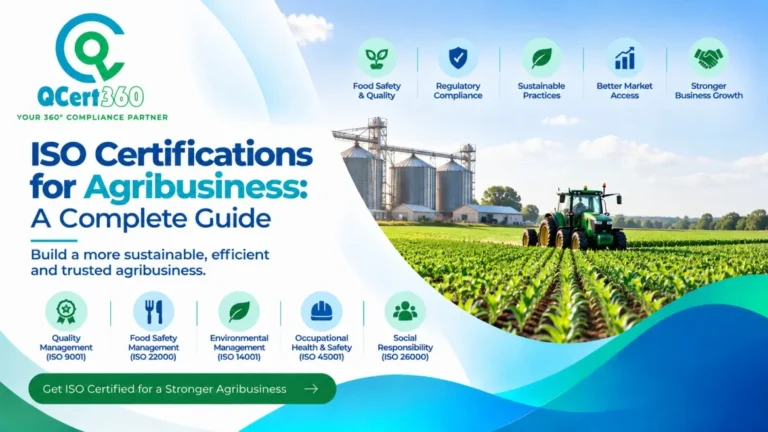
ISO 22000 is the core standard where agribusiness touches food or feed, controlling hazards through HACCP and prerequisite programs. ISO 9001 adds consistency across farming, processing and logistics. ISO 14001 manages environmental impact, and ISO 45001 protects workers across fields, plants and yards. ISO 50001 targets energy in irrigation and cold chain, and ISO/IEC 27001 secures farm and supply chain data. An independent body audits you in two stages, then certifies you for three years with yearly surveillance.
What Is ISO Certification for Agribusiness?
Agribusiness ISO certification is independent proof that your company runs its operations under an internationally recognized management system standard. An auditor checks that your procedures, controls and records meet the standard, and that people follow them in the field, the plant and the warehouse.
ISO certification for crop production, livestock, food processing and agricultural equipment businesses can cover:
- Land preparation, planting and crop cultivation
- Livestock feeding, health monitoring and welfare
- Harvesting, grading and post-harvest handling
- Processing, milling and packaging
- Storage, cold chain and distribution logistics
- Agricultural equipment design and manufacturing
You define the scope, and the auditor tests it against real operations, from field or feed intake to loaded truck.
Why Agribusiness Companies Need ISO Certification
Agribusiness sits exposed to forces most industries do not face together: weather volatility, pest and disease pressure, perishable products and long, multi-site supply chains. ISO certification brings structure to that exposure and gives buyers a clear signal of control.
Common pressures ISO standards address:
- Contamination risk across crops, feed and processed products
- Inconsistent practices across fields, sites and seasons
- Water use, soil health and chemical runoff
- Worker injuries from machinery, chemicals and heat
- Weather, pest and market volatility
- Buyer and export market certification requirements
- Weak traceability from input to finished product
Is ISO certification mandatory for agribusiness? Usually not. It is voluntary unless a customer, contract or export market requires it. Many retailers, food processors and export buyers now list certified systems as a supplier condition. Certification also sits alongside legal duties and never replaces them.
Which ISO Certifications Do Agribusiness Companies Need?
Most agribusiness operations begin with ISO 9001 or ISO 22000, depending on whether they handle food or feed directly, then add ISO 14001 and ISO 45001. Larger integrated groups add ISO 50001 and ISO/IEC 27001. The table summarizes ISO standards for agribusiness.
Standard | Focus | What it controls | Certifiable? |
ISO 22000 | Food safety management system | Hazards, HACCP, prerequisite programs, traceability | Yes |
ISO 9001 | Consistency, grading, specifications, corrective action | Yes | |
ISO 14001 | Environmental management system | Soil, water, chemicals, waste, emissions | Yes |
ISO 45001 | Occupational health and safety | Machinery, chemicals, heat, animal handling | Yes |
ISO 50001 | Energy management | Irrigation, cold storage, processing plants | Yes |
ISO/IEC 27001 | Farm data, sensor systems, supply chain records | Yes | |
Business continuity | Weather, disease and supply disruption | Yes | |
ISO 31000 / ISO 26000 | Risk and social responsibility guidance | Risk thinking, ethical and sustainable practice | No, guidance only |
How ISO Standards Map to the Agribusiness Value Chain
Each stage of agribusiness carries different risks, so different standards lead at different stages. Farms lean on environment and safety. Processing leans on food safety and quality. Logistics leans on traceability and continuity.
Stage | Main risks | Lead standards |
Crop and livestock production | Contamination, pests, disease, chemical use | ISO 22000, ISO 14001 |
Input supply (seed, feed, chemicals) | Substandard or unapproved inputs | ISO 22000, ISO 9001 |
Harvesting and grading | Quality variation, damage, mixing | ISO 9001 |
Processing and packaging | Cross-contamination, allergens, mislabeling | ISO 22000, ISO 9001 |
Storage and cold chain | Temperature abuse, spoilage | ISO 22000, ISO 50001 |
Equipment manufacturing | Design defects, machinery hazards | ISO 9001, ISO 45001 |
Distribution and export | Traceability gaps, disruption | ISO 22000, ISO 22301 |
Data and farm systems | Data loss, sensor and IoT security | ISO/IEC 27001 |
Use this map to choose your order of adoption. Start where your biggest risks and buyer demands overlap.
Does ISO Certification Replace Food Safety and Agricultural Regulations?
No. ISO certification verifies that your management system controls food safety, quality, environment or safety. Legal duties, agricultural inspections and export requirements remain separate. ISO systems help you meet those duties consistently and prove it.
An ISO certificate does not approve a crop, a feed formulation or a piece of equipment, and it does not replace product testing. Say your company holds ISO certification for its management system. Do not imply that ISO approves individual batches or products.
Why Is ISO 22000 Important for Agribusiness?
ISO 22000 matters wherever agribusiness touches food or feed, because contamination can enter at any stage from field to fork. The standard gives you a food safety management system that identifies hazards, sets controls and proves they work every day.
ISO 22000 for agribusiness combines HACCP analysis with prerequisite programs and management discipline. You assess biological, chemical and physical hazards, then set critical control points with limits, monitoring and corrective action.
Key controls include:
- Input and supplier control: seeds, feed, fertilizers, pesticides and veterinary medicines
- Water quality monitoring and testing
- Pest management and sanitation programs
- Personnel hygiene and training
- Pathogen and pesticide residue testing
- Allergen control in processing and packaging
- Recall and withdrawal procedures tested through simulation
Farm-to-fork traceability across crop, livestock and processing operations relies on batch and lot identification that follows inputs through to finished products. Test it often. Pick a finished batch and trace it back to its field, flock or feed lot within the hour. Good records shrink recalls and speed buyer and regulator questions.
How Does ISO 9001 Help an Agribusiness Operation?
ISO 9001 helps because buyers judge you on consistency across seasons, sites and products. The standard turns quality from operator habit into a documented system that ties objectives, procedures, training and corrective action together.
ISO 9001 for agribusiness operations builds a quality management system that covers:
- Standardized procedures for planting, feeding, harvesting and processing
- Quality specifications for seeds, feed formulations and chemical inputs
- Supplier qualification and evaluation
- Quality control checkpoints from field to finished product
- Equipment calibration and maintenance programs
- Customer complaint handling with root-cause analysis
Precision agriculture and digital farm management systems increasingly feed data into these quality checkpoints. GPS-guided equipment, sensor networks and yield monitoring generate records that support both quality objectives and food safety traceability, so building ISO 9001 procedures around this data pays off twice.
ISO 14001 for Agribusiness: Soil, Water and Chemical Management
ISO 14001 helps agribusiness operations measure and reduce environmental impact. It identifies where soil, water, chemical use and waste create impact, sets targets and proves progress. Buyers with sustainability commitments increasingly ask for audited evidence rather than claims.
ISO 14001 for agribusiness builds an environmental management system around the sector’s main aspects:
- Soil health and conservation: rotation, cover cropping and erosion control
- Water conservation and irrigation efficiency: metering, precision irrigation and source protection
- Pesticide and fertilizer application and runoff prevention
- Waste management, including organic waste, packaging and chemical containers
- Greenhouse gas emissions and energy use
- Biodiversity and habitat impact
Integrated pest management and sustainable input use reduces chemical dependency while protecting yields, and ISO 14001 gives you the structure to measure whether these practices actually work. Climate-smart agriculture practices such as drought-resistant varieties, crop diversification and regenerative techniques fit naturally into an ISO 14001 objectives program, turning sustainability commitments into tracked, auditable targets.
ISO 45001 for Agribusiness: Protecting Field and Plant Workers
ISO 45001 protects the people who work the fields, run the machinery and staff the processing lines. It requires you to identify hazards, assess risks, apply controls, train workers and learn from incidents. ISO 45001 for agribusiness workers turns safety from a checklist into a routine that follows people across very different work environments.
An occupational health and safety system addresses real hazards across the value chain:
- Tractors, harvesters and processing machinery
- Chemical exposure from pesticides and fertilizers
- Heat stress and outdoor field conditions
- Animal handling and livestock-related injuries
- Confined spaces in grain storage and silos
- Repetitive motion and manual handling in packing lines
Chemical exposure and machinery safety in farm operations relies on machine guarding, lockout-tagout procedures, PPE requirements and ventilation. Heat stress and worker safety in outdoor agricultural work needs specific controls: hydration schedules, shaded rest areas, work-rest cycles during peak heat and training on early symptom recognition. Worker consultation is central, because people in the field and on the line see hazards first.
ISO 50001 Energy Management for Agribusiness
ISO 50001 helps agribusiness operations cut energy waste across irrigation, cold storage and processing. The standard asks you to set a baseline, find the biggest energy uses, set targets and prove savings.
ISO 50001 energy management in agribusiness typically targets irrigation pumps, cold rooms, drying equipment, boilers and vehicle fleets. Metering by system reveals waste that farm-wide averages hide. Gains often come from better pump scheduling, cold chain insulation, renewable power adoption and route optimization for transport fleets. Lower energy use cuts cost per tonne produced and supports emissions reporting to buyers.
ISO/IEC 27001 for Agribusiness Data and Systems
Farm sensor data, yield records, supply chain information and customer contracts hold real commercial value, and connected agriculture is expanding the digital footprint of the sector fast. ISO/IEC 27001 for agribusiness protects that information through a structured security system covering access control, device security, supplier access and incident response.
Precision agriculture and digital farm management systems raise the stakes. GPS equipment, drone imagery, IoT sensors and cloud-based farm management platforms improve efficiency but expand the attack surface. Typical controls include role-based access to farm data, secure connections for field devices, staff awareness training and tested incident response plans.
Business Continuity and Risk Management in Agribusiness
ISO 22301 business continuity matters because agribusiness faces disruption risks that many sectors do not: crop failure, disease outbreaks, extreme weather and volatile input costs. The standard asks you to identify critical operations, define recovery strategies and test them regularly, covering scenarios such as harvest failure, processing plant breakdown and cold chain loss.
ISO 31000 risk management offers guidance, though it is not certifiable, for identifying and managing risks unique to agribusiness: weather volatility, pest and disease outbreaks, market price fluctuations and regulatory change. Use it to shape how your organization thinks about risk, then apply certifiable standards such as ISO 22000, ISO 45001 and ISO 22301 to put that thinking into action.
Other ISO international Standards Worth Knowing for Argibusiness
Some agribusiness operations add further standards as they grow:
- ISO 26000 offers guidance on social responsibility, covering fair labor practices, community engagement and ethical sourcing, though it is not certifiable
- ISO 14064 and ISO 14067 support greenhouse gas and product carbon footprint reporting for buyers requesting emissions data
- ISO 22005 offers principles for designing traceability systems, though it is guidance-based
When you combine standards, build an integrated management system. One policy set, one internal audit program and one management review cover everything, which reduces paperwork and audit time across farms, plants and warehouses.
Requirements of ISO Certification for Agribusiness
The requirements of ISO certification for agribusiness center on documented processes, proof of implementation and continual improvement. You must show that your system exists, that people follow it and that it improves.
Core requirements include:
- Defined scope. State which farms, sites, processes and activities are covered, since a single system can span farming, processing and distribution.
- Policies and objectives. Set targets for food safety, quality, environmental performance and worker safety.
- Hazard and risk analysis. Assess food safety, environmental, safety and continuity risks across the operation.
- Prerequisite programs. Cover water quality, pest management, sanitation and hygiene where food safety applies.
- Documented procedures. Cover the flow from input sourcing to finished product or dispatch.
- Supplier control. Evaluate seed, feed, chemical and equipment suppliers.
- Competence and training. Prove workers understand their tasks and safety requirements.
- Monitoring and records. Track yields, tests, incidents, water use and energy consumption.
- Traceability and recall. Test that you can trace and withdraw product where food safety applies.
- Internal audits and management review. Check the system and close gaps.
- Corrective action. Fix root causes, not just symptoms.
Tip: Focus first on your highest-impact areas, typically food safety, environmental sustainability and worker safety. Map current farming, processing and safety practices against the standard to find gaps before you write a single new procedure.
What Documents Do You Need for ISO Certification for Agribusiness?
You need policies, procedures and records that prove your system works. ISO standards ask for documented information, not paperwork volume. Keep what helps you control the process and show evidence.
Typical documents include:
- Food safety, quality, environment and safety policies
- Hazard analysis and critical control point records
- Input, supplier and chemical inventory records
- Water quality and soil testing records
- Traceability and mock recall reports
- Calibration and maintenance logs
- Waste, emissions and energy records
- Hazard and risk registers
- Training and competence records
- Complaint, incident and corrective action registers
- Internal audit reports and management review minutes
What Does an ISO Auditor Check in an Agribusiness Operation?
An ISO auditor checks whether your documented system matches real work. They visit fields, plants and warehouses, watch processes, sample records and interview staff. They rely on objective evidence.
What does an ISO auditor check in an agribusiness operation? Expect focus on:
- Hazard analysis and critical control point records
- Input and supplier approval files
- Water, soil and pesticide residue testing records
- Traceability tests, tracing a lot back to its field, flock or feed source
- Machine guarding, chemical storage and PPE use
- Waste, emissions and energy records
- Training files and corrective actions
- Internal audit and management review results
Prepare by following your own procedures every day, and be ready to trace product across seasons and sites, not just within one facility.
Benefits of ISO Certification for Agribusiness
The benefits of ISO certification for agribusiness appear in safety, consistency, market access and resilience. Certified operations run tighter systems and earn stronger trust from retailers, processors and export partners.
- Enhanced market access. Certification meets retailer, food service and export market requirements.
- Stronger contamination prevention. Systematic HACCP and traceability reduce food safety incidents.
- Improved resource efficiency. Water, chemical and energy savings improve margins.
- Better operational consistency. Standardized practices reduce yield variation and rework.
- Higher buyer confidence. Third-party certification demonstrates quality and safety commitment.
- Reduced injuries and insurance cost. Structured hazard control lowers incidents.
- Faster recall response. Documented traceability limits scope and cost.
- Stronger investor and lender confidence. Demonstrated risk management supports financing.
- Continual improvement. Data drives decisions instead of guesswork.
ISO certification for agricultural exporters and cooperatives carries extra value. Export buyers rely on documents, and a recognized certificate speeds supplier approval across multiple markets.
Agribusiness Market Trends
Demand for food, feed and agricultural inputs keeps growing, and buyers keep raising expectations on traceability, sustainability and proof.
Estimates for the 2026 global agribusiness market vary widely by research firm and scope, from about USD 3.4 trillion to over USD 4 trillion, with some broader definitions placing the market considerably higher. Projected annual growth ranges from roughly 2.7 to 5.5 percent depending on methodology, so treat all figures as directional.
Several shifts shape what buyers expect:
- Precision and smart agriculture. The smart agriculture market is projected to grow from around USD 26 to 29 billion in 2026 to as much as USD 75 to 81 billion by 2035, driven by IoT sensors, drone imagery and automated field systems. The precision agriculture segment alone is expected to grow from about USD 13.65 billion in 2026 to USD 22.74 billion by 2034.
- Digital agriculture platforms. Agriculture analytics, combining IoT data with productivity software, is projected to grow from about USD 4.0 billion in 2026 to USD 9.9 billion by 2033.
- Premiumization and traceability. Consumer preference for organic, traceable and high-quality farm products is reshaping supply chains, with buyers demanding transparent, verifiable sourcing.
- Climate-smart and regenerative agriculture. Producers are adopting drought-resistant varieties, improved irrigation efficiency and soil conservation practices in response to climate variability.
- Consolidation and vertical integration. Larger agribusiness groups are expanding through acquisitions and partnerships, creating pressure for consistent, shared management systems across multiple sites and business lines.
- Rising food security pressure. The UN Food and Agriculture Organisation estimates global food production needs to expand significantly by 2050 to meet population growth, intensifying pressure on productivity and resource efficiency.
- Technology-enabled compliance. IoT sensors and digital tracking tools are increasingly used to support real-time monitoring and supply chain visibility, supporting the documentation ISO systems require.
The pattern is clear. Buyers want traceable, sustainable and consistently produced agricultural products, and they want proof. ISO certification gives you documented evidence rather than claims.
ISO Certification Services for Agribusiness Companies: What You Get
Our ISO certification services for agribusiness companies cover the full journey from first gap check to certificate and surveillance. You get a clear scope, a defined audit plan and reports that explain findings in plain language.
Typical service components:
- ISO gap assessment services for agribusiness operations. We compare your practices with each requirement and give you a ranked list of gaps.
- ISO implementation support for farms and processors. We help you build practical procedures and records that fit real field and plant work.
- Independent Stage 1 and Stage 2 audits. Our auditors check conformity against evidence and issue a clear certification decision.
- Surveillance and recertification audits. We keep your certificate current across the three-year cycle.
We keep audit teams independent from implementation support to protect impartiality.
How to Choose an Agribusiness ISO Certification Body
Choose an agribusiness ISO certification body on evidence, not price alone. A weak audit gives you a certificate buyers may question. A strong one gives you insight and credibility.
Ask each candidate:
- Do your auditors understand farming, processing and agricultural supply chain operations?
- Can you audit ISO 22000, ISO 9001, ISO 14001 and ISO 45001 together?
- How will you sample fields, plants and records across multiple sites?
- What is your audit plan, timeline and reporting format?
- How do you keep audit and implementation support impartial?
- What does surveillance involve, and what will it cost?
How to Apply for ISO certfication for Agribusiness and Request a Quote
To apply for ISO certification for an agribusiness company, share a short profile of your operation. A clear profile lets us scope the audit and price it accurately.
To request an ISO certification quote for agribusiness, prepare:
- Company size and number of sites, including farms, plants and warehouses
- Activities in scope, such as crop production, livestock, processing or equipment manufacturing
- Standards you need and any existing certificates
- Target certification date and any buyer or export deadline
We reply with a scoped plan, audit stages and a quote for your profile.
How to Get ISO Certification for an Agribusiness Company
To get ISO certified, choose standards, assess gaps, build and run your system, audit it internally and pass an external audit. How to get ISO certification for an agribusiness company follows the same ISO certification process every time:
- Select standards. Match them to what you produce and who you sell to. Most start with ISO 9001 or ISO 22000, adding ISO 14001 and ISO 45001 as needs grow.
- Define scope. List farms, sites, processes and activities covered. A single integrated system can span farming, processing and distribution if scope defines each part clearly.
- Run a gap analysis. Compare current practice with each requirement, using real records from the field and plant. Rank gaps by risk and effort.
- Build the system. Write only the procedures and records you need, and reuse existing farm and plant routines wherever they already work.
- Train your people. Train field workers, plant staff, drivers and supervisors on the procedures they use, with records tied to each role.
- Operate the system. Run operations under the new system long enough to build real records across a full production cycle, not just one season’s peak.
- Complete an internal audit and management review. Audit your own system with independent internal auditors, then present results to management. Fix findings and confirm the fixes hold.
- Choose a third-party certification body for agribusiness. Pick an independent body that understands agricultural operations and can audit your standards together.
- Pass the Stage 1 audit. The auditor reviews documents, scope and readiness, and flags concerns to resolve before Stage 2.
- Pass the Stage 2 audit. The auditor verifies on site that your system works, through observation, traceability tests, record sampling and interviews.
- Receive your certificate and keep it alive. The certificate stays valid for three years, with annual surveillance audits confirming the system still works.
How Long Does ISO Certification Take for an Agribusiness Company?
Most agribusiness operations need about three to nine months. Site count, crop or production cycles, existing records and number of standards all affect timing. A single-site operation with solid records moves faster than a multi-site group spanning farming, processing and distribution.
A typical project moves through these phases:
- Gap analysis: roughly two to four weeks
- System build and training: one to three months
- Operation and record building: one to three months, ideally spanning a full production cycle
- Internal audit and management review: two to four weeks
- Stage 1 and Stage 2 audits: scheduled a few weeks apart
Seasonal and harvest calendars can shift timing, so plan audits around production activity.
How Much Does ISO Certification Cost for an Agribusiness Company?
ISO certification cost depends on employee numbers, sites, process complexity, scope and chosen standards. How much does ISO certification cost for an agribusiness company? No fixed price fits everyone, so a quote based on your profile is the only reliable answer.
Typical cost elements:
- Stage 1 and Stage 2 audits
- Annual surveillance audits
- Recertification audit every three years
- Optional consulting and gap analysis
- Internal training and staff time
More sites, larger headcount, multiple activities and extra standards raise cost. Mature records, a single site and integrated audits lower it.
ISO Certificate Validity for Agribusiness and Small Agribusiness Operations
An ISO certificate stays valid for three years. Surveillance audits confirm the system still works, and a recertification audit renews the certificate at the end of the cycle.
Are ISO certifications realistic for small farms and agribusiness cooperatives? Yes. Standards scale to size. Small producers can use lean documentation and shared systems, and cooperatives can achieve certification together or individually. Auditors judge whether your system works for your operation, not how thick your manuals are.
ISO certification for smallholder cooperatives and agri-startups often pays back fastest, since export buyers and retailers send detailed supplier qualification questionnaires that a certificate answers at once.
Common Gaps We See in Agribusiness Operations
- Input and supplier approvals based on paperwork alone
- Traceability tests that are never practiced across full seasons
- Generic risk assessments that ignore real field and plant tasks
- Water and chemical use tracked inconsistently across sites
- Machine guarding and PPE compliance that varies by location
- Heat stress controls that exist on paper but are not enforced
- Waste and emissions records without clear ownership
- Training files that do not prove competence across seasonal staff
How QCert360 Supports Agribusiness Companies in ISO certification
QCert360 helps crop producers, livestock operations, food processors, agricultural equipment manufacturers and cooperatives achieve ISO certification with clear guidance and audit services aligned to international standards. We support clients across 195 countries.
Our support includes:
- Standard selection advice. We help you choose the right mix of ISO 22000, ISO 9001, ISO 14001, ISO 45001 and supporting standards.
- Gap assessment. We compare your operations with each requirement.
- Implementation guidance. We help you build practical systems that fit real farm and plant work.
- Independent audit and certification. We assess conformity objectively.
- Ongoing support. We stay with you through surveillance and recertification.
Frequently Asked Questions
Which ISO standards are most relevant for agribusiness companies?
Common standards include ISO 9001 for quality, ISO 22000 for food safety, ISO 14001 for environment, ISO 45001 for worker safety, and ISO 50001 where irrigation or cold chain energy use is significant.
How does ISO 9001 apply to agribusiness operations?
It structures planning, production, storage, processing, logistics and customer service so products follow consistent, documented processes across seasons and sites.
When should an agribusiness adopt ISO 22000?
When you handle food or feed ingredients, processing, packing or storage and need a formal system to control contamination and food safety risks.
Why is ISO 14001 important for agribusiness?
It helps manage soil and water use, chemicals, waste, emissions and biodiversity impact, supporting more sustainable and resource-efficient operations.
What does ISO 45001 cover in an agribusiness context?
Worker safety around machinery, vehicles, chemicals, storage areas, field work and packing lines through structured risk assessments and controls.
Are ISO standards suitable for mixed agribusiness models combining farming, processing and distribution?
Yes. A single integrated management system can cover multiple activities, with scope defined to include farms, plants, warehouses and logistics as needed.
How long does ISO certification take for an agribusiness company?
Typically three to nine months, depending on size, complexity and readiness.
How much does ISO certification cost for an agribusiness company?
Cost varies with employees, sites, scope and standards. Request a tailored quote.
Are ISO certifications realistic for small farms and agribusiness cooperatives?
Yes. Requirements scale to size, and cooperatives can certify together or individually.
What does an ISO auditor check in an agribusiness operation?
Hazard analysis, input and supplier records, water and soil testing, traceability tests, machinery and chemical safety controls, training and corrective action.
Ready to Get your agribusiness ISO Certified with QCert360?
Agribusiness buyers reward operations that prove control. ISO certification gives you that proof across food safety, quality, environment, worker safety and resilience. It helps you win contracts, protect your workers and land, and build trust with every partner in the chain.
Talk to QCert360 today for a free consultation, and request an ISO certification quote tailored to your agribusiness operation.
[Request Your Free ISO Certification Quote]
Our Services
ISO Standards
- ISO 9001 Certification
- ISO 14001 Certification
- ISO 45001 Certification
- ISO 22000 Certification
- ISO 17025 Certification
- ISO 27001 Certification
- ISO 13485 Certification
- ISO 20000-1 Certification
- ISO 41001 Certification
- ISO 22716 Certification
- ISO 50001 Certification
- ISO 22301 Certification
- ISO 29993 Certification
Product Certifications
Other international standards
- FSSC 22000 Certification
- HIPAA
- HACCP Certification
- SA 8000 Certification
- GMP Certification
- GDPR
- GDP Certification
- GLP Certification
- Certificate of Conformity
QCert360 provides a wide range of services including ISO certification, audit support, compliance consulting, and training. They specialize in helping businesses achieve global standards and certifications like ISO 9001, ISO 27001, ISO 14001, and many others. Their team ensures a seamless experience from consultation to certification, supporting clients at every stage.
The time it takes to achieve certification can vary depending on the complexity of the standard and the readiness of your organization. On average, it takes about 3 to 6 months. QCert360 works closely with clients to streamline the process, ensuring that all requirements are met efficiently and within a reasonable timeline.
QCert360 is a trusted partner with years of experience in helping businesses obtain international certifications. Their expert consultants provide tailored solutions, ensuring your organization not only meets but exceeds industry standards. With a customer-centric approach, they focus on offering end-to-end support to simplify the certification journey.
QCert360 serves a wide range of industries including manufacturing, healthcare, information technology, education, and services, among others. They customize their certification solutions to meet the unique requirements of each industry, ensuring relevance and compliance with global standards.
Yes, QCert360 provides ongoing support even after certification. They offer services like surveillance audits, recertification guidance, and consultancy to help maintain and improve your certification status. Their team ensures that your organization stays compliant and up-to-date with any changes in certification standards.
Getting started with QCert360 is simple. You can contact them via their website to request a consultation. Their team will assess your needs, discuss the best certification options for your business, and outline the steps involved. From there, they’ll guide you through the entire process, ensuring you’re prepared for certification.
QCert360 stands out due to its customer-focused approach, industry expertise, and comprehensive service offerings. Their team doesn’t just help you obtain certification but works to ensure your organization thrives in compliance with international standards. They also offer personalized consultation, making the process smoother and more efficient, ensuring long-term success for your business.
The cost of certification varies depending on factors such as the type of certification, the size and complexity of your organization, and the specific industry requirements. QCert360 offers competitive pricing and provides tailored quotes based on your unique needs. They ensure transparency and work with you to find the most cost-effective solution for your certification goals.
Yes, QCert360 offers internal audit services to help assess and improve your organization’s processes. Their expert auditors conduct thorough reviews of your systems and operations to ensure they meet required standards. They also provide actionable recommendations to help enhance efficiency and compliance, making sure you’re fully prepared for external audits.
If your organization doesn’t pass an audit or certification assessment, QCert360 works with you to understand the reasons for non-compliance and provides support to rectify the issues. They offer guidance on corrective actions and help you prepare for a re-assessment. Their goal is to ensure your organization meets the necessary standards for certification, and they will be by your side to make the process as smooth as possible.