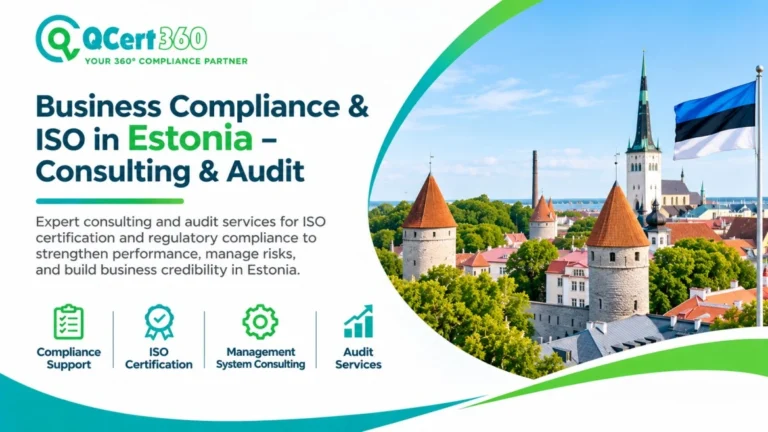
Business Compliance & ISO Services in Estonia
WWhat Are Business Compliance and ISO Consulting Services in Estonia?
Business compliance in Estonia means meeting applicable Estonian laws, European Union regulations and industry-specific requirements covering cybersecurity, data protection, workplace safety, environmental management, financial compliance and business operations.
ISO standards provide internationally recognized management system frameworks that help organizations establish, document, monitor and improve their compliance processes. Important standards include ISO 9001 for quality management, ISO/IEC 27001 for information security, ISO 14001 for environmental management, ISO 45001 for occupational health and safety, and ISO 37301 for compliance management.
QCert360 provides business compliance consulting, ISO certification consulting, management system implementation, gap analysis, employee training, internal audit support and certification audit preparation for businesses in Estonia.
ISO management system standards are generally voluntary. An ISO certificate does not automatically demonstrate compliance with every legal requirement. Final certification decisions are made independently by the relevant certification body.
Business Compliance in Estonia: Why It Matters in 2027
Estonia is one of Europe’s most digitally developed economies. Its business environment combines national legislation, directly applicable EU regulations, international standards and increasingly demanding customer and supply-chain expectations.
Cybersecurity and data protection have become particularly important. Amendments to Estonia’s Cybersecurity Act implementing the NIS2 framework entered into force on 1 January 2026, expanding the number of organizations subject to cybersecurity obligations.
According to Estonia’s Information System Authority (RIA), the number of organizations covered increased from approximately 3,500 to nearly 6,500.
Businesses must also consider GDPR, the Digital Operational Resilience Act (DORA), the Whistleblower Protection Act, occupational health and safety legislation and relevant environmental and sector-specific requirements.
For organizations operating in Tallinn, Tartu, Narva, Pärnu and other Estonian business locations, maintaining a structured compliance management system can help improve accountability, manage operational risks and demonstrate control to customers, regulators and business partners.
This guide explains the main business compliance requirements in Estonia, the ISO standards that support them, how independent certification works and how QCert360 helps organizations prepare.
What Is Business Compliance in Estonia, and How Does ISO Fit In?
Business compliance in Estonia involves identifying and meeting the legal, regulatory, contractual and industry-specific requirements that apply to an organization. These obligations may cover personal data protection, cybersecurity, occupational health and safety, environmental responsibilities, financial crime prevention, taxation and product conformity.
ISO standards provide structured management frameworks that help businesses manage these responsibilities consistently.
The distinction between legal compliance and ISO certification is important:
- Legal compliance: Meeting mandatory requirements established by Estonian legislation and applicable EU regulations.
- ISO implementation: Establishing management processes, controls, responsibilities and records aligned with an international standard.
- ISO certification: An independent assessment confirming that a management system meets the applicable standard within its defined scope.
- Accreditation: Formal recognition that a conformity assessment body is competent to perform specified activities.
An ISO certificate does not automatically establish compliance with every Estonian law or EU regulation. Organizations must identify their applicable legal obligations separately.
For example, ISO/IEC 27001 can support an organization’s information security risk management and provide evidence of implemented controls. However, it does not automatically satisfy every requirement of the NIS2 Directive or Estonia’s Cybersecurity Act.
Which Estonian Authorities Oversee Business Compliance?
Different Estonian authorities supervise different areas of business activity. Organizations should identify the authority relevant to their industry, operations and legal obligations.
Regulatory authority | Estonian name | Main responsibility |
Data Protection Inspectorate | Andmekaitse Inspektsioon (AKI) | GDPR and personal data protection |
Information System Authority | Riigi Infosüsteemi Amet (RIA) | Cybersecurity, NIS2 and CERT-EE coordination |
Financial Supervision Authority | Finantsinspektsioon | Banks, insurers and regulated financial services |
Financial Intelligence Unit | Rahapesu Andmebüroo | Anti-money laundering and suspicious transaction reporting |
Labour Inspectorate | Tööinspektsioon | Occupational health and safety and employment requirements |
Consumer Protection and Technical Regulatory Authority | TTJA | Product safety, consumer protection and technical regulation |
Agriculture and Food Board | Põllumajandus- ja Toiduamet (PTA) | Food safety, feed and veterinary supervision |
Environmental Board | Keskkonnaamet | Environmental permits and environmental supervision |
Health Board | Terviseamet | Public health and healthcare-related supervision |
Tax and Customs Board | Maksu- ja Tolliamet (EMTA) | Taxation, customs and tax administration |
Businesses should consult the relevant authority’s official guidance before making decisions about regulatory obligations.
Useful official resources:
- Data Protection Inspectorate
- Information System Authority
- Financial Supervision Authority
- Financial Intelligence Unit
- Labour Inspectorate
- Consumer Protection and Technical Regulatory Authority
- Agriculture and Food Board
- Environmental Board
- Health Board
- Tax and Customs Board
Which Estonian and EU Laws Shape Business Compliance in 2026?
The main business compliance requirements in Estonia arise from national legislation, directly applicable EU regulations and EU directives implemented through national law.
The following overview highlights important requirements that businesses should assess.
- General Data Protection Regulation (GDPR)
The General Data Protection Regulation (GDPR) governs how organizations collect, process, store and protect personal information.
Businesses handling employee information, customer records, payment details or other personal data must establish appropriate technical and organizational safeguards.
The Estonian Personal Data Protection Act supplements the GDPR in areas where national legislation provides additional rules.
Relevant ISO standards:
- ISO/IEC 27001: Information Security Management System.
- ISO/IEC 27701: Privacy Information Management System.
- Estonian Cybersecurity Act and NIS2 Directive
Estonia’s amended Cybersecurity Act entered into force on 1 January 2026, implementing the NIS2 framework into national legislation.
The changes increased the number of organizations subject to cybersecurity requirements from approximately 3,500 to nearly 6,500, according to the Information System Authority.
The requirements cover relevant essential and important entities and other organizations within the legislation’s scope.
Depending on their classification and activities, affected organizations may need to address:
- Cybersecurity risk management.
- Network and information system security.
- Incident identification and reporting.
- Business continuity and disaster recovery.
- Supply-chain security.
- Access control and vulnerability management.
- Management accountability and oversight.
Smaller organizations within scope may be subject to proportionate baseline measures under RIA’s guidance. Requirements should be determined according to the organization’s actual legal classification rather than assuming every business has identical obligations.
Relevant ISO standards: ISO/IEC 27001 and ISO 22301.
Official reference: RIA – Cybersecurity in Estonia.
- Whistleblower Protection Act
Estonia’s Act on Protection of Persons Who Report Work-Related Breaches of European Union Law entered into force on 1 September 2024.
Organizations meeting the applicable employee thresholds must establish appropriate internal reporting channels.
For legal entities with 50–249 employees, the relevant internal reporting channel provision applied from 1 January 2025.
Organizations should establish suitable reporting procedures, confidentiality safeguards and protections against retaliation.
Relevant ISO standard: ISO 37002:2021, Whistleblowing Management Systems – Guidelines.
ISO 37002 provides guidance rather than a certifiable management system requirements standard.
Official reference: Riigi Teataja – Whistleblower Protection Act.
- Anti-Money Laundering and Counter-Terrorist Financing Requirements
The Money Laundering and Terrorist Financing Prevention Act establishes obligations for organizations classified as obliged entities.
Depending on their activities, these organizations may need to implement:
- Customer due diligence.
- Beneficial ownership verification.
- Transaction monitoring.
- Suspicious transaction reporting.
- Record retention.
- Risk assessment and internal controls.
Relevant ISO standards: ISO 37301 and ISO 37001.
ISO 37301 provides a compliance management framework, while ISO 37001 addresses bribery risks. Neither replaces mandatory anti-money laundering requirements.
- Occupational Health and Safety Act
Estonian employers must address workplace safety responsibilities under the Occupational Health and Safety Act.
Important areas include workplace risk assessments, employee instruction, training, incident reporting and preventive controls.
Relevant ISO standard: ISO 45001:2018.
- Digital Operational Resilience Act (DORA)
DORA establishes ICT risk management and operational resilience requirements for financial entities within its scope.
It addresses:
- ICT risk management.
- Incident reporting.
- Digital operational resilience testing.
- Third-party ICT service provider risk.
- Business continuity.
- Governance and accountability.
Relevant ISO standards: ISO/IEC 27001 and ISO 22301.
These standards can support the organization’s control framework, but DORA compliance requires a separate assessment against the applicable regulatory provisions.
- EU Artificial Intelligence Act
The EU AI Act establishes obligations for providers, deployers and other operators of AI systems according to their roles and the systems involved.
Following the 2026 legislative changes, its application timetable includes:
Application date | Main requirement |
2 February 2025 | AI literacy provisions and prohibited AI practices |
2 August 2025 | General-purpose AI model obligations |
2 August 2026 | Majority of the AI Act’s rules and applicable enforcement |
2 December 2027 | Certain high-risk AI system requirements |
2 August 2028 | High-risk AI systems embedded in regulated products |
The precise obligations depend on the AI system, its intended purpose and the organization’s role.
Relevant ISO standard: ISO/IEC 42001:2023, Artificial Intelligence Management System.
Official reference: European Commission – AI Act implementation timeline.
- Environmental and Sustainability Requirements
Estonian organizations must assess environmental obligations relevant to their activities, including applicable waste, emissions, energy, environmental permitting and reporting requirements.
EU sustainability reporting rules have also undergone changes. Reporting obligations depend on the applicable legislation, company characteristics and reporting period.
Relevant ISO standards:
- ISO 14001:2026 – Environmental Management System.
- ISO 50001:2018 – Energy Management System.
These standards help organizations structure environmental and energy management activities but do not replace statutory reporting or environmental permits.
- Industry-Specific Compliance Requirements
Additional requirements may apply to:
- Food processing and food distribution.
- Medical devices and healthcare.
- Construction and engineering.
- Financial services.
- Manufacturing and product safety.
- Pharmaceuticals and cosmetics.
- Transportation and logistics.
Organizations should identify sector-specific legislation before deciding which ISO standards to implement.
Important: This section provides general compliance information, not legal advice. Businesses should confirm current obligations with the competent Estonian authority or a qualified legal adviser.
Which ISO Standards Support Business Compliance in Estonia?
The right ISO standard depends on an organization’s activities, regulatory obligations, customer expectations and operational risks.
The following standards are particularly relevant to businesses operating in Estonia.
ISO standard | Management system | Business application |
ISO 9001:2026 | Customer satisfaction, process control and quality consistency | |
ISO 14001:2026 | Environmental management | Environmental impacts, waste and resource management |
ISO 45001:2018 | Occupational health and safety | Workplace hazards and employee safety |
ISO/IEC 27001:2022 | Information security | Cybersecurity and information protection |
ISO/IEC 27701 | Privacy information management | Personal data and privacy management |
ISO 22301:2019 | Business continuity | Disruption preparedness and operational resilience |
ISO 37301:2021 | Compliance management | Legal and regulatory compliance processes |
ISO 37001:2025 | Anti-bribery management | Bribery prevention and ethical business practices |
ISO 37002:2021 | Whistleblowing management guidance | Internal reporting and whistleblower protection |
Food safety management | Food safety hazards and traceability | |
Medical device quality management | Medical device manufacturing and supply | |
ISO 50001:2018 | Energy management | Energy performance and efficiency |
ISO/IEC 42001:2023 | Artificial intelligence management | AI governance and risk management |
Laboratory competence | Testing and calibration laboratory competence | |
IT service management | IT service delivery and management |
Before implementation or certification, confirm the applicable edition and any national or European adoption through ISO and EVS.
Which ISO Standards Support NIS2 and GDPR?
ISO/IEC 27001 is particularly relevant for organizations managing cybersecurity risks, confidential information and digital infrastructure.
It establishes a structured information security management system that includes:
- Information security risk assessment.
- Security policies and responsibilities.
- Access control.
- Asset management.
- Incident management.
- Supplier security.
- Business continuity considerations.
- Internal audits and continual improvement.
ISO/IEC 27701 adds a privacy information management framework, while ISO 22301 supports business continuity and resilience.
Together, these standards can provide useful management system controls for organizations preparing for customer security assessments, GDPR responsibilities and NIS2-related requirements.
However, certification to ISO/IEC 27001 does not automatically establish compliance with NIS2 or GDPR.
Which ISO Standard Editions Should Businesses in Estonia Plan For?
Businesses should use the current editions of ISO standards when establishing new management systems and plan transitions where older certificates are affected by revisions.
Two important changes in 2026 are ISO 9001:2026 and ISO 14001:2026.
ISO 9001:2026 Transition Requirements
ISO 9001:2026 was published on 16 September 2026, replacing ISO 9001:2015 as the current edition.
The revision includes clarifications around leadership, quality culture, accountability, risks and opportunities.
The Global Accreditation Cooperation Incorporated (Global ACI) has established the following transition timetable:
Transition milestone | Deadline |
Publication of ISO 9001:2026 | 16 September 2026 |
New initial accredited certifications to 2026 edition only | 31 March 2028 |
Final transition deadline for existing ISO 9001:2015 certificate holders | 30 September 2029 |
Organizations should begin with a transition gap analysis, review their existing quality management system and agree an appropriate transition plan with their certification body.
Official source: Global ACI – ISO 9001:2026 Transition Requirements.
ISO 14001:2026 Transition Requirements
ISO 14001:2026 was published in April 2026, replacing ISO 14001:2015.
The updated edition provides greater clarity and stronger alignment with environmental priorities, including climate change, biodiversity, resource efficiency and environmental management across organizational activities.
The transition timetable is:
Transition milestone | Deadline |
Publication of ISO 14001:2026 | April 2026 |
New initial accredited certifications to 2026 edition only | 31 October 2027 |
Final transition deadline for ISO 14001:2015 certificate holders | 30 April 2029 |
Existing certificate holders should conduct a transition gap assessment and review environmental aspects, impacts, objectives, operational controls and relevant compliance obligations.
Official source: Global ACI – ISO 14001:2026 Transition Requirements.
Other Important ISO Editions
Standard | Current edition to consider |
ISO/IEC 27001 | ISO/IEC 27001:2022 |
ISO 45001 | |
ISO 22000:2018 | |
ISO 13485:2016 | |
ISO 22301 | ISO 22301:2019 |
ISO 37301 | ISO 37301:2021 |
ISO 37001 | ISO 37001:2025 |
ISO 37002 | ISO 37002:2021 |
ISO/IEC 42001 | ISO/IEC 42001:2023 |
ISO 50001 | ISO 50001:2018 |
For ISO 37001, organizations should specifically consider the 2025 edition, which replaces ISO 37001:2016.
Source: ISO 37001:2025 official standard information.
How Do EVS and EAK Fit Into ISO Standardisation and Accreditation in Estonia?
Two important national institutions support standards and conformity assessment in Estonia: the Estonian Centre for Standardisation and Accreditation (EVS) and the Estonian Accreditation Centre (EAK).
Although their functions are related, they perform different roles.
Estonian Centre for Standardisation (EVS)
EVS is Estonia’s national standards organization. It publishes and provides access to Estonian standards, including national adoptions of international and European standards.
Businesses may encounter designations such as:
- EVS-EN.
- EVS-EN ISO.
- EVS-EN ISO/IEC.
- EVS-ISO.
These designations indicate how European and international standards have been adopted within the Estonian standards system.
Official website: Estonian Centre for Standardisation.
Estonian Accreditation Centre (EAK)
EAK performs accreditation activities and assesses the competence of conformity assessment bodies against applicable international requirements.
Its activities cover areas including:
- Management system certification bodies.
- Testing laboratories.
- Calibration laboratories.
- Inspection bodies.
- Product certification bodies.
Businesses selecting an accredited ISO certification body should verify its accreditation status, standard coverage and relevant industry scope.
EAK participates in European and international accreditation arrangements. Accreditation through an appropriate recognized body can support confidence in certification results, although acceptance always depends on the buyer’s or regulator’s requirements and the actual accreditation scope.
Official website: Estonian Accreditation Centre.
Why does this distinction matter?
EVS provides access to standards. EAK assesses the competence of conformity assessment bodies. Neither institution acts as a management system consultant for businesses seeking ISO implementation.
QCert360 provides consulting and implementation support, while the independent certification body performs the certification assessment and makes the final decision.
QCert360’s Business Compliance and ISO Consulting Services in Estonia
QCert360 provides ISO certification consulting, compliance management support and implementation guidance to organizations operating in Estonia.
Our approach focuses on building management systems that reflect actual business activities, customer expectations and applicable compliance requirements.
We support organizations from initial standard selection through implementation and independent certification audit preparation.
- ISO Standard Selection and Gap Analysis
We assess an organization’s current processes against the requirements of the selected ISO standard and identify areas requiring improvement.
The assessment considers:
- Business activities and operational scope.
- Existing management systems.
- Applicable customer and contractual requirements.
- Relevant legal and regulatory obligations.
- Documentation and process gaps.
- Available resources and implementation priorities.
- Business Compliance Mapping
Compliance mapping helps organizations connect legal requirements, customer obligations and management system controls.
Our support includes:
- Identifying relevant compliance obligations.
- Reviewing existing compliance procedures.
- Mapping obligations to responsible departments.
- Establishing monitoring and review processes.
- Developing compliance registers and supporting records.
- ISO Documentation and Implementation
We help organizations develop practical management system documentation aligned with the selected ISO standard.
Depending on the requirements, this may include:
- Management system policies.
- Procedures and work instructions.
- Risk assessment records.
- Operational control documents.
- Objectives and performance indicators.
- Internal audit records.
- Corrective action procedures.
- Management review documentation.
The objective is to create documentation that supports actual operations rather than unnecessary paperwork.
- NIS2 and Information Security Management Support
Estonian businesses affected by the Cybersecurity Act and NIS2 requirements may need to strengthen their cybersecurity governance and information security controls.
QCert360 can support relevant management system preparation through:
- Information security gap assessments.
- ISO/IEC 27001 implementation guidance.
- Risk assessment and treatment support.
- Information security policy development.
- Supplier security controls.
- Incident management procedures.
- Business continuity planning.
- Internal audit and readiness support.
The scope of consulting depends on the organization’s legal classification and applicable cybersecurity obligations. Legal interpretation and regulatory submissions should be handled with appropriately qualified Estonian advisers where required.
- ISO Training for Employees
Employee awareness is important for effective ISO implementation.
We provide training and awareness support covering relevant requirements, responsibilities and internal procedures.
Training topics may include:
- ISO 9001 quality management.
- ISO 14001 environmental management.
- ISO 45001 occupational health and safety.
- ISO/IEC 27001 information security.
- ISO 22000 food safety.
- ISO 37301 compliance management.
- ISO/IEC 42001 AI management.
- Internal Audit Support
Our support includes:
- Internal audit programme preparation.
- Audit planning and checklists.
- Process-based audit guidance.
- Identification of nonconformities.
- Corrective action follow-up.
- Internal audit reporting.
- Management Review and Corrective Action
Management reviews help leadership evaluate management system performance and determine whether further improvements are required.
We support organizations with:
- Management review preparation.
- Review of objectives and performance indicators.
- Internal audit result evaluation.
- Risk and opportunity assessment.
- Corrective action monitoring.
- Continual improvement planning.
- Certification Audit Readiness
Before an external certification assessment, organizations should confirm that their management systems are implemented and supported by appropriate records.
QCert360 helps businesses review documentation, employee awareness, internal audit findings, management review outputs and corrective actions.
The external certification audit is conducted by an independent certification body.
- Integrated Management System Implementation
Businesses implementing multiple ISO standards can benefit from an integrated management system.
For example, ISO 9001, ISO 14001 and ISO 45001 can share common processes for documentation, risk assessment, training, internal audits and management reviews.
Similarly, ISO/IEC 27001 and ISO 22301 can be coordinated where information security and business continuity objectives overlap.
QCert360 supports organizations in planning and implementing integrated management systems according to their business needs.
What Do Compliance and ISO Audit Services Cover?
Compliance and ISO audit services help organizations evaluate their processes against defined standards, legal obligations and customer requirements.
However, not every audit leads to certification.
Audit type | Who performs it? | Main purpose |
ISO gap analysis | Consultant or internal team | Identify implementation gaps |
Internal audit | Organization or competent auditor | Evaluate management system effectiveness |
Compliance audit | Internal team or qualified external adviser | Assess relevant compliance obligations |
Readiness audit | Consultant | Prepare for independent certification assessment |
Supplier audit | Customer or its representative | Evaluate supplier performance and controls |
Certification audit | Independent certification body | Assess conformity and make certification decision |
QCert360 supports gap analysis, internal audit assistance, compliance assessments within the agreed consulting scope and certification readiness.
The independent certification body is responsible for the external certification assessment and certification decision.
A consultant should not guarantee certification or represent consulting services as independent certification.
What Is the Step-by-Step Process for ISO Certification in Estonia?
Businesses seeking ISO certification in Estonia generally follow a structured process involving standard selection, implementation, internal verification and independent external assessment.
The process usually includes ten stages.
Step 1: Identify Business and Compliance Requirements
Determine the customer, regulatory and contractual requirements relevant to your organization.
Step 2: Select the Appropriate ISO Standard
Choose the standard according to your industry, activities, risks and business objectives.
Step 3: Define the Certification Scope
Identify the departments, activities, locations, products and services included in the management system.
Step 4: Conduct an ISO Gap Analysis
Compare existing business processes against the selected ISO standard and identify areas requiring improvement.
Step 5: Develop the Management System
Establish policies, procedures, responsibilities, objectives and operational controls.
Step 6: Train Employees
Ensure that employees understand their responsibilities and relevant management system requirements.
Step 7: Implement and Operate the System
Put the management system into practice and maintain records demonstrating that relevant processes are operating.
Step 8: Conduct Internal Audit and Management Review
Evaluate system performance, identify nonconformities and establish corrective actions.
Step 9: Select an Independent Certification Body
Verify accreditation, scope, industry competence, impartiality and customer acceptance before selecting a certification provider.
Step 10: Complete Stage 1 and Stage 2 Certification Audits
The certification body conducts the required external assessments.
Stage 1 generally evaluates management system readiness and documented information. Stage 2 evaluates whether the system has been implemented effectively.
If nonconformities are identified, the organization must address them according to the certification body’s procedures.
The certification body independently reviews the evidence and decides whether certification can be granted. Surveillance audits and eventual recertification follow the applicable certification cycle.
How Do You Choose an Accredited ISO Certification Body in Estonia?
Selecting the right certification body is important because the credibility and acceptance of an ISO certificate depend on the certification body’s competence, accreditation and certification scope.
Before selecting a provider, consider these factors:
- Accreditation status: Verify the certification body’s accreditation through the relevant accreditation body’s official register.
- Standard coverage: Confirm that the accreditation scope includes the ISO standard you require.
- Industry competence: Check whether the certification body has competence in your industry sector.
- Certification scope: Ensure that the certificate accurately identifies your activities, products, services and locations.
- Impartiality: Confirm that the certification body operates independently from the consultancy that helped implement your management system.
- International recognition: Review the relevant accreditation body’s recognition arrangements and scope.
- Audit arrangements: Understand the proposed audit duration, surveillance requirements and recertification arrangements.
- Transparent pricing: Request an itemized quotation covering initial certification, surveillance and other applicable fees.
EAK provides accreditation information for relevant conformity assessment bodies in Estonia. Certification bodies accredited by other recognized European accreditation bodies may also operate in the Estonian market.
QCert360 helps organizations prepare for certification but does not endorse one certification body for every business. The appropriate choice depends on your industry, certification scope, customer expectations and accreditation requirements.
How Much Does ISO Consulting and Certification Cost in Estonia?
The cost of ISO certification in Estonia depends on the selected standard, company size, number of employees, operational complexity, number of locations and existing management system maturity.
There are two separate cost components.
- ISO consulting and implementation fees
These may cover:
- Gap analysis.
- Management system documentation.
- Implementation guidance.
- Employee training.
- Risk assessment.
- Internal audit support.
- Management review preparation.
- Certification audit readiness.
- Independent certification body fees
These may cover:
- Stage 1 certification audit.
- Stage 2 certification audit.
- Certification decision and certificate administration.
- Surveillance audits.
- Recertification assessments.
Factors Affecting ISO Certification Pricing in Estonia
Cost factor | How it affects pricing |
Employee count | Larger workforces may require additional audit time |
Number of locations | Multiple sites increase audit complexity |
Industry type | High-risk or technically complex operations may require more assessment |
ISO standard | Different standards involve different requirements |
Existing documentation | Mature systems may require less implementation support |
Number of standards | Integrated projects require coordinated implementation |
Consulting scope | Full implementation generally requires more support than readiness assistance |
Certification body | Audit duration, travel and other fees vary |
A small software company implementing ISO/IEC 27001 will have different requirements from a multi-site manufacturing organization implementing ISO 9001, ISO 14001 and ISO 45001 together.
QCert360 provides consulting quotations based on the organization’s actual requirements. Businesses can request a quotation by sharing their industry, employee count, locations and required ISO standards.
How Long Does ISO Implementation Take in Estonia?
ISO implementation timelines depend on organizational size, existing procedures, management commitment, employee participation and the complexity of the selected standard.
The following are indicative planning ranges, not guaranteed certification timelines.
Organization type | Indicative implementation period |
Small business with established processes | 2–4 months |
Small business starting from limited documentation | 3–6 months |
Medium-sized organization | 4–8 months |
Large or multi-site organization | 6–12 months or longer |
Multiple ISO standards | Depends on scope and integration requirements |
Factors that can shorten implementation include:
- Active management participation.
- An assigned internal ISO coordinator.
- Existing procedures and records.
- A clearly defined certification scope.
- Employee awareness and cooperation.
- Timely corrective actions.
Factors that can delay implementation include incomplete records, unclear responsibilities, limited employee participation, changing project scope and insufficient time to operate the system before the external audit.
The management system must be implemented in practice. Preparing documents alone does not demonstrate that an organization meets the requirements.
Benefits of ISO Certification for the Recycling Industry
QCert360 supports businesses across Estonia through remote consulting, implementation guidance, employee training, internal audit support and certification readiness services.
Our services are relevant to organizations in Tallinn, Tartu, Narva, Pärnu, Kohtla-Järve, Viljandi, Rakvere, Maardu, Kuressaare and Sillamäe.
The appropriate ISO standards depend on the organization’s industry, activities, customer requirements and operational risks.
ISO Consulting and Compliance Support in Tallinn
Technology, fintech, professional services, financial organizations and shared-service providers may consider ISO/IEC 27001, ISO 9001, ISO 22301, ISO 37301 and ISO/IEC 42001 according to their business activities.
ISO Implementation Services in Tartu
Life sciences, research-linked organizations, education providers and healthcare-related businesses may consider ISO 9001, ISO/IEC 27001, ISO 13485 and ISO 15189 where applicable.
ISO Certification Consulting in Narva
Manufacturing, logistics and industrial businesses may consider ISO 9001 for quality management, ISO 14001 for environmental management and ISO 45001 for occupational health and safety.
ISO Consulting Services in Pärnu
Tourism, hospitality, service providers and light manufacturing organizations may consider ISO 9001, ISO 14001 and ISO 45001 based on their operational requirements.
ISO Implementation in Kohtla-Järve
Industrial, energy-related and chemical-sector organizations may consider ISO 14001, ISO 45001 and ISO 50001 to manage environmental impacts, workplace safety and energy performance.
ISO Certification Support in Viljandi
Food businesses, manufacturers and service providers may consider ISO 22000 and ISO 9001 according to their products, processes and customer requirements.
ISO Consulting in Rakvere
Food processors, agribusiness suppliers and manufacturing organizations may consider ISO 22000, ISO 9001 and ISO 14001.
ISO Compliance Services in Maardu
Port-related, logistics and industrial organizations may consider ISO 9001, ISO 14001 and ISO 45001.
ISO Implementation Support in Kuressaare
Tourism, hospitality and marine-related businesses may consider ISO 9001 and ISO 14001 according to their operational and environmental priorities.
ISO Consulting Services in Sillamäe
Industrial and chemical-sector organizations may consider ISO 14001, ISO 45001 and ISO 9001 to manage production quality, environmental responsibilities and workplace risks.
These locations represent potential service coverage, not confirmed QCert360 offices or completed client projects. Consulting delivery and any on-site activities are subject to project scope and availability.
Which Estonian Industries Benefit Most from ISO and Compliance Consulting?
ISO standards are useful across industries, but the right management system depends on the organization’s activities, risks, regulatory obligations and customer expectations.
Industry | Relevant ISO standards | Main business application |
ISO/IEC 27001, ISO/IEC 27701, ISO/IEC 42001 | Information security, privacy and AI governance | |
ISO/IEC 27001, ISO 22301, ISO 37301 | Security, resilience and compliance management | |
ISO 9001, ISO 13485, ISO 15189 | Quality, medical device and laboratory management | |
ISO 9001, ISO 14001, ISO 45001 | Quality, environment and occupational safety | |
ISO 22000, ISO 9001 | Food safety and quality management | |
ISO 9001, ISO 14001, ISO 45001 | Service quality, environmental and safety controls | |
ISO 50001, ISO 14001, ISO 45001 | Energy efficiency, environmental management and safety | |
ISO 9001, ISO 14001, ISO 45001 | Project quality, environmental controls and workplace safety | |
ISO 21001, ISO 9001 | Educational organization management and quality | |
ISO 22716, ISO 9001 | Cosmetics GMP and quality management |
These standards may help businesses demonstrate structured management practices to customers, suppliers and other interested parties.
Certification requirements should always be determined according to the organization’s actual scope and applicable scheme requirements.
Why Combine ISO Certification and Business Compliance into One Integrated Management System?
An integrated management system (IMS) combines the requirements of multiple compatible management system standards into one coordinated framework.
For example, an organization implementing ISO 9001, ISO 14001 and ISO 45001 can integrate several common processes rather than operating three completely separate management systems.
These may include:
- Management policies and objectives.
- Document and record control.
- Risk assessment and treatment.
- Employee training.
- Operational controls.
- Internal audit programmes.
- Management reviews.
- Corrective action and continual improvement.
Benefits of an Integrated Management System
- Reduced duplication: Shared procedures and records can reduce repetitive administrative work.
- Improved risk management: A coordinated approach helps management evaluate quality, environmental, safety and compliance risks together.
- Simplified internal audits: Common audit programmes can cover several management system requirements.
- Better management oversight: Leadership can review performance, objectives and corrective actions through a coordinated process.
- Coordinated certification audits: Certification bodies may combine assessments where their audit arrangements and applicable requirements permit.
QCert360 supports integrated management system consulting and implementation for organizations seeking to coordinate multiple ISO standards.
Real-World Estonia Case Study: Expansion of Cybersecurity Compliance Under NIS2
A significant regulatory development in Estonia provides a useful example of why organizations need structured information security and compliance management systems.
On 1 January 2026, amendments to Estonia’s Cybersecurity Act implementing NIS2 entered into force. The changes expanded the number of organizations subject to cybersecurity requirements.
According to the Estonian Information System Authority (RIA), the number of organizations covered increased from approximately 3,500 to nearly 6,500.
Documented cybersecurity compliance development in Estonia
- 3,500 — Approximate organizations previously covered
- 6,500 — Approximate organizations covered after expansion
- 3,000 — Approximate additional organizations brought within the expanded framework
Effective date: 1 January 2026
Responsible authority: Estonian Information System Authority (RIA)
Source: RIA, Cyber Security in Estonia 2026. The counts are approximate, not exact registration totals. Read the official RIA publication.
What Does This Mean for Estonian Businesses?
The expanded regulatory framework makes cybersecurity governance relevant to a wider range of organizations.
Affected businesses need to understand their legal classification, applicable security requirements and responsibilities for managing network and information systems.
ISO/IEC 27001 can support this work by providing a structured framework for information security risk assessment, security controls, incident management, supplier security and continual improvement.
ISO 22301 can provide additional support for business continuity and disruption preparedness.
However, these standards do not replace the specific obligations established by the Cybersecurity Act.
Practical Lessons for Businesses
Organizations preparing for NIS2-related requirements should:
- Determine whether their activities fall within the applicable legal scope.
- Identify the information systems and business services requiring protection.
- Conduct information security risk assessments.
- Establish appropriate cybersecurity policies and controls.
- Define incident response and reporting procedures.
- Evaluate supplier and third-party security risks.
- Assign management responsibilities.
- Monitor and review the effectiveness of implemented controls.
Why this case study matters: It demonstrates a real regulatory change affecting thousands of Estonian organizations. It is not a QCert360 client success story, and the increase in regulated organizations should not be interpreted as an ISO certification outcome.
Which Business Compliance and ISO Trends Matter in Estonia in 2027?
Several regulatory and business developments are likely to influence compliance priorities for Estonian organizations in 2027.
- Wider Cybersecurity Responsibilities
The expanded Cybersecurity Act means more organizations must assess their cybersecurity responsibilities.
Businesses should review whether ISO/IEC 27001 or Estonia’s applicable information security requirements provide an appropriate framework for their operations.
- Greater Demand for Supply-Chain Security
Customers increasingly evaluate suppliers on information security, operational resilience and risk management.
- Digital Operational Resilience in Financial Services
Financial entities subject to DORA need to manage ICT risks, incidents and third-party technology dependencies.
ISO/IEC 27001 and ISO 22301 can support relevant management processes, although DORA-specific obligations require separate assessment.
- AI Governance and Responsible AI Management
The EU AI Act is progressively applicable, with the majority of its rules applying from 2 August 2026 and further high-risk system requirements scheduled for 2027 and 2028.
Organizations developing or deploying AI systems should evaluate their obligations and consider ISO/IEC 42001 for AI management.
- Environmental Management and Sustainability
Businesses facing environmental obligations and customer sustainability requirements may consider ISO 14001:2026 and ISO 50001.
These standards help establish structured environmental and energy management processes.
- Updated ISO Certification Requirements
Organizations certified to ISO 9001:2015 and ISO 14001:2015 should plan their transitions to the 2026 editions.
Businesses preparing for new certification should also check which edition is currently accepted for accredited certification.
What Are the Most Common Business Compliance and ISO Implementation Challenges in Estonia?
Even organizations with established procedures can experience difficulties when implementing ISO management systems or preparing for regulatory assessments.
Common challenge | Practical solution |
Uncertainty about applicable laws | Develop a legal and regulatory obligations register |
Unclear NIS2 applicability | Review organizational scope and RIA guidance |
Incomplete information security controls | Conduct a structured ISO/IEC 27001 gap assessment |
Excessive documentation | Develop procedures suited to actual business activities |
Limited employee awareness | Conduct role-specific ISO training |
Incomplete audit records | Establish consistent monitoring and record-keeping |
Weak internal audits | Develop an effective internal audit programme |
Unclear management responsibilities | Assign responsibilities and management oversight |
Multiple separate management systems | Integrate common procedures and audit activities |
Delayed ISO transitions | Establish a transition plan with the certification body |
A successful management system should be practical, proportionate and aligned with the organization’s actual risks and responsibilities.
Frequently Asked Questions About Business Compliance and ISO Certification in Estonia
- Is ISO certification mandatory for businesses in Estonia?
No. ISO management system standards are generally voluntary. However, customers, procurement contracts, supplier qualification requirements or specific industry schemes may require organizations to hold particular certifications. Businesses must separately meet applicable legal obligations.
- What is the difference between ISO certification and business compliance in Estonia?
Business compliance means meeting applicable Estonian and EU legal requirements. ISO certification independently confirms that an organization’s management system meets a specified international standard. ISO certification can support compliance management but does not replace legal obligations.
- Which ISO standard should an Estonian business implement first?
The choice depends on the organization’s activities and customer requirements. ISO 9001 is a common starting point for quality management, while technology companies and organizations handling sensitive information may prioritize ISO/IEC 27001. Organizations with broader regulatory obligations may consider ISO 37301.
- Does ISO/IEC 27001 satisfy NIS2 requirements in Estonia?
No, not automatically. ISO/IEC 27001 provides a structured information security management framework that can support NIS2 preparation. However, organizations must separately address applicable Cybersecurity Act requirements, including registration, incident reporting and other obligations relevant to their classification.
- What is ISO 37301 certification in Estonia?
ISO 37301:2021 specifies requirements for establishing, implementing, evaluating, maintaining and improving a compliance management system. It helps organizations manage compliance obligations, monitor regulatory risks and strengthen accountability. The standard can be independently certified.
- What is the difference between ISO 37001 and ISO 37301?
ISO 37001:2025 focuses specifically on anti-bribery management, including prevention, detection and response to bribery risks. ISO 37301:2021 covers a broader range of organizational compliance obligations, including applicable laws, regulations, policies and contractual requirements.
- How can Estonian businesses prepare for the EU AI Act?
Businesses should identify whether they develop, supply, deploy or operate AI systems and determine their responsibilities under the regulation. They should assess AI-related risks, document governance responsibilities, address AI literacy requirements and implement appropriate controls. ISO/IEC 42001 can support an AI management framework but does not automatically establish compliance with the AI Act.
- What is the difference between EAK accreditation and ISO certification?
EAK accreditation assesses whether a conformity assessment body is competent to perform specified activities. ISO certification is an independent assessment of an organization’s management system against a particular ISO standard. Accreditation and certification are separate processes.
- How much does ISO certification cost in Estonia?
The cost depends on the standard, employee count, number of locations, process complexity, existing documentation and audit requirements. Consulting and implementation fees are separate from independent certification body fees. Businesses should request itemized quotations based on their actual requirements.
- How long does ISO implementation take in Estonia?
Small organizations with established processes may complete implementation within a few months. Medium-sized, multi-site and multi-standard projects may take six to twelve months or longer. The actual duration depends on organizational readiness and the time needed to operate the management system.
- Does the Whistleblower Protection Act apply to my company in Estonia?
The applicable internal reporting channel requirements include legal entities with at least 50 employees. The provisions for organizations with 50–249 employees applied from 1 January 2025. Organizations should review the legislation and confirm their obligations according to their structure and employee count.
- Can small businesses in Estonia obtain ISO certification?
Yes. ISO management system standards can be implemented by organizations of different sizes and industries. The management system should be proportionate to the organization’s activities, complexity, risks and resources.
- Can multiple ISO standards be implemented together?
Yes. Compatible standards can be integrated into a single management system. For example, ISO 9001, ISO 14001 and ISO 45001 can share common documentation, risk assessment, internal audit and management review processes.
- Who accredits ISO certification bodies in Estonia?
The Estonian Accreditation Centre (EAK) is Estonia’s national accreditation body. Other recognized European accreditation bodies may also accredit certification bodies operating in Estonia. Businesses should verify the actual accreditation status, applicable standard and industry scope.
- What is the difference between an ISO internal audit and a certification audit?
An internal audit evaluates whether an organization’s management system meets applicable requirements and operates effectively. A certification audit is conducted by an independent certification body to determine whether the organization qualifies for certification.
- What should ISO 9001:2015 certificate holders do about ISO 9001:2026?
Existing certificate holders should conduct a transition gap analysis, review their quality management system and prepare an implementation plan. The current Global ACI transition deadline for ISO 9001:2015 certificates is 30 September 2029.
- What is the ISO 14001:2026 transition deadline?
Organizations certified to ISO 14001:2015 must complete their transition to ISO 14001:2026 by 30 April 2029 under the published Global ACI transition requirements. Businesses should coordinate their transition with their certification bodies.
- Does QCert360 provide ISO consulting services in Tallinn and other Estonian cities?
QCert360 supports organizations across Estonia through remote consulting and agreed on-site activities. Services include ISO gap analysis, documentation guidance, management system implementation, employee training, internal audit support and certification audit preparation.
- Can QCert360 help businesses prepare for customer and supplier audits?
Yes. QCert360 provides management system consulting, compliance assessment support and audit preparation to help organizations review documentation, operational controls, internal audit results and corrective actions against applicable requirements.
- Can QCert360 issue an accredited ISO certificate?
No. QCert360 provides consulting, implementation guidance, training and audit-readiness services. Independent certification bodies conduct external certification audits and make the final certification decision.
Request Business Compliance and ISO Consulting Services in Estonia from QCert360
Are you planning to implement an ISO management system, strengthen your business compliance framework or prepare for an independent certification audit?
QCert360 helps organizations operating in Estonia identify relevant standards, evaluate compliance gaps, develop practical management systems and prepare for external certification assessments.
Our consulting and implementation support covers:
- ISO 9001:2026 – Quality Management.
- ISO 14001:2026 – Environmental Management.
- ISO 45001:2018 – Occupational Health and Safety.
- ISO/IEC 27001:2022 – Information Security.
- ISO/IEC 27701:2025 – Privacy Information Management.
- ISO 22301:2019 – Business Continuity.
- ISO 37301:2021 – Compliance Management.
- ISO 37001:2025 – Anti-Bribery Management.
- ISO 22000:2018 – Food Safety.
- ISO/IEC 42001:2023 – Artificial Intelligence Management.
- ISO 13485:2016 – Medical Device Quality Management.
- ISO 50001:2018 – Energy Management.
What Information Should You Share to Receive an ISO Consulting Quotation?
To help us evaluate your requirements, provide:
- Company name and industry.
- Number of employees.
- Number of operational locations.
- Required ISO standard or compliance framework.
- Whether you need full implementation or audit preparation.
- Existing certifications, if any.
- Any customer, regulatory or certification deadline.
Our team will review your requirements and provide a suitable consulting scope and written quotation.
Build a management system that supports your business, strengthens compliance and prepares your organization for independent certification.
Contact QCert360 to discuss business compliance and ISO consulting services in Estonia.
Website: https://www.qcert360.com/
Important certification statement: QCert360 provides management system consulting, implementation guidance, training, internal audit support and certification audit preparation. Independent certification bodies conduct external certification assessments and make certification decisions. QCert360 does not issue or guarantee accredited ISO certificates.
Disclaimer: This article provides general business and management system information. It is not a substitute for legal advice or a formal assessment of an organization’s regulatory obligations.
Our Services
ISO Standards
- ISO 9001 Certification
- ISO 14001 Certification
- ISO 45001 Certification
- ISO 22000 Certification
- ISO 17025 Certification
- ISO 27001 Certification
- ISO 13485 Certification
- ISO 20000-1 Certification
- ISO 41001 Certification
- ISO 22716 Certification
- ISO 50001 Certification
- ISO 22301 Certification
- ISO 29993 Certification
Product Certifications
Other international standards
- FSSC 22000 Certification
- HIPAA
- HACCP Certification
- SA 8000 Certification
- GMP Certification
- GDPR
- GDP Certification
- GLP Certification
- Certificate of Conformity
QCert360 provides a wide range of services including ISO certification, audit support, compliance consulting, and training. They specialize in helping businesses achieve global standards and certifications like ISO 9001, ISO 27001, ISO 14001, and many others. Their team ensures a seamless experience from consultation to certification, supporting clients at every stage.
The time it takes to achieve certification can vary depending on the complexity of the standard and the readiness of your organization. On average, it takes about 3 to 6 months. QCert360 works closely with clients to streamline the process, ensuring that all requirements are met efficiently and within a reasonable timeline.
QCert360 is a trusted partner with years of experience in helping businesses obtain international certifications. Their expert consultants provide tailored solutions, ensuring your organization not only meets but exceeds industry standards. With a customer-centric approach, they focus on offering end-to-end support to simplify the certification journey.
QCert360 serves a wide range of industries including manufacturing, healthcare, information technology, education, and services, among others. They customize their certification solutions to meet the unique requirements of each industry, ensuring relevance and compliance with global standards.
Yes, QCert360 provides ongoing support even after certification. They offer services like surveillance audits, recertification guidance, and consultancy to help maintain and improve your certification status. Their team ensures that your organization stays compliant and up-to-date with any changes in certification standards.
Getting started with QCert360 is simple. You can contact them via their website to request a consultation. Their team will assess your needs, discuss the best certification options for your business, and outline the steps involved. From there, they’ll guide you through the entire process, ensuring you’re prepared for certification.
QCert360 stands out due to its customer-focused approach, industry expertise, and comprehensive service offerings. Their team doesn’t just help you obtain certification but works to ensure your organization thrives in compliance with international standards. They also offer personalized consultation, making the process smoother and more efficient, ensuring long-term success for your business.
The cost of certification varies depending on factors such as the type of certification, the size and complexity of your organization, and the specific industry requirements. QCert360 offers competitive pricing and provides tailored quotes based on your unique needs. They ensure transparency and work with you to find the most cost-effective solution for your certification goals.
Yes, QCert360 offers internal audit services to help assess and improve your organization’s processes. Their expert auditors conduct thorough reviews of your systems and operations to ensure they meet required standards. They also provide actionable recommendations to help enhance efficiency and compliance, making sure you’re fully prepared for external audits.
If your organization doesn’t pass an audit or certification assessment, QCert360 works with you to understand the reasons for non-compliance and provides support to rectify the issues. They offer guidance on corrective actions and help you prepare for a re-assessment. Their goal is to ensure your organization meets the necessary standards for certification, and they will be by your side to make the process as smooth as possible.