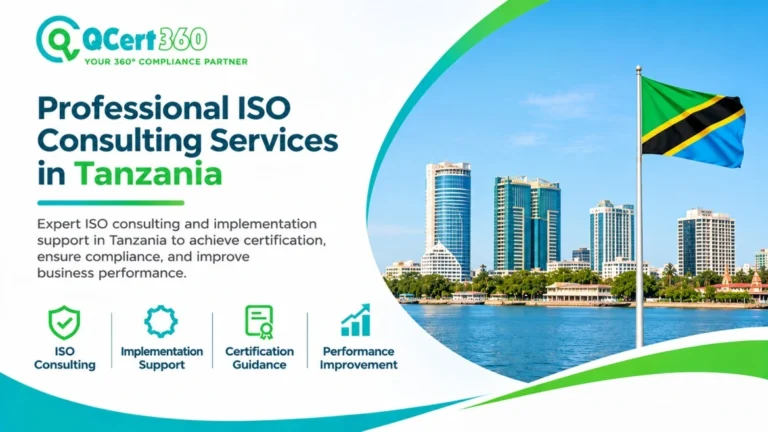
Professional ISO Consulting & Certification Support for Businesses in Tanzania
What Are Professional ISO Consulting Services in Tanzania?
Professional ISO consulting services in Tanzania help organisations select, implement and improve management systems that meet international ISO standards and support relevant Tanzanian legal and customer requirements. These services can cover quality management, environmental management, occupational health and safety, information security, food safety, business continuity and regulatory compliance.
ISO certification is generally voluntary, although customers, public tenders, export buyers and industry-specific contracts may require it. An independent certification body conducts the external audit and makes the certification decision.
QCert360 provides ISO consulting, implementation guidance, employee training, internal audit support and certification readiness services for businesses in Tanzania. QCert360 does not issue ISO certificates or guarantee certification outcomes.
Tanzanian businesses operate in sectors where customers and regulators expect evidence of effective management controls. Mining, construction, agriculture, food processing, tourism, logistics, financial services and technology companies may all need to demonstrate how they manage quality, safety, environmental impact and business risks.
Public procurement through the National e-Procurement System (NeST), personal data protection requirements administered by the Personal Data Protection Commission (PDPC), and supply-chain expectations from international buyers make documented management systems increasingly relevant.
This guide explains how ISO consulting works in Tanzania, which standards businesses should consider, how local regulatory requirements relate to ISO management systems, and how to prepare for certification in Dar es Salaam, Dodoma, Arusha, Mwanza and other business locations.
What Are Professional ISO Consulting Services in Tanzania, and How Do They Differ From ISO Certification?
Professional ISO consulting services help an organisation understand an ISO standard, assess existing processes, implement the required management system and prepare for an independent certification audit.
ISO certification is a separate process. An independent certification body evaluates the organisation’s management system and decides whether it meets the applicable standard.
ISO consulting and implementation | ISO certification |
Reviews existing processes and identifies gaps | Independently evaluates the management system |
Helps develop policies and procedures | Reviews documented information and operational evidence |
Supports risk assessment and implementation | Conducts Stage 1 and Stage 2 certification audits |
Provides employee awareness and training | Interviews employees and evaluates implementation |
Supports internal audits and corrective actions | Makes the independent certification decision |
Prepares the organisation for external assessment | Issues a certificate when certification requirements are met |
The distinction is important because certification must remain impartial. A consultant helps the organisation prepare, while the certification body independently evaluates the result.
A professional ISO consultant should help create a management system that works in everyday operations, not simply provide generic documents intended to pass an audit.
Why Do Tanzanian Businesses Consider ISO Certification?
Businesses in Tanzania may pursue ISO certification for several commercial and operational reasons:
- Public procurement: Certain tender documents may request ISO certificates or other evidence of management capability.
- Mining and energy supply chains: Contractors may need to demonstrate quality, environmental and occupational health and safety controls.
- Export markets: International customers may request documented quality, traceability and food safety systems.
- Manufacturing: ISO standards can help improve production consistency, product quality and operational control.
- Technology and financial services: Information security and business continuity requirements can influence supplier selection.
- Tourism and hospitality: Management systems can support consistent service delivery and environmental practices.
- Regulatory management: Structured processes help organisations identify obligations, assign responsibilities and retain compliance evidence.
An ISO certificate does not automatically establish compliance with every Tanzanian law. Organisations must identify and meet their legal obligations separately.
Which Tanzanian Authorities Oversee Standards, Accreditation and Business Compliance?
Several government and regional organisations have responsibilities relating to standards, accreditation, workplace safety, environmental protection, data privacy and business regulation in Tanzania.
The relevant authorities depend on the organisation’s activities, location and industry.
Authority | Main area of responsibility |
Tanzania Bureau of Standards (TBS) | National standards, product conformity services and management systems certification |
Southern African Development Community Accreditation Service (SADCAS) | Accreditation of conformity assessment bodies within its regional accreditation framework |
Personal Data Protection Commission (PDPC) | Registration and supervision under the Personal Data Protection Act |
Occupational Safety and Health Authority (OSHA) | Workplace occupational safety and health |
National Environment Management Council (NEMC) | Environmental assessment, audits and compliance functions |
Tanzania Medicines and Medical Devices Authority (TMDA) | Medicines, medical devices and related regulated products |
Public Procurement Regulatory Authority (PPRA) | Public procurement oversight and the NeST procurement system |
Tanzania Communications Regulatory Authority (TCRA) | Telecommunications and electronic communications regulation |
Bank of Tanzania (BoT) | Banking and payment systems oversight |
Capital Markets and Securities Authority (CMSA) | Capital markets and securities regulation |
Financial Intelligence Unit (FIU) | Anti-money laundering reporting and financial intelligence |
Fair Competition Commission (FCC) | Competition and consumer protection |
Tanzania Revenue Authority (TRA) | Tax and customs administration |
Business Registrations and Licensing Agency (BRELA) | Business registration and related services |
Zanzibar Bureau of Standards (ZBS) | Standards-related matters within Zanzibar |
These organisations have different responsibilities. For example, TBS is Tanzania’s national standards body and operates a management systems certification service. SADCAS is a regional accreditation body that publishes accreditation information and scopes for conformity assessment bodies.
Businesses should verify the current requirements directly with the authority responsible for their sector.
Which Tanzanian Laws and Regulations Should Businesses Consider in 2027?
Tanzanian businesses may need to comply with national legislation, subsidiary regulations, industry-specific rules and contractual requirements.
The following laws are particularly relevant when organisations assess their ISO management systems.
- Personal Data Protection Act, 2022 (Act No. 11 of 2022)
The Personal Data Protection Act, 2022 establishes Tanzania’s legal framework for collecting, processing, using, storing, disclosing and transferring personal data.
The Act came into force on 1 May 2023, and the Personal Data Protection Commission was established under the legislation. The Commission became fully operational in April 2024.
The Act and its Personal Data Collection and Processing Regulations, 2023 are relevant to organisations that process personal information.
Businesses should assess whether they need to:
- Register with the PDPC as a data controller or data processor before collecting or processing personal data.
- Identify the personal information they collect and the purposes for processing it.
- Establish appropriate processes for handling personal data.
- Review access controls and information security arrangements.
- Manage data sharing and third-party processing.
- Assess cross-border personal data transfers.
- Establish procedures for privacy complaints and personal data incidents.
- Designate the appropriate data protection officer or registration contact in line with PDPC requirements.
The PDPC’s registration instructions require an organisation to identify a person who will act as its Data Protection Officer for the registration process and provide the relevant introduction letter.
ISO/IEC 27001 and ISO/IEC 27701 can support information security and privacy management. They do not replace PDPC registration or other statutory requirements.
Official references:
- Personal Data Protection Commission
- PDPC registration requirements
- Personal Data Protection Act, 2022
- Cybercrimes Act, 2015
The Cybercrimes Act, 2015 addresses offences involving computer systems, electronic communications and digital information.
Technology providers, financial services businesses, telecommunications operators and organisations handling sensitive information should assess the legal and security requirements relevant to their activities.
ISO/IEC 27001 can support a structured information security management system through risk assessment, access management, incident response and security controls.
- Occupational Health and Safety Act, 2003
The Occupational Health and Safety Act, 2003 establishes employer responsibilities relating to workplace health and safety.
Organisations should assess relevant obligations concerning workplace hazards, employee safety, workplace registration, incident management and preventive controls.
ISO 45001 can help organisations establish systematic processes for:
- Identifying workplace hazards.
- Assessing occupational health and safety risks.
- Establishing operational safety controls.
- Providing employee training.
- Encouraging worker participation.
- Investigating incidents.
- Monitoring safety performance.
ISO 45001 supports the management of occupational health and safety but does not replace statutory obligations or OSHA requirements.
- Environmental Management Act, 2004
The Environmental Management Act, 2004 establishes Tanzania’s environmental management framework.
Manufacturers, construction companies, mining operators, energy businesses and other organisations with environmental impacts should identify the environmental requirements applicable to their activities.
ISO 14001 supports environmental management through environmental aspect assessments, operational controls, compliance evaluations and performance monitoring.
- Employment and Labour Relations Act, 2004
The Employment and Labour Relations Act, 2004 establishes core employment and labour standards.
Businesses should review the requirements relevant to employment arrangements, working conditions and employee relations.
ISO management systems can support clear responsibilities, employee awareness, documented procedures and workplace management. They do not replace employment law obligations.
- Public Procurement Act, 2023 (Act No. 10 of 2023)
The Public Procurement Act, 2023 provides the legal framework for public procurement in Tanzania.
The National e-Procurement System (NeST) supports electronic procurement activities, including supplier registration and tender submission.
Some tender documents may request ISO certificates or equivalent evidence of organisational capability. However, ISO certification is not a universal requirement for every public tender.
Businesses should read the specific tender conditions and confirm which certificates, registrations and supporting documents are required.
Official reference: Public Procurement Regulatory Authority
- Anti-Money Laundering Act, 2006
The Anti-Money Laundering Act, 2006 establishes obligations for relevant reporting persons and other entities covered by the legislation.
Organisations in regulated and higher-risk sectors should assess applicable customer due diligence, recordkeeping and reporting requirements.
ISO 37301 can support a broader compliance management system, while ISO 37001 focuses on anti-bribery management. Neither standard replaces statutory anti-money laundering duties.
- Fair Competition Act, 2003
The Fair Competition Act, 2003 addresses competition and consumer protection matters.
Businesses should ensure that their commercial practices, customer communications and market activities meet the requirements applicable to their operations.
- Standards and Product Conformity Requirements
The Standards Act and relevant TBS requirements apply to products and activities covered by national standards and technical requirements.
Manufacturers, importers and exporters should determine whether their products require testing, inspection, product certification or other conformity assessment.
TMDA requirements should also be considered by organisations involved in regulated medicines and medical devices.
- Sector-Specific Requirements
Some industries have additional licensing, technical and operational requirements.
Examples include:
- Mining and mineral processing.
- Petroleum and energy.
- Banking and financial services.
- Telecommunications.
- Tourism and hospitality.
- Pharmaceuticals and medical devices.
- Food manufacturing and distribution.
- Public infrastructure and construction.
The relevant regulatory framework depends on the activity, licence, location and business model.
Important: This section is a general compliance overview, not legal advice. Applicability depends on the organisation’s activities and legal circumstances. Confirm current requirements with the relevant Tanzanian authority or a qualified Tanzanian legal adviser.
Which ISO Standards Support Regulatory Compliance in Tanzania?
ISO standards help organisations establish repeatable management processes for quality, security, safety, environmental performance and other business risks.
No ISO standard automatically replaces a legal obligation. However, the right management system can help an organisation identify responsibilities, implement controls, retain records and improve performance.
Business requirement or risk | Relevant ISO standard | How the standard helps |
Quality management | Supports consistent processes, customer satisfaction and continual improvement | |
Environmental management | Helps manage environmental aspects, impacts and compliance obligations | |
Occupational health and safety | ISO 45001 | Supports hazard identification and workplace risk controls |
Information security | ISO/IEC 27001 | Establishes an information security management system |
Privacy management | ISO/IEC 27701 | Provides requirements for a privacy information management system |
Business continuity | Supports continuity planning and disruption recovery | |
Compliance management | ISO 37301 | Establishes a structured compliance management system |
Anti-bribery management | Supports bribery risk assessment, controls and reporting | |
Energy management | Helps monitor and improve energy performance | |
Food safety | Supports hazard control, traceability and food safety management | |
Medical device quality | Establishes quality management requirements for medical device organisations | |
Educational organisations | Supports management systems for educational organisations | |
Artificial intelligence governance | Provides a management system for responsible AI governance |
ISO 9001 Certification in Tanzania
ISO 9001 is a quality management system standard suitable for organisations across manufacturing, construction, logistics, agriculture, tourism, healthcare, technology and professional services.
It helps businesses establish consistent processes, define responsibilities, monitor performance and improve customer satisfaction.
Tanzanian businesses may consider ISO 9001 when responding to supplier qualification requirements, public tenders, export buyer assessments and internal quality improvement objectives.
ISO 14001 Certification in Tanzania
ISO 14001 provides an environmental management system framework for organisations seeking to control their environmental impacts and improve environmental performance.
It can be relevant to mining companies, manufacturers, construction contractors, agricultural processors, logistics providers and energy businesses.
The standard supports environmental aspect assessments, operational controls, compliance obligations and continual improvement.
ISO 45001 Certification in Tanzania
ISO 45001 establishes an occupational health and safety management system.
It is particularly relevant to mining, construction, manufacturing, logistics, energy and other industries where employees may face workplace hazards.
The standard supports hazard identification, risk reduction, worker participation, incident investigation and safety performance monitoring.
ISO 27001 Certification in Tanzania
ISO/IEC 27001 provides a framework for establishing, implementing, maintaining and continually improving an information security management system.
It is relevant to technology companies, financial institutions, telecommunications providers, outsourcing businesses and organisations handling sensitive customer or business information.
The standard helps organisations manage information security risks, access control, incident response, supplier security and business information protection.
ISO 22000 Certification in Tanzania
ISO 22000 supports food safety management throughout the food supply chain.
It can be relevant to food manufacturers, agricultural processors, food distributors, hospitality businesses and exporters.
The standard helps organisations manage food safety hazards, prerequisite programmes, traceability and operational controls.
ISO 13485 Certification in Tanzania
ISO 13485 establishes quality management requirements for organisations involved in medical device design, manufacturing, installation and servicing.
It can support medical device manufacturers and suppliers seeking to manage product quality, traceability and applicable regulatory requirements.
ISO 27701 Certification in Tanzania
ISO/IEC 27701:2025 is the current edition of the privacy information management system standard.
It provides requirements for establishing, implementing, maintaining and continually improving a privacy information management system.
Organisations processing personal information may consider it alongside ISO/IEC 27001 and Tanzania’s Personal Data Protection Act.
ISO 42001 Certification in Tanzania
ISO/IEC 42001 provides a management system framework for organisations that develop, provide or use artificial intelligence systems.
It supports AI governance, risk management, accountability and continual improvement.
It may be relevant to software developers, technology companies, financial services providers and organisations adopting AI in business operations.
Which ISO Standard Editions Should Tanzanian Businesses Plan For in 2027?
Organisations planning ISO certification should use the applicable current edition of each standard and understand any transition requirements affecting existing certificates.
Two important revisions in 2026 are ISO 9001:2026 and ISO 14001:2026.
ISO standard | Current edition | Important information |
Quality management | ISO 9001:2026 | Published 16 September 2026; transition ends 30 September 2029 |
Environmental management | ISO 14001:2026 | Published 15 April 2026; transition ends 30 April 2029 |
Information security | ISO/IEC 27001:2022 | Current edition |
Privacy information management | ISO/IEC 27701:2025 | Revised edition published in October 2025 |
Occupational health and safety | Current edition | |
Food safety | ISO 22000:2018 | Current edition |
Medical device quality | ISO 13485:2016 | Current edition |
Business continuity | ISO 22301:2019 | Current edition |
Educational organisations | ISO 21001:2018 | Current edition |
Energy management | ISO 50001:2018 | Current edition |
AI management systems | ISO/IEC 42001:2023 | Current edition |
Compliance management | ISO 37301:2021 | Current edition |
Anti-bribery management | ISO 37001:2025 | Revised edition published in February 2025 |
ISO 9001:2026 Transition Requirements
ISO 9001:2026 was published on 16 September 2026, replacing ISO 9001:2015 as the latest edition.
The transition period is three years, with the following important dates under the Global ACI transition requirements:
- 16 September 2026: ISO 9001:2026 published.
- 31 March 2028: New and initial accredited certifications must move to ISO 9001:2026.
- 30 September 2029: Existing ISO 9001:2015 certificate holders must complete their transition.
Organisations currently certified to ISO 9001:2015 should arrange a gap assessment, review their processes and agree a transition plan with their certification body.
ISO 14001:2026 Transition Requirements
ISO 14001:2026 was published on 15 April 2026, replacing ISO 14001:2015 as the latest edition.
The transition period ends on 30 April 2029.
Under the Global ACI transition requirements, new and initial accredited certifications must move to ISO 14001:2026 from 31 October 2027.
Existing ISO 14001:2015 certificate holders should review the revised standard and agree a transition schedule with their certification body.
What Should Businesses Do Before Starting an ISO Transition?
Organisations should:
- Obtain the applicable current edition of the standard.
- Conduct a gap assessment against the revised requirements.
- Identify processes and documents that need updating.
- Train relevant employees.
- Implement the required changes.
- Conduct internal audits.
- Review the system with management.
- Agree the transition audit arrangements with the certification body.
Transition dates and certification eligibility should be confirmed with the relevant certification body and accreditation body.
Official transition information:
- Global ACI ISO 9001:2026 transition requirements
- Global ACI ISO 14001:2026 transition requirements
How Do TBS and SADCAS Fit Into ISO Certification in Tanzania?
Tanzania has a national standards body that operates management systems certification services, alongside a regional accreditation body that assesses conformity assessment bodies.
Understanding their roles helps businesses select an appropriate certification provider.
Tanzania Bureau of Standards (TBS)
TBS is Tanzania’s national standards body. Its responsibilities include developing and publishing national standards, supporting product conformity assessment and operating management systems certification services.
TBS publicly lists certification schemes that include:
- ISO 9001:2015 Quality Management Systems.
- ISO 14001:2015 Environmental Management Systems.
- ISO 22000:2018 Food Safety Management Systems.
- ISO 45001:2018 Occupational Health and Safety Management Systems.
- ISO 21001:2018 Educational Organisations Management Systems.
- ISO 50001:2018 Energy Management Systems.
- HACCP certification.
The standards and editions listed by TBS may change. Businesses should check its current scheme information before applying.
Official reference: TBS Management Systems Certification Services
Southern African Development Community Accreditation Service (SADCAS)
SADCAS is a regional accreditation body serving conformity assessment bodies in participating economies.
It publishes accreditation information and scopes for certification bodies and other conformity assessment organisations.
Its public register lists TBS Management System Certification Services under specific accreditation entries, including:
- QMS-CERT 004.
- HACCP-CERT 003.
The exact accredited activities and standards must be confirmed against the current accreditation schedule. A certification scheme appearing on the TBS website does not automatically mean that every scheme is covered by the same SADCAS accreditation.
Official reference: SADCAS Management System Certification Bodies Register
Can Tanzanian Businesses Use International ISO Certification Bodies?
Yes. Organisations in Tanzania may consider TBS or an international certification body, depending on their requirements and the certification body’s accreditation scope.
Before choosing a provider, verify:
- The accreditation body responsible for its accreditation.
- Its current recognition status under the applicable international arrangement.
- Whether the accreditation covers the exact ISO standard.
- Whether the relevant industry sector is included.
- Whether the certificate will be accepted by your customers and tender authorities.
- Whether the certification body has appropriate arrangements for auditing your locations.
Understanding Global Accreditation Recognition in 2026
The international accreditation framework changed on 1 January 2026, when Global Accreditation Cooperation Incorporated (Global ACI) assumed the roles previously performed by the International Accreditation Forum (IAF) and the International Laboratory Accreditation Cooperation (ILAC).
Global ACI now operates the international Mutual Recognition Arrangement (MRA) framework.
During the transition, legacy IAF MLA and ILAC MRA marks may still appear on accreditation documents under approved transitional arrangements. Their appearance does not automatically mean that a certificate is outside the current recognition framework.
When checking a certification body, businesses should verify the accreditation body’s current Global ACI membership and recognised scope rather than relying only on an old logo or accreditation statement.
Official reference: Global ACI Frequently Asked Questions
TBS, SADCAS and QCert360: Understanding Their Different Roles
Organisation | Role |
TBS | Develops national standards and operates product and management systems certification services |
SADCAS | Accredits conformity assessment bodies within its approved accreditation scopes |
QCert360 | Provides ISO consulting, implementation guidance, training and audit readiness support |
QCert360 is not an accreditation body and does not issue ISO certificates. Our role is to help organisations build management systems and prepare for independent certification.
QCert360’s Professional ISO Consulting Services in Tanzania
QCert360 provides ISO consulting, auditing support, employee training and management system implementation guidance for organisations seeking to improve their processes and prepare for independent certification.
Our services focus on practical management systems that reflect the organisation’s activities, risks and business objectives.
- ISO Standard Selection and Gap Analysis
We assess your business activities, existing management controls and customer requirements to identify suitable ISO standards.
A gap analysis compares current practices with the requirements of the selected standard and identifies areas requiring improvement.
- Regulatory and Customer Compliance Mapping
We help organisations identify relevant legal, contractual and customer requirements and connect them with management system processes.
This may include developing a compliance obligations register, assigning responsibilities and identifying records that demonstrate how requirements are addressed.
Legal interpretation and confirmation of statutory duties should be obtained from the relevant Tanzanian authority or a qualified legal adviser.
- ISO Documentation and Implementation Support
We provide guidance on developing and implementing management system documentation appropriate to the organisation’s scope.
This may include:
- Management system policies.
- Procedures and work instructions.
- Risk and opportunity assessments.
- Process controls and responsibilities.
- Objectives and performance monitoring.
- Internal audit procedures.
- Corrective action records.
- Management review records.
Documentation should reflect actual business processes rather than relying on generic templates.
- Risk Assessment and Process Improvement
We help organisations identify operational, quality, environmental, occupational safety, information security and compliance risks.
The objective is to establish appropriate controls and improve the processes that affect business performance.
- ISO Training for Employees
Employees need to understand their responsibilities within the management system.
QCert360 can support ISO awareness training, standard-specific training and role-based sessions to help employees understand relevant procedures, operational controls and audit expectations.
- Internal Audit Support
We support internal audit planning, audit preparation, evidence review, findings and corrective action follow-up.
- Management Review Preparation
Management review enables leadership to assess management system performance, objectives, audit results, risks and improvement requirements.
We help organisations prepare relevant information and structure the review process.
- Corrective Action Guidance
When an audit identifies a nonconformity, the organisation should investigate the underlying cause and implement suitable corrective action.
We help businesses review findings, investigate root causes, identify corrective measures and evaluate whether actions have been effective.
- Certification Audit Readiness
Before the external certification audit, we help assess whether the management system has been implemented and whether the required records and processes are available.
The independent certification body conducts the external audit and makes the certification decision.
- Integrated Management System Consulting in Tanzania
Businesses implementing multiple ISO standards can benefit from a coordinated management system.
QCert360 can support organisations combining ISO 9001, ISO 14001, ISO 45001, ISO/IEC 27001 and other relevant standards within one implementation programme.
Our consulting services can be delivered remotely or on site, depending on project requirements and operational arrangements.
What Do ISO Consulting and Audit Services Cover in Tanzania?
ISO consulting and audit services help organisations assess whether their processes and controls meet the requirements of a selected standard.
However, not every audit leads to certification.
Audit type | Who performs it? | Main purpose |
Gap analysis | Consultant or internal team | Identifies differences between current practices and ISO requirements |
Internal audit | Organisation’s internal auditors, with support where needed | Evaluates management system implementation and effectiveness |
Readiness audit | Consultant | Reviews preparation before the certification audit |
Supplier or second-party audit | Customer or appointed representative | Checks supplier compliance with contractual requirements |
Certification audit | Independent certification body | Evaluates the management system and makes the certification decision |
QCert360 supports gap analysis, internal audit preparation and readiness activities, along with preparation for customer or supplier audits.
The certification audit must be performed by an independent certification body to maintain impartiality.
What Is the Step-by-Step Process to Get ISO Certified in Tanzania?
The ISO certification process generally follows ten stages. The amount of time and effort required depends on the selected standard, organisation size, operational complexity and existing management system.
Step 1: Identify Business and Compliance Requirements
Identify customer expectations, tender requirements, applicable laws and operational risks.
This helps establish why certification is needed and which ISO standard is appropriate.
Step 2: Select the ISO Standard and Certification Scope
Choose the standard based on your business activities, customer requirements and risk profile.
Define the activities, locations, products and services that will be covered by the management system.
Step 3: Conduct an ISO Gap Analysis in Tanzania
Compare your current processes and controls with the selected ISO standard.
Identify the gaps and prepare an implementation plan with responsibilities and target dates.
Step 4: Obtain Management Commitment
Senior management should approve the implementation approach, assign responsibilities and provide the necessary resources.
Step 5: Develop and Implement the Management System
Establish relevant policies, procedures, controls, objectives and records.
The management system should reflect the organisation’s actual operations.
Step 6: Train Employees
Provide awareness and role-specific training so employees understand the management system and their responsibilities.
Step 7: Operate the Management System
Put the processes into practice and maintain records demonstrating implementation.
The system needs sufficient operating evidence before the external certification audit.
Step 8: Conduct Internal Audits and Management Review
Evaluate whether the management system meets the applicable standard and identify nonconformities.
Management should review system performance and agree on necessary improvements.
Step 9: Select an Accredited Certification Body
Compare certification providers based on accreditation, scope, industry experience, audit arrangements and customer acceptance.
Obtain a written quotation and confirm the provider’s competence for the required standard and sector.
Step 10: Complete Stage 1 and Stage 2 Certification Audits
The certification body conducts the external audits and evaluates the available evidence.
If the certification requirements are met, it makes the certification decision. Surveillance and recertification activities follow the applicable certification cycle.
How Do You Choose an ISO Certification Body in Tanzania?
Choosing an appropriate certification body is an important part of the ISO certification process.
Businesses should evaluate the provider’s accreditation, technical scope, impartiality and acceptance by relevant customers.
Use this checklist before making a decision:
- Accreditation body: Identify the organisation that accredited the certification body and verify its current recognition status under the applicable Global ACI MRA framework.
- Accreditation scope: Confirm that the accreditation covers the exact ISO standard required.
- Industry scope: Check that the relevant technical or industry sector is included.
- TBS or international certification: Compare the available certification routes according to your requirements and buyer acceptance.
- Local requirements: Check whether any applicable Tanzanian registration or regulatory requirements apply.
- Certificate scope: Ensure the proposed scope accurately describes your products, services, sites and activities.
- Impartiality: Confirm that the certification body is independent and has not provided consultancy for the management system it audits.
- Edition readiness: Ask whether the certification body is accredited and ready to audit against ISO 9001:2026 or ISO 14001:2026, where applicable.
- Audit arrangements: Review audit duration, audit team competence and the certification process.
- Commercial terms: Request a clear breakdown of initial audit, surveillance, recertification and travel costs.
- Customer acceptance: Confirm that your customers, export buyers and tender authorities accept the proposed certification arrangement.
Do not rely solely on a certification provider’s website or accreditation logo. Verify the current accreditation status and scope through the relevant official register.
QCert360 helps organisations prepare for certification but does not endorse one certification body for every business.
How Much Does ISO Consulting and Certification Cost in Tanzania?
There is no single ISO certification price for all Tanzanian businesses. Costs depend on the organisation’s size, number of locations, selected standard, process complexity and existing management system maturity.
There are generally two separate cost categories.
- ISO Consulting and Implementation Fees in Tanzania
These are paid to the consultant for services such as:
- Gap analysis.
- Documentation guidance.
- Implementation support.
- Employee training.
- Risk assessment.
- Internal audit support.
- Corrective action guidance.
- Certification readiness.
- ISO Certification Fees
These are paid to the independent certification body for activities such as application review, Stage 1 audit, Stage 2 audit, certification decision, surveillance and recertification.
Factors That Affect ISO Certification Costs in Tanzania
Cost factor | How it affects the quotation |
Number of employees | Influences audit planning and implementation effort |
Number of locations | May increase audit and coordination requirements |
Business activities | Complex processes may require additional assessment |
Selected ISO standard | Different standards involve different implementation requirements |
Existing documentation | Established processes may reduce implementation work |
Number of standards | Integrated projects may reduce duplication but require broader planning |
Audit duration | Determined by the certification body’s applicable audit rules |
Travel and logistics | May affect the cost of audits at regional and remote locations |
Surveillance and recertification | Adds ongoing certification costs during the certification cycle |
Businesses should request separate written quotations for consulting and certification.
A quotation should clearly state the scope, services, audit arrangements, exclusions and ongoing costs.
To receive an accurate ISO consulting quotation in Tanzania, provide your industry, employee count, number of sites, selected standards and current implementation status.
How Long Does ISO Implementation Take in Tanzania?
ISO implementation time depends on the organisation’s size, complexity, existing processes and level of support required.
As a general planning estimate:
- Small organisations with established processes may prepare within a few months.
- Medium-sized businesses may require several months of implementation and operational evidence.
- Multi-site, highly regulated or multi-standard projects may take six to twelve months or longer.
These are indicative planning ranges, not guaranteed delivery times.
What Can Shorten an ISO Implementation Project in Tanzania?
- Active management involvement.
- A clearly defined certification scope.
- An assigned internal coordinator.
- Existing procedures and operational records.
- Employees who understand their responsibilities.
- Timely completion of internal audits and corrective actions.
What Can Delay ISO Implementation in Tanzania?
- Unclear responsibilities.
- Multiple sites or complex processes.
- Missing operational records.
- Limited employee availability.
- Significant gaps in existing controls.
- Implementing several standards without a coordinated plan.
The management system must be implemented and generate suitable evidence before the certification audit. Businesses should plan backwards from customer, tender or contractual deadlines.
QCert360’s ISO Consulting Support Across 10 Business Locations in Tanzania
QCert360 provides ISO consulting, implementation guidance, employee training, internal audit support and certification readiness services for organisations operating in Tanzania.
Our services are relevant to businesses in Dar es Salaam, Dodoma, Arusha, Mwanza, Mbeya, Morogoro, Tanga, Moshi, Zanzibar City and Geita.
The most appropriate standard depends on each organisation’s activities, customers, risks and business objectives.
ISO Consulting in Dar es Salaam
Dar es Salaam has businesses across logistics, port operations, manufacturing, financial services and technology.
Organisations in these sectors may consider ISO 9001, ISO/IEC 27001, ISO 22301 and ISO 45001.
ISO Consulting in Dodoma
Government suppliers, contractors and professional services firms may consider ISO 9001, ISO/IEC 27001 and ISO 37001, depending on their tender and operational requirements.
ISO Consulting in Arusha
Tourism, hospitality and agribusiness operators may consider ISO 9001, ISO 14001 and ISO 22000 to support service quality, environmental management and food safety.
ISO Consulting in Mwanza
Fish processors, manufacturers and logistics companies around Lake Victoria may consider ISO 22000, ISO 9001 and ISO 45001.
ISO Consulting in Mbeya
Agribusiness, trading and transport businesses may consider ISO 9001, ISO 22000 and ISO 45001 according to their activities.
ISO Consulting in Morogoro
Agro-processors and manufacturers may consider ISO 22000, ISO 9001 and ISO 14001.
ISO Consulting in Tanga
Port-related businesses, cement producers and agro-processing companies may consider ISO 14001, ISO 45001 and ISO 9001.
ISO Consulting in Moshi
Coffee businesses, agribusiness operators and tourism providers may consider ISO 22000, ISO 9001 and ISO 14001.
ISO Consulting in Zanzibar City
Hotels, tour operators and marine-service businesses may consider ISO 9001, ISO 14001 and ISO 22000.
ISO Consulting in Geita
Mining operators and suppliers may consider ISO 45001, ISO 14001 and ISO 9001 to support occupational safety, environmental management and contractor prequalification.
These examples illustrate potential applications of ISO standards. They do not represent confirmed QCert360 client projects or physical offices in each location.
Important: Mainland Tanzania and Zanzibar
Businesses operating in Zanzibar should check whether the relevant regulatory and standards requirements differ from those applicable in Mainland Tanzania.
Some laws and regulations apply across both parts of the United Republic, while non-Union matters may be governed separately. For example, the Personal Data Protection Collection and Processing Regulations, 2023 state that they apply to Mainland Tanzania and Zanzibar, subject to the stated exception for non-Union matters in Zanzibar.
Businesses should therefore confirm the applicable requirements with the relevant mainland or Zanzibar authority, including TBS or ZBS where relevant.
Which Industries in Tanzania Benefit Most From ISO Consulting?
Industries with demanding customers, significant operational risks or sector-specific regulatory requirements can benefit from structured ISO management systems.
The following examples show how different industries may use ISO standards.
Industry | Relevant ISO standards | Potential business benefits |
ISO 45001, ISO 14001, ISO 9001 | Workplace safety, environmental controls and quality management | |
ISO 22000, ISO 9001, ISO 14001 | Food safety, traceability and process consistency | |
ISO 22000, ISO 9001 | Food safety controls and product quality | |
ISO 9001, ISO 14001, ISO 45001 | Guest service consistency, environmental practices and workplace safety | |
ISO 45001, ISO 9001, ISO 14001 | Site safety, project quality and environmental management | |
ISO/IEC 27001, ISO 22301, ISO 37301 | Information security, continuity and compliance management | |
ISO 45001, ISO 14001, ISO 50001 | Occupational safety, environmental controls and energy performance | |
ISO 13485, ISO 9001, ISO 15189 where applicable | Quality management and technical competence | |
ISO 21001, ISO 9001 | Learner-focused processes and service consistency | |
ISO 9001, ISO 45001, ISO 14001 | Service reliability, operational safety and environmental controls |
ISO Certification for Mining Companies in Tanzania
Mining operators and their suppliers may need to demonstrate that they manage workplace hazards, environmental impacts and operational quality.
ISO 45001 can support occupational health and safety management, ISO 14001 can support environmental controls, and ISO 9001 can help strengthen operational processes.
The appropriate certification scope depends on the company’s activities, sites, customer requirements and applicable mining regulations.
ISO Certification for Agriculture and Food Businesses in Tanzania
Agricultural processors, food manufacturers and exporters may need to demonstrate food safety, traceability and consistent production controls.
ISO 22000 can support food safety management, while ISO 9001 can help improve process consistency and customer satisfaction.
Businesses should also review the relevant TBS, food safety and export-market requirements.
ISO Certification for Tourism and Hospitality Businesses in Tanzania
Hotels, lodges, tour operators and hospitality providers may consider ISO 9001 to improve service consistency and ISO 14001 to manage environmental aspects such as water, energy and waste.
ISO 45001 may also be relevant where workplace health and safety risks need a structured management approach.
ISO Certification for Technology and Financial Services in Tanzania
Technology companies, fintech providers and organisations handling customer information may consider ISO/IEC 27001 for information security, ISO/IEC 27701 for privacy management and ISO 22301 for business continuity.
These standards can support supplier assessments and customer assurance requirements, while applicable Tanzanian legal obligations must be assessed separately.
Why Combine Multiple ISO Standards Into an Integrated Management System?
An integrated management system (IMS) combines the requirements of multiple management system standards within one coordinated framework.
For example, a business may integrate:
- ISO 9001 for quality management.
- ISO 14001 for environmental management.
- ISO 45001 for occupational health and safety.
- ISO/IEC 27001 for information security.
- ISO 37301 for compliance management.
Many ISO management system standards share a common structure. This makes it possible to coordinate shared processes such as document control, risk assessment, internal audits, corrective action and management review.
Benefits of an Integrated Management System in Tanzania
- Reduced duplication: Shared processes can reduce repeated documentation and separate management activities.
- Better risk visibility: Leadership can review quality, environmental, safety, security and compliance risks within one coordinated framework.
- More consistent internal audits: A combined audit programme can assess shared processes and standard-specific requirements.
- Clearer responsibilities: Employees can work with connected procedures and responsibilities rather than disconnected systems.
- More efficient management reviews: Leadership can assess performance, objectives and improvement actions together.
Integration works best when the organisation understands the requirements of each standard and ensures that all standard-specific controls are addressed.
Which ISO and Compliance Trends Should Tanzanian Businesses Watch in 2027 and 2028?
Several developments are influencing how Tanzanian businesses approach compliance and ISO management systems.
- Personal Data Protection Registration
The PDPC is operational and provides an online registration process for data controllers and data processors.
Organisations handling personal data should review their registration status, processing activities, data protection responsibilities and relevant procedures.
ISO/IEC 27001 and ISO/IEC 27701 can help structure information security and privacy management, but they do not replace PDPC registration or other statutory requirements.
- E-Procurement and Tender Readiness
Public procurement through NeST means suppliers need to maintain relevant registration details, tender documents and supporting evidence.
Some tender documents may request ISO certificates, but the requirements vary. Businesses should check each tender rather than assuming certification is mandatory for every public procurement opportunity.
- Mining, Energy and Infrastructure Supply Chains
Mining, energy and infrastructure projects can involve significant occupational safety, environmental and quality risks.
Contractors may be asked to demonstrate management controls as part of prequalification and supplier assessment.
ISO 45001, ISO 14001 and ISO 9001 can support these requirements where relevant.
- Export and Regional Trade Requirements
Exporters may need to demonstrate consistent product quality, traceability and food safety controls.
ISO 9001 and ISO 22000 can support management system requirements, while product-specific standards and destination-market regulations must be considered separately.
- Digital Finance and Information Security
Technology providers, payment services and financial organisations handle information and systems that require appropriate security and continuity controls.
ISO/IEC 27001 and ISO 22301 can support information security risk management and business continuity planning.
- Artificial Intelligence Governance
Businesses developing or using AI systems may need to establish responsibilities, risk controls and oversight arrangements.
ISO/IEC 42001 provides a management system framework for AI governance.
- Updated ISO 9001 and ISO 14001 Editions
The publication of ISO 9001:2026 and ISO 14001:2026 means organisations certified to previous editions should plan their transitions.
A gap assessment can identify the processes, controls and documented information that may need to be updated.
These developments reinforce the importance of keeping management systems current. Businesses should monitor official regulatory updates and review their controls when requirements change.
What Are the Most Common ISO Consulting Challenges in Tanzania?
Businesses may understand the value of ISO certification but still face difficulties during implementation.
Common challenge | Recommended approach |
Uncertainty about applicable laws and standards | Prepare a legal and customer requirements register |
Multiple regulators and overlapping expectations | Map each regulator to relevant processes and records |
Limited management involvement | Appoint a management sponsor and agree measurable objectives |
Excessive or unsuitable documentation | Develop procedures that reflect actual business processes |
Employees lack awareness | Provide role-specific ISO training |
Incomplete operational records | Establish recordkeeping responsibilities early |
Weak internal audits | Train internal auditors and use a risk-based audit programme |
Remote sites are difficult to coordinate | Plan site visits, local responsibilities and evidence collection |
Several standards are managed separately | Consider an integrated management system |
Corrective actions do not address root causes | Investigate causes and verify corrective action effectiveness |
The goal should not be to create the largest possible documentation system. It should be to establish a management system that is practical, proportionate and effective.
Frequently Asked Questions About ISO Consulting and ISO Certification in Tanzania
- Is ISO certification mandatory in Tanzania?
ISO certification is generally voluntary in Tanzania. However, customers, public tenders, supply-chain agreements and sector-specific requirements may request particular ISO certificates. Organisations must also meet applicable legal requirements separately. An ISO certificate does not automatically establish compliance with every Tanzanian law.
- Who accredits ISO certification bodies in Tanzania?
SADCAS is a regional accreditation body that accredits conformity assessment bodies within its approved scope. TBS operates its own management systems certification service, and its public accreditation entries should be checked against the current SADCAS register and schedules. International certification bodies may also hold accreditation from other recognised accreditation bodies.
- Does TBS provide ISO certification?
Yes. TBS operates a management systems certification service and publicly lists schemes including ISO 9001, ISO 14001, ISO 45001, ISO 22000, ISO 21001, ISO 50001 and HACCP. The current scheme and accredited scope should be verified directly with TBS and the relevant accreditation register before applying.
- What is the difference between TBS certification and internationally accredited ISO certification? TBS is Tanzania’s national standards body and operates management systems certification services. International certification bodies may operate under accreditation from other accreditation bodies. The important consideration is the actual accreditation status, standard, industry scope and acceptance by the organisation’s customers or tender authority. Businesses should compare these details rather than assuming that one certification route is suitable for every purpose.
- Does ISO/IEC 27001 satisfy Tanzania’s Personal Data Protection Act?
No. ISO/IEC 27001 supports information security management, while ISO/IEC 27701 supports privacy management. Neither standard replaces the Personal Data Protection Act, PDPC registration or other statutory requirements. Organisations should separately assess their obligations as data controllers or processors.
- Do businesses need to register with the PDPC in Tanzania?
The PDPC states that a person must not collect or process personal data without being registered with the Commission as a data controller or data processor. Businesses should review the Commission’s registration requirements and determine the obligations applicable to their activities.
- What documents are needed for PDPC registration?
The PDPC lists different supporting documents depending on the organisation type. Its current registration guidance identifies documents such as a BRELA certificate, Tax Identification Number certificate and financial-year audited report for private organisations. It also requires the organisation to identify a Data Protection Officer for the registration process. Check the Commission’s current instructions before applying.
- Can a foreign ISO certification body certify a Tanzanian company?
A Tanzanian organisation may use an international certification body if the provider is competent and appropriately accredited for the required standard and scope. The business should verify the accreditation body’s current recognition status, the certification body’s scope and acceptance by its customers or tender authority.
- Which ISO standard should a Tanzanian business implement first?
Start with the standard required by your key customers, tender documents or industry requirements. ISO 9001 is a common foundation for quality management. Mining and construction suppliers may consider ISO 45001 and ISO 14001, while food businesses may prioritise ISO 22000. Technology and data-driven organisations may consider ISO/IEC 27001.
- Can an ISO consultant guarantee certification?
No. A consultant can help an organisation implement its management system, train employees and prepare for audits, but the independent certification body makes the certification decision. Be cautious of any provider promising guaranteed certification.
- How much does ISO consulting cost in Tanzania?
The cost depends on employee numbers, locations, selected standards, business complexity, existing management system maturity and the level of consulting support required. Consulting fees and certification body fees are separate. Request written quotations based on your actual scope.
- How long does ISO implementation take in Tanzania?
Small organisations with established processes may prepare within a few months. Multi-site, complex or multi-standard projects may take six to twelve months or longer. The management system must operate long enough to generate suitable evidence before the certification audit.
- Do public tenders in Tanzania require ISO certificates?
Some public tenders request ISO certificates or similar evidence of management capability, but requirements vary by tender. Public procurement uses the NeST system, so businesses should review each tender document carefully and confirm the required certificates and supporting documents.
- What should existing ISO 9001:2015 holders do about ISO 9001:2026?
Existing certificate holders should conduct a gap assessment against ISO 9001:2026, identify necessary changes and agree a transition plan with their certification body. The transition must be completed by 30 September 2029 under the Global ACI transition requirements.
- What should existing ISO 14001:2015 holders do about ISO 14001:2026?
Organisations certified to ISO 14001:2015 should review the revised standard, assess their environmental management system and plan the transition with their certification body. The transition must be completed by 30 April 2029 under the Global ACI transition requirements.
- Can a small business in Tanzania get ISO certified?
Yes. Small businesses can implement ISO management systems when requirements are applied proportionately to their activities, risks and size. Documentation and implementation should reflect the organisation’s actual operations.
- Can a company implement more than one ISO standard together?
Yes. Many management system standards share a common structure, allowing organisations to integrate risk assessment, document control, internal audits and management review. Each standard’s specific requirements must still be addressed.
- Can QCert360 provide ISO consulting services remotely in Tanzania?
Yes. QCert360 offers remote consulting support, including gap analysis, documentation guidance, employee training, internal audit support and certification audit preparation. On-site support may also be considered depending on the project scope and operational requirements.
- Does QCert360 issue ISO certificates in Tanzania?
No. QCert360 provides ISO consulting, implementation guidance, training, internal audit support and certification preparation. Independent certification bodies conduct external certification audits and make certification decisions.
- How can I get an ISO consulting quotation in Tanzania?
Share your industry, number of employees, operating locations, selected ISO standards and current implementation status with QCert360. This information helps establish the required consulting scope and prepare a suitable written quotation.
Request Professional ISO Consulting Services in Tanzania
Are you planning to obtain ISO certification in Tanzania, improve your management system or prepare for a customer or certification audit?
QCert360 helps businesses identify suitable ISO standards, assess existing processes, implement practical management systems and prepare for independent certification audits.
Our professional ISO consulting services in Tanzania can include:
- ISO standard selection and gap analysis.
- ISO implementation and documentation guidance.
- Regulatory and customer compliance mapping.
- Employee awareness and standard-specific training.
- Internal audit support.
- Management review preparation.
- Corrective action guidance.
- Certification audit readiness.
- Integrated management system implementation support.
Request an ISO consulting quotation for your business in Tanzania.
Share your industry, employee count, number of operating locations and the ISO standards you are considering. Our team can review your requirements and provide a proposed consulting scope and written quotation.
Visit QCert360 to learn more about our ISO consulting, auditing, training and management system support services.
Service clarification: QCert360 provides consulting, implementation guidance, internal audit support and certification preparation. ISO certificates are issued by independent certification bodies following their own audit and certification decision process. QCert360 does not guarantee certification outcomes.
This article provides general information about ISO management systems and Tanzanian compliance topics. It is not legal advice. Verify current regulatory requirements with the relevant authority or a qualified Tanzanian legal adviser before making compliance decisions.
Our Services
ISO Standards
- ISO 9001 Certification
- ISO 14001 Certification
- ISO 45001 Certification
- ISO 22000 Certification
- ISO 17025 Certification
- ISO 27001 Certification
- ISO 13485 Certification
- ISO 20000-1 Certification
- ISO 41001 Certification
- ISO 22716 Certification
- ISO 50001 Certification
- ISO 22301 Certification
- ISO 29993 Certification
Product Certifications
Other international standards
- FSSC 22000 Certification
- HIPAA
- HACCP Certification
- SA 8000 Certification
- GMP Certification
- GDPR
- GDP Certification
- GLP Certification
- Certificate of Conformity
QCert360 provides a wide range of services including ISO certification, audit support, compliance consulting, and training. They specialize in helping businesses achieve global standards and certifications like ISO 9001, ISO 27001, ISO 14001, and many others. Their team ensures a seamless experience from consultation to certification, supporting clients at every stage.
The time it takes to achieve certification can vary depending on the complexity of the standard and the readiness of your organization. On average, it takes about 3 to 6 months. QCert360 works closely with clients to streamline the process, ensuring that all requirements are met efficiently and within a reasonable timeline.
QCert360 is a trusted partner with years of experience in helping businesses obtain international certifications. Their expert consultants provide tailored solutions, ensuring your organization not only meets but exceeds industry standards. With a customer-centric approach, they focus on offering end-to-end support to simplify the certification journey.
QCert360 serves a wide range of industries including manufacturing, healthcare, information technology, education, and services, among others. They customize their certification solutions to meet the unique requirements of each industry, ensuring relevance and compliance with global standards.
Yes, QCert360 provides ongoing support even after certification. They offer services like surveillance audits, recertification guidance, and consultancy to help maintain and improve your certification status. Their team ensures that your organization stays compliant and up-to-date with any changes in certification standards.
Getting started with QCert360 is simple. You can contact them via their website to request a consultation. Their team will assess your needs, discuss the best certification options for your business, and outline the steps involved. From there, they’ll guide you through the entire process, ensuring you’re prepared for certification.
QCert360 stands out due to its customer-focused approach, industry expertise, and comprehensive service offerings. Their team doesn’t just help you obtain certification but works to ensure your organization thrives in compliance with international standards. They also offer personalized consultation, making the process smoother and more efficient, ensuring long-term success for your business.
The cost of certification varies depending on factors such as the type of certification, the size and complexity of your organization, and the specific industry requirements. QCert360 offers competitive pricing and provides tailored quotes based on your unique needs. They ensure transparency and work with you to find the most cost-effective solution for your certification goals.
Yes, QCert360 offers internal audit services to help assess and improve your organization’s processes. Their expert auditors conduct thorough reviews of your systems and operations to ensure they meet required standards. They also provide actionable recommendations to help enhance efficiency and compliance, making sure you’re fully prepared for external audits.
If your organization doesn’t pass an audit or certification assessment, QCert360 works with you to understand the reasons for non-compliance and provides support to rectify the issues. They offer guidance on corrective actions and help you prepare for a re-assessment. Their goal is to ensure your organization meets the necessary standards for certification, and they will be by your side to make the process as smooth as possible.